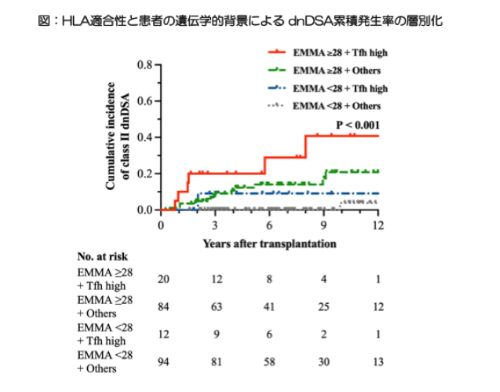
A research group led by Professor Hideki Ohdan of the Department of Gastrointestinal and Transplant Surgery at Hiroshima University Graduate School of Medical Sciences, Dr. Yukitoshi Shidawara, and Dr. Kentaro Ide of Hiroshima Prefectural Hospital investigated the risk of production of de novo donor-specific antibodies (dnDSA), which newly appear after kidney transplantation, in 210 patients who underwent kidney transplantation at Hiroshima University Hospital. dnDSA causes antibody-related rejection and affects long-term survival of transplanted kidneys. In addition to HLA molecular mismatch analysis, which is widely used worldwide, the research group focused on patient genetic variations (single nucleotide polymorphisms (SNPs), which are widely present in the general population), and analyzed genes related to follicular helper T cells (Tfh cells), which assist in antibody production. As a result, we found that not only the HLA compatibility between donor and patient, but also the genetic background related to Tfh cells of the patient caused dnDSA production.
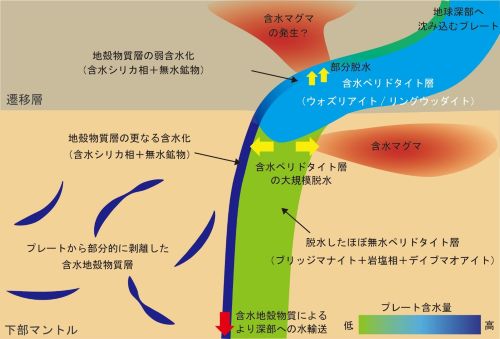
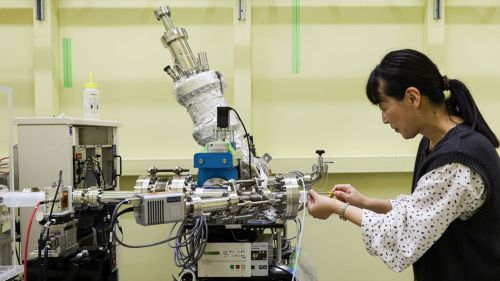
An international joint research group consisting of Associate Professor Takayuki Ishii of the Okayama University Graduate School of Advanced Research (Planetary Materials Research Institute), Specially Appointed Assistant Professor Jun Takaichi of Hiroshima University, Ehime University, Teikyo University of Science, Kyoto University, High Brightness Photon Science Research Center, and the Beijing High Pressure Research Center in China is working on a Kawai-type multi-anvil high-pressure generator 2) at the large synchrotron radiation facility SPring-8 1). Using a combination of synchrotron radiation and X-rays, we precisely measured the water-containing volume of Dave Maoite, a major mineral in the Earth's lower mantle, at high temperatures and pressures up to the conditions at the top of the lower mantle. This result was published in the British geoscience journal Communications Earth & Environment on July 24th. The water content of Dave Maoite is difficult to determine experimentally, which has been a major barrier to building deep Earth water cycle models. From the results of this experiment, the volumes of Dave Maoite synthesized under dry and hydrated conditions are almost the same, and the water solubility is lower than the conventional estimate.
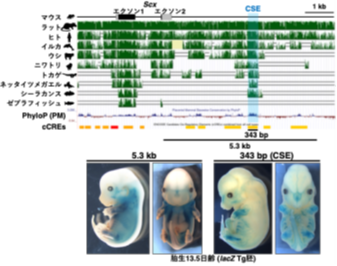
In collaboration with Professor Shinse Yamaga and Professor Chisa Shukuminami of the Department of Biomolecular Functions, Graduate School of Medical Sciences, Hiroshima University, and Professor Kenta Sumiyama of the Graduate School of Bioagricultural Sciences, Nagoya University, Assistant Professor Hitomi Watanabe, Professor Gen Kondo of the Institute of Medical Biology, Kyoto University, and others, they identified an enhancer (*2) that controls the expression of the transcription factor Scx (*1), which is essential for the maturation of tendons and ligaments, and clarified its role. Our research group first analyzed the activity of candidate genomic regions using lacZ Tg mouse (*3) embryos and revealed that a 5.3kb genomic region that includes part of the mouse Scx gene and its downstream region has enhancer activity. Furthermore, we found that the evolutionarily highly conserved region (CSE) contained in this 5.3kb region also has enhancer activity. Next, when we created and analyzed mice lacking CSE using genome editing technology, we found that Scx expression was significantly reduced during the limb formation process. Also, usually
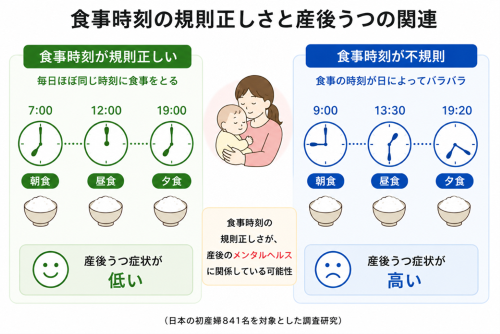
Hiroshima University Graduate School of Medical Sciences, Department of Public Health (Associate Professor Masaru Tahara), in collaboration with Waseda University (Professor Emeritus Shigenobu Shibata) and Combi Co., Ltd. Life Science Division (Headquarters: Taito-ku, Tokyo; President and CEO: Yasuji Matsuura), conducted a study aimed at clarifying the relationship between postpartum mental health and regularity of mealtimes among women in Japan who have their first child between 0 and 12 months old. The results of this study revealed that people with regular mealtimes had significantly lower scores on the Edinburgh Postnatal Depression Questionnaire (EPDS) (*1), an indicator of postnatal depression symptoms, than those with irregular meal times. On the other hand, no significant relationship was found between breakfast intake frequency and EPDS score. This study shows that not only the content of meals, but also the perspective of ``when to eat'' may be important when considering postpartum mental health. (*1) EPDS: The higher the score, the stronger the depressive symptoms.
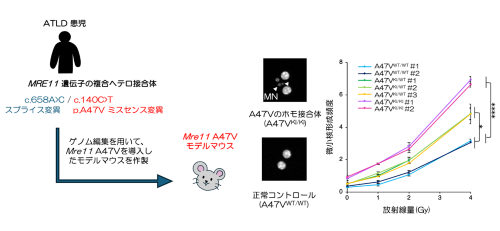
A research group including Assistant Professor Sylvia Natsuko Akutsu, Graduate Student Risa Matsumura, Associate Professor Takamoto Asano, Emeritus Professor Shinya Matsuura, Professor Megumi Sasaya, Professor Shinji Yoshinaga of the Atomic Bomb Radiological Research Institute of Hiroshima University, and Professor Tatsuo Miyamoto of the Yamaguchi University Graduate School of Medicine is using genome editing (*2) to develop ataxia-telangiectasia-like disorder (AT-like disorder). We created a model mouse with a mutation in the MRE11 gene found in patients with ATLD (*3). When we examined this mouse model, we found that when it was exposed to radiation under certain genetic conditions, the number of tumors that formed in the small intestine increased significantly. The results of this research were published in the online version of the British scientific journal Scientific Reports on August 14, 2026.
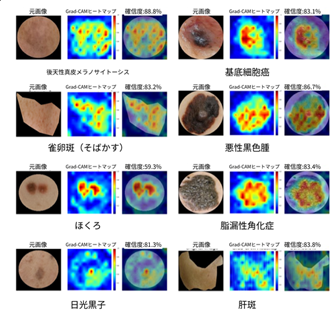
Atsushi Otsuka, Chief Professor, Department of Dermatology, Kindai University School of Medicine (Sakai City, Osaka Prefecture), Doctor of Dermatology, Kindai University Hospital (Sakai City, Osaka Prefecture), Doctoral Student, Department of Medicine, Kindai University Graduate School of Medicine A research group led by Norimi Iinuma, in collaboration with Kyoto University (Kyoto City, Kyoto Prefecture), Sapporo Medical University (Sapporo City, Hokkaido), and Hiroshima University (Higashihiroshima City, Hiroshima Prefecture), has developed artificial intelligence (AI) that can automatically distinguish eight types of pigmented skin lesions (spots, moles, skin cancer, etc.) from ordinary skin images taken with a regular camera. Until now, image diagnosis using AI has been highly accurate, but the reason for its judgment has been a black box, which has been a barrier to its use in medical settings. The newly developed AI creates a heat map *2 that shows where in the skin photo the AI was focused on when making a diagnosis, using color shading, and allows a person to visually confirm the ``reason'' for the diagnosis. The significance of this research is that it not only achieved high diagnostic accuracy but also the ability to explain the basis for judgment.
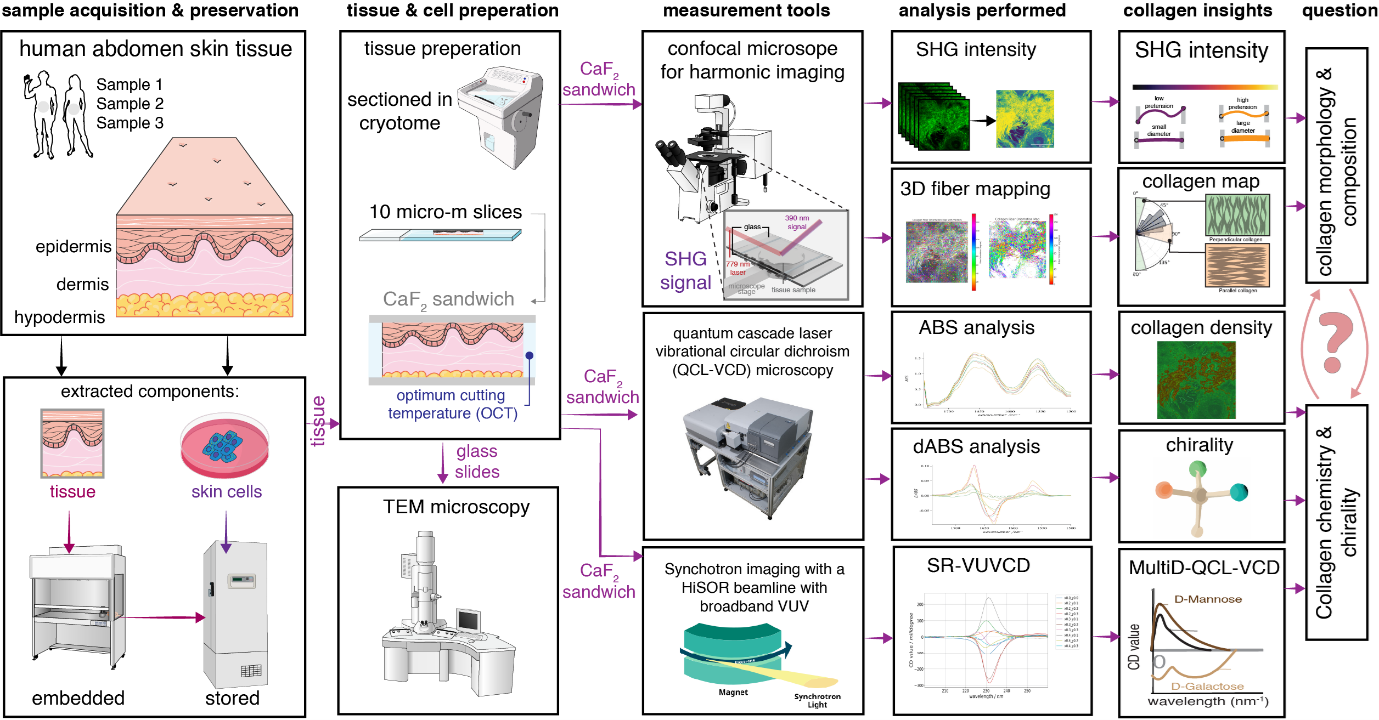
A research group led by Professor Katsuya Inoue of WPI-SKCM² (*2), Graduate School of Advanced Science and Engineering, Hiroshima University, has investigated the collagen contained in human skin in detail using a variety of analytical methods and discovered that even at a stage where there is almost no change in appearance, tiny structural changes have begun within the collagen. In this study, we combined multiple analytical techniques to examine in detail the amount of collagen contained in human skin, the arrangement of fibers, and its internal structure using the same sample. The results revealed that even before visible changes such as a decrease in the amount of collagen or breakage of fibers appear, very small structural changes begin within the collagen. This result demonstrated a new analysis method that allows for detailed evaluation of skin conditions, including changes in internal structure, which had previously been evaluated mainly based on changes in the amount of collagen and fiber shape. In the future, in addition to elucidating the mechanisms of skin aging and diseases, we will continue to study wound healing, scar formation, and fibrotic