発表のポイント
- 地球深部の主要鉱物の一つデイブマオアイトが、従来想定よりはるかに少量しか水を取り込まないことを、超高精度高温高圧実験により明らかにしました。
- これまで「下部マントルの水を担う可能性がある」と考えられてきたデイブマオアイトは、実際にはほぼ乾いた状態で存在することが判明しました。
- この発見は、深部水が主に沈み込んだ地殻物質に集中するという新しい描像を提示しました。
岡山大学学術研究院先鋭研究領域(惑星物質研究所)の石井貴之准教授、広島大学の高市合流特任助教、愛媛大学、帝京科学大学、京都大学、高輝度光科学研究センター、中国北京高圧研究センターの国際共同研究グループは、大型放射光施設SPring-81)In, Kawai type multi-anvil high pressure generator2)と放射光X線を組み合わせ、地球下部マントルの主要鉱物であるデイブマオアイトの含水下の体積を、下部マントル最上部条件までの高温高圧下で精密測定しました。この成果は7月24日、英国の地球科学誌「Communications Earth & Environment” was published. The water content of Dave Maoite is difficult to determine experimentally, which has been a major barrier to building deep Earth water cycle models. The results of this experiment revealed that the volumes of Dave Maoite synthesized under dry and hydrated conditions are almost the same, and the water solubility is less than 1/10 of the conventional estimate (0.08 wt% or less). Since major lower mantle minerals do not retain water, we proposed a new water cycle model in which deep water is concentrated in subducting crustal materials. This result will greatly advance our understanding of the material circulation and evolution within the Earth.
研究者からのひとこと
This result was achieved by a domestic research group maximizing the integration of synchrotron radiation and multi-anvil press technologies, which Japan has led the world in. Multi-anvil experiments continue to evolve as a powerful method that allows us to recreate the deep parts of the Earth in the laboratory. We would like to pass on this knowledge and skills to the next generation, and create an environment where students and young researchers can truly feel like ``I, too, want to tackle the mysteries of the earth with a multi-anvil.'' If you are interested, please let's research together!
発表内容
current situation
地球内部の水は、岩石の融解、電気伝導度、レオロジー(変形しやすさ)など多くの物性を左右し、地球内部構造の理解や地球がどのように進化してきたかを解明するうえで欠かせない要素です。そのため、「どの鉱物がどれだけ水を保持できるのか」は地球科学の根幹をなす重要課題となっています。深さ410〜660kmのマントル遷移層では、上部マントルの主要鉱物オリビンの高圧相であるウォズレアイトやリングウッダイトが2-3wt%の水を保持できることが知られており、この領域における水貯蔵量は、海洋の数倍に達する可能性すら指摘されています。一方、深さ660km以深の下部マントルでは、主要鉱物であるブリッジマナイトとフェロペリクレースはほとんど水を含まないことが分かっています。しかし、もう一つの主要鉱物であるデイブマオアイト(CaSiO₃ペロブスカイト)の水含有量は長年不明で、「1wt%以上の水を含む可能性がある」とする研究もありました。この不確定性は、地球深部の水循環モデルを構築するうえで大きな障壁となっていました。
Contents of research results
岡山大学惑星物質研究所・愛媛大学・広島大学・帝京科学大学・京都大学・高輝度光科学研究センター・中国北京高圧研究センターの国際共同研究グループは、大型放射光施設SPring-81)のBL04B1にて、川井型マルチアンビル高圧発生装置2)と放射光X線を組み合わせ、人工的に合成したデイブマオアイトの含水下の体積を下部マントル条件までの高温高圧下で精密に測定しました。
その結果、乾燥条件と含水条件で合成したデイブマオアイトの体積は誤差範囲内で一致し、含水化による体積変化はほとんど認められませんでした。観測された体積差はわずか–0.02%で、1wt%の水を含む場合に予測される–0.2〜–0.5%の減少よりはるかに小さい値です。さらに、回収試料の二次イオン質量分析法でも水はほとんど検出されず、デイブマオアイトが下部マントル条件下で実質的に“ほぼ乾燥した状態”で存在することが裏付けられました。第一原理計算3)の結果と合わせると、水溶解度は0.08wt%以下であり、従来想定の1/10以下であることが明らかになりました。
This result showed that the major lower mantle minerals (bridgmanite, ferropericlase, and dave maoite) in the mantle rock peridotite can hardly hold water. On the other hand, the main mineral silica in the earth's crust undergoes a phase transition into a high-pressure mineral that can hold large amounts of water under lower mantle conditions, led by members of this research.4)することを近年明らかにしました。つまり、下部マントルの水循環を支配しているのは主要マントル岩石ではなく、シリカ高圧鉱物を含む沈み込む地殻物質であるという新しい水循環モデルが浮かび上がります。
社会的な意義
Water is an important substance that influences not only the origin and survival of life, but also earth phenomena such as earthquakes and volcanic activity that are directly connected to our lives. This research experimentally clarified how water is distributed and moves inside the planet Earth. The clarification of the deep water cycle will greatly advance the knowledge that forms the basis of earth science, including understanding the Earth's internal material cycles and the evolution process of the mantle.
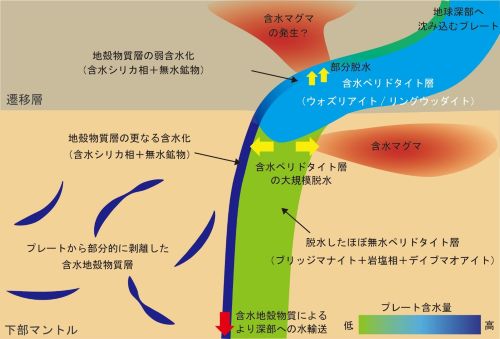
図1.沈み込むプレート内の水の分布。沈み込むプレート内部では、深さによって水の保持能力が大きく変化します。マントル遷移層までの深さでは、ウォズレアイトやリングウッダイトが数wt%の水を保持できるため、プレート内部の水は主にこれらの鉱物を含む領域に蓄えられます。一方、プレート表層の地殻物質層では、シリカ鉱物が一部の水を取り込むことが知られています。下部マントルに入ると、ブリッジマナイト、フェロペリクレース、デイブマオアイトなどの主要下部マントル鉱物は水をほとんど保持できません。そのため、プレート内部の水はペリドタイト中にはとどまらず、より水を保持できるシリカ鉱物を含む地殻物質層へ再分配されます。シリカ鉱物は下部マントル条件で高圧相へと相転移4)As we go deeper, water becomes concentrated in layers of crustal material, which can hold more water. Thus, water transport and retention in the lower mantle is likely controlled by near-material layers, with deep water being stored in subducting crustal material containing primarily silica high-pressure minerals.
Paper information
Paper title: Limited water incorporation in davemaoite under lower-mantle conditions
Magazine published:Communications Earth & Environment
Author: Takayuki Ishii, Goru Takaichi, Yu Nishihara, Kyoko N. Matsukage, Shoichi Itoh, Yanhao Lin, Tetsuo Irifune, Daijo Ikuta, Bin Zhao, Dilan H. F. Diyalanthonige, Noriyoshi Tsujino, Sho Kakizawa, Yuji Higo
DOI: 10.1038/s43247-026-03856-7
URL:https://www.nature.com/articles/s43247-026-03856-7
補足・用語説明
1) Large synchrotron radiation facility SPring-8
Located in Harima Science Park City in Hyogo Prefecture, it is a RIKEN facility that produces the world's highest performance synchrotron radiation, and user support is provided by the High Brightness Photon Science Research Center (JASRI). The name of SPring-8 isSupperPhotonring-8GeV(ギガ電子ボルト)に由来します。放射光とは、電子を光とほぼ等しい速度まで加速し、磁場によって進行方向を曲げた時に発生する、指向性が高く強力な電磁波のことを言います。SPring-8では、この放射光を用いて、ナノテクノロジーやバイオテクノロジー、産業利用まで幅広い研究が行われています。
2) Kawai type multi-anvil high pressure generator
川井型マルチアンビル高圧発生装置は、地球深部と同じような「超高圧・高温」の環境を実験室で再現するための装置です。外側に配置された複数の硬いアンビル(押し金具)が、中心に置かれた試料を三次元的に均等に押し込むことで、地球内部の数万~数十万気圧に相当する超圧力環境をつくり出します。さらに高圧力セル内部に設置している電気炉によって加熱することで、例えば660km不連続面周辺の温度である1600℃を超える高温条件も同時に実現できます。大型放射光施設SPring-8のBL04B1では、特にこの装置を用いた研究を推進しており、世界でも屈指の技術力と研究実績を有しています。
By combining this device with synchrotron radiation, we can artificially recreate an extreme environment equivalent to hundreds to thousands of kilometers deep inside the Earth, and directly examine how minerals change under that environment. The volume change of Dave Maoite under hydrous conditions, which was revealed in this research, was also demonstrated using the synchrotron radiation and Kawai-type multi-anvil high-pressure generator at SPring-8.
3) First principles calculation
原子の動きや結晶構造を物理法則に基づいてコンピューター上で再現する“原子レベルのシミュレーション”であり、実験では直接観察できない水の入り方や構造のゆがみを理論的に評価するために用いられます。先行研究では、デイブマオアイトに水が入った際の構造の変化をシミュレーションするために使用しました。
4)高圧相転移
The atoms that make up a crystal are arranged in a regular manner, but when pressure or temperature changes, they can change to a completely different arrangement. This is called a phase transition. The major minerals that make up the Earth undergo various phase transitions at pressures equivalent to the depths of the Earth's depths, becoming denser minerals (high-pressure minerals). The silica minerals in the lower mantle undergo this high-pressure phase transition, changing their structure to one that can better retain water.
- Press release materials (751.61 KB)
- Article publication journal (Communications Earth & Environment)
- 広島大学研究者ガイドブック (高市 合流 特任助教)
[Inquiries regarding research content]
Okayama University Academic Research Institute Advanced Research Area (Planetary Materials Research Institute)
Associate Professor Takayuki Ishii
(電話番号) 0858-43-3754 (FAX) 0858-43-2184
(Email) takayuki.ishii*okayama-u.ac.jp
広島大学 大学院先進理工系科学研究科
Specially Appointed Assistant Professor Jun Takaichi
(Phone number) 082-424-5271 (FAX) 082-424-0735
(メール) goal5050*hiroshima-u.ac.jp
Ehime University Advanced Research Institute Deep Earth Dynamics Research Center
Professor Yu Nishihara
(Phone number) 089-927-8150 (FAX) 089-927-8405
(Email) nishihara.yu.mc*ehime-u.ac.jp
Teikyo University of Science, Faculty of Life and Environmental Sciences, Department of Natural Environment
Professor Koko Matsukage
(Telephone number) 03-6910-1010 (FAX) 03-6910-3800
(メール) matsukage*ntu.ac.jp
Kyoto University, Graduate School of Science, Department of Earth and Planetary Sciences
准教授 伊藤正一
(Phone number) 075-753-4152 (FAX) 075-753-4189
(Email) itoh.shoichi.8a*kyoto-u.ac.jp
高輝度光科学研究センター
回折・散乱推進室 試料環境開発チーム
研究員 辻野典秀
(Telephone number) 050-3496-8988
(Email) noriyoshi.tsujino*spring8.or.jp
<SPring-8/SACLAに関すること>
High Brightness Photon Science Research Center (JASRI)
Utilization Promotion Department Dissemination Information Division
(Telephone number) 0791-58-2785 (PBX) 050-3502-3763
(Email) kouhou*spring8.or.jp
[Inquiries regarding press]
Okayama University General Affairs Department Public Relations Division
(Telephone number) 086-251-7292
(Email) www-adm*adm.okayama-u.ac.jp
Hiroshima University Public Relations Group
(Telephone number) 082-424-4518
(Email) koho*office.hiroshima-u.ac.jp
Ehime University General Affairs Department Public Relations Division
(Email) [email protected]
Teikyo University of Science Entrance Examination and Public Relations Division
(メール)koho*ntu.ac.jp
京都大学 広報室 国際報道班
(Telephone number) 075-753-5729
(Email) comms*mail2.adm.kyoto-u.ac.jp
(Please replace * with half-width @)