point
- 本来高温でのみ安定なα-Li₃PS₄が、急昇温により合成・急冷で保持できる理由を解明。
- The α phase has extremely low surface energy and is thermodynamically stable in the medium temperature range in the nano-sized region.
- 理論と実験を統合した時間-温度-変態図(TTT図)を構築し、準安定相の理論的創出指針を提示。
概要
Professor Akira Miura, Assistant Professor Yuta Fujii, and Professor Seiji Tadanaga of the Hokkaido University Graduate School of Engineering; Mr. Baek Woo-hyun of the University of Michigan's Department of Materials Science and Engineering; Assistant Professor Sunwen Hao of the University's Department of Materials Science and Engineering; Professor Shigeo Mori, Associate Professor Atsushi Sakuta, and Project Researcher Ding Hei of the Osaka Public University Graduate School of Engineering; Hayashi of the Osaka Public University Graduate School of Engineering and the Institute for Materials Research, Tohoku University. A research group consisting of Professor Terutoshi, Professor Keiichi Mizuguchi of the Graduate School of Science, Tokyo Metropolitan University, Professor Chikako Moriyoshi of the Hiroshima University Graduate School of Advanced Science and Engineering, and Principal Researcher Shogo Kawaguchi of the High Brightness Photon Science Research Center (JASRI) is developing next-generation all-solid-state batteries.*1solid electrolyte*2材料「Li₃PS₄」において、最も高いリチウムイオン伝導度を持つ高温相(α-Li₃PS₄)が、なぜ急昇温プロセスによって合成できるのかという謎を解明しました。
The α phase of Li₃PS₄ is thermodynamically stable only at high temperatures above 480°C, and when cooled to room temperature it undergoes a phase transition to the γ phase with low ionic conductivity. However, in recent years, rapid heating (rapid temperature rise) of glass precursors has led to the formation of α phase, which is further rapidly cooled to room temperature (quenched).*3)できることが報告されていました。
The research group uses first-principles calculations*4and the large synchrotron radiation facility SPring-8*5のビームラインBL13XUを用いた高時間分解能のin-situ X線回折実験を組み合わせ、急昇温によりナノサイズのα相の優先的な核生成*6We found that the reason why metastable α phase can be selectively synthesized and retained is that crystal growth is suppressed by short retention times, which is caused in the intermediate temperature range. This result provides rational material design guidelines for the synthesis of metastable materials.
The results of this research were published online in the journal Nature Communications published on Saturday, August 22, 2026.
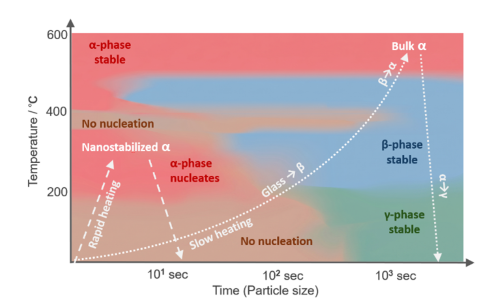
Li₃PS₄polymorphism*7体の合成経路を描いた時間-温度-変態(TTT)図
background
全固体電池の実用化に向けて、リチウムイオン伝導性の高い固体電解質の開発が急務となっています。硫化物固体電解質である「Li₃PS₄」には同じ組成でも結晶構造が異なる多形3種類が存在し、高温相である「α相」が高いイオン伝導度を示します。
However, the bulk α phase (normal crystal) is thermodynamically stable only at temperatures above 480°C, and normally changes to a stable phase at room temperature (γ phase) during the cooling process to room temperature. However, in recent years, it has been discovered that the α phase can be maintained in a metastable state even at room temperature by rapidly heating (e.g., 400°C/min) an amorphous precursor at a relatively low temperature (300 to 350°C) and then rapidly cooling it. On the other hand, slow heating produces the mesophilic β phase.
「なぜ、高温でしか安定しないはずのα相が低温領域で合成でき、かつ室温でその不安定な状態を凍結できるのか?」——このパラドックスの論理的な理解が求められていました。
Research methods and research results
研究グループは、計算科学と最先端の実験を組み合わせることで、このパラドックスを熱力学と速度論の両面から解き明かしました。
1) Reversal of stability at nano size
The surface energy of each phase is determined by first-principles calculations.*8As a result of calculation, the α phase has the lowest surface energy compared to the other β and γ phases (α: 0.43 J/m², β: 0.50 J/m², γ: 0.58 J/m²), is the most thermodynamically stable among nanoparticles, and is the barrier to nucleation from amorphous.*9が全温度域で最も低くなることが示されました(図1)。
2) Demonstration of phase transition dynamics
In-situ X-ray diffraction measurement with ultra-high time resolution of 0.5 seconds at a large synchrotron radiation facility (SPring-8)*10を実施しました。アモルファス前駆体を急昇温した際、速度論的に有利なα相が瞬時に核生成することを捉えることに成功しました(図2)。
If it is held for a short time (approximately 10 seconds) and then rapidly cooled, crystal growth will not proceed, so it can be frozen to room temperature as a "nano-sized alpha phase." On the contrary, it was demonstrated that when held at an isothermal temperature for a long time, the crystals grow and change into a large β phase that is stable at that temperature.
3) 「時間-温度-変態図(TTT図)*11” construction
これらの知見を統合し、粒子サイズ(時間)と温度を軸とした包括的な「時間-温度-変態図(TTT図)」を構築しました。金属工学やガラスの分野で実績のあるTTT図ですが、加熱後の解析によって作られているものが大半です。機能性セラミックスにおいて、計算熱力学と最先端高時間分解能測定を統合して構築した本成果は画期的です。
Expectations for the future
本研究で確立された「理論計算(サイズ・温度依存の安定性)と最先端高時間分解能測定(核生成と速度論)の統合的アプローチ」は、全固体電池材料にとどまらず、従来の手法では合成が困難だった新たな準安定機能性材料(ガラスセラミックス、次世代電子部品など)の探索及び最適な合成プロセス設計に対する、強力で汎用的な基盤技術となります。
謝辞
Part of this research is supported by JST Innovative GX Technology Creation Project (GteX) (JPMJGX23S5), JST Strategic Basic Research Promotion Project PRESTO (JPMJPR21Q8), JST Advanced International Collaborative Research Promotion Project (ASPIRE) (JPMJAP2419), JSPS KAKENHI Grants JP20KK0124 and JP24K21775, JSPS This work was supported by the J-PEAKS program (JPJS00420230001).
論文情報
論文名 Time-Temperature-Transformation Diagrams to Navigate the Nucleation and Quenchability of Metastable α-Li₃PS₄(準安定α-Li₃PS₄の核生成と急冷性を探るための時間-温度-変態図)
著者名 三浦 章1、Woohyeon Baek2、藤井雄太1、忠永清治1、Rana Hossain1、山下愛智3, Keiichi Mizuguchi3、森吉千佳子4, Shintaro Kobayashi5、河口彰吾5, Ding Heung6、森 茂生6、作田 敦6、林 晃敏6、7, Wenhao Sun2(1北海道大学大学院工学研究院、2ミシガン大学材料科学工学科、3東京都立大学理学研究科、4広島大学大学院先進理工系科学研究科、5高輝度光科学研究センター、6Osaka Public University Graduate School of Engineering,7東北大学金属材料研究所)
雑誌名 Nature Communications(英国の総合科学誌)
DOI 10.1038/s41467-026-76661-7
公表日 2026年8月22日(土)(オンライン公開)
参考図
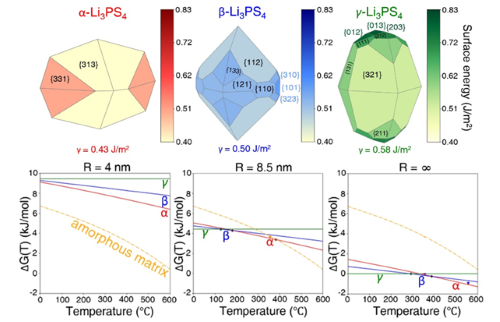
図1.Li₃PS₄ 多形の計算ウルフ形と、サイズによる多形安定性の変化
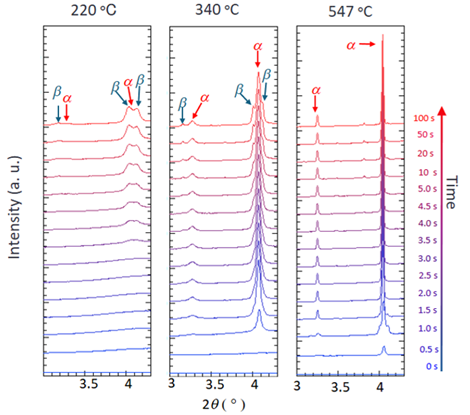
図2.Li₃PS₄の核生成、相転移を0.5秒毎で検出した高時間分解X線回折
Glossary
*1 All-solid-state battery: A secondary battery that uses a solid electrolyte instead of a conventional liquid electrolyte. Highly safe with no risk of flammable liquid leakage.
*2 固体電解質 … イオン伝導性があるが電子伝導性がない固体のこと。特にLi₃PS₄は、リチウムイオンを運ぶ役割を担う固体電解質の中でもっとも有名なものの一つである。
*3 クエンチ … 物質を高温状態から急激に冷却することで、高温での構造や状態を保ったまま室温で保持する手法。
*4 第一原理計算 … 実験データや経験則に頼らず、量子力学の波動関数を計算することで、物質の電子状態やエネルギーをコンピュータ上で正確に予測・計算する手法。
*5 SPring-8 … 理化学研究所が所有する兵庫県の播磨科学公園都市にある世界最高性能の放射光を生み出す大型放射光施設で、利用者支援等は高輝度光科学研究センター(JASRI)が行っている。SPring-8(スプリングエイト)の名前はSuperPhotonring-8GeVに由来。SPring-8では、放射光を用いてナノテクノロジー、バイオテクノロジーや産業利用まで幅広い研究が行われている。
*6 核生成 … 前駆体(アモルファスなど)から新しい結晶相が生まれる最初の過程のこと。
*7 多形 … 化学組成は同じでも、原子の配列(結晶構造)が異なる結晶。Li₃PS₄にはα相(高温相)、β相(中温相)、γ相(低温相)が存在する。
*8 表面エネルギー … 物質の表面を形成するために必要なエネルギー。粒子がナノサイズになると、体積に対する表面積の割合が極めて大きくなるため、バルク(通常の結晶)では不安定な相であっても、表面エネルギーが低い相のほうが全体として安定になることがある。
*9 核生成障壁 … 核生成の際に乗り越えなければならないエネルギーの壁のこと。
*10 In-situ X-ray diffraction measurement: A method of observing real-time changes in the crystal structure of a substance by irradiating it with X-rays “in situ” while heating and cooling the substance. In this study, we used extremely powerful X-rays from a large synchrotron radiation facility (SPring-8) to perform measurements with a high time resolution of 0.5 seconds.
*11 時間-温度-変態図(TTT図) … 特定の温度で、時間・温度を変えた際に物質の構造(相)がどのように変化するかを表した図。欲しい材料を得るための「合成プロセスの究極設計図」ともいえる。
【研究内容に関すること】
北海道大学大学院工学研究院 教授 三浦 章(みうらあきら)
TEL 011-706-7116 FAX 011-706-7116 Email amiura*eng.hokudai.ac.jp
【JST事業に関すること】
科学技術振興機構 未来創造研究開発推進部 GteX推進グループ 波羅 仁(はらまさし)
TEL 03-3512-3543 FAX 03-3512-3533 Email gtex*jst.go.jp
配信元
Public Relations Division, Department of Social Co-creation, Hokkaido University (Kita 8-jo Nishi 5-chome, Kita-ku, Sapporo 060-0808)
TEL 011-706-2610 FAX 011-706-2092 Email jp-press*general.hokudai.ac.jp
Public Relations Division, Japan Science and Technology Agency (5-3 Yonbancho, Chiyoda-ku, 102-8666)
TEL 03-5214-8404 FAX 03-5214-8432 メール jstkoho*jst.go.jp
Osaka Public University Public Relations Division (3rd floor, 1-6-85 Morinomiya, Joto-ku, Osaka 536-0025)
TEL 06-6967-1834 メール koho-list*ml.omu.ac.jp
Hiroshima University Public Relations Group (1-3-2 Kagamiyama, Higashihiroshima City, 739-8511)
TEL 082-424-4383 FAX 082-424-6040 Email koho*office.hiroshima-u.ac.jp
高輝度光科学研究センター(JASRI)利用推進部普及情報課(〒679-5198 佐用郡佐用町光都1-1-1)
TEL 0791-58-2785 PBX 050-3502-3763 Email kouhou*spring8.or.jp
Public Relations Section, Information Planning Office, Institute for Materials Research, Tohoku University (2-1-1 Katahira, Aoba-ku, Sendai 980-8577)
TEL 022-215-2144 FAX 022-215-2482 Email press.imr*grp.tohoku.ac.jp
Public Relations Section, Planning and Public Relations Division, Administration Department, Tokyo Metropolitan University (1-1 Minamiosawa, Hachioji City, 192-0397)
TEL 042-677-1806 Email info*jmj.tmu.ac.jp
(Please convert * to half-width @)