Key points of this research result
- We have discovered a new DNA region (enhancer) that regulates the function of genes necessary for the formation of tendons and ligaments that connect muscles and bones.
- This enhancer has been commonly inherited from coelacanths to humans, and it has been found that it has played an important role in the evolutionary process of living things.
- In mice lacking this enhancer, the deltoid tuberosity, one of the bony prominences of the humerus, was not formed, and the position where the muscle attaches to the bone was also shifted.
- This result provides clues to understanding how tendons and ligaments are created and how muscles and bones are properly connected, and is expected to lead to the development of regenerative medicine for tendons and ligaments in the future.
overview
In collaboration with Professor Shinse Yamaga and Professor Chisa Shukuminami of the Department of Biomolecular Functions, Graduate School of Medical Sciences, Hiroshima University, and Professor Kenta Sumiyama of the Graduate School of Bioagricultural Sciences, Nagoya University, Assistant Professor Hitomi Watanabe, Professor Gen Kondo of the Institute of Medical Biology, Kyoto University, and others, they identified an enhancer (*2) that controls the expression of the transcription factor Scx (*1), which is essential for the maturation of tendons and ligaments, and clarified its role.
This research group firstlylacZWe analyzed the activity of candidate genomic regions using Tg mouse (*3) embryos, andScxWe revealed that a 5.3kb genomic region containing part of the gene and its downstream region has enhancer activity. Furthermore, we found that the evolutionarily highly conserved region (CSE) contained in this 5.3kb region also has enhancer activity.
Next, when we created and analyzed mice lacking CSE using genome editing technology, we found that Scx expression was significantly reduced during the limb formation process.
Additionally, the rough surface of the deltoid muscle (*4), which is normally formed on the humerus, had disappeared, and the attachment point of the deltoid muscle and brachialis muscle had moved upward. These results revealed that CSE-mediated Scx expression is important not only for the formation of the deltoid tuberosity but also for guiding the muscle to the appropriate position and attaching it to the bone.
本研究は、腱によって制御される骨隆起の形成と筋肉の付着位置決定の仕組みの理解につながる成果です。
The results of this research were published in "Development" on June 1, 2026.
Published paper
Paper title
Divergent temporal control of deltoid tuberosity and limb tendon development by an evolutionarily conserved scleraxis enhancer
author
Yamake Shinsei1†, Kenta Sumiyama2†, Hitomi Watanabe3, Akira Takimoto4, Takako Sasaki5, Gen Kondo3, Denitsa Docheva6, Chisa Shukunan1*
1. Hiroshima University, Graduate School of Medical Sciences, Department of Biomolecular Function
2. Nagoya University, Graduate School of Bioagricultural Sciences, Animal Genetics and Breeding
3. Kyoto University, Institute of Medical Biology, Department of Integrated Bioprocessing
4. Kyoto University, Institute for Frontier Medical Sciences, Department of Biomolecular Design
5. Oita University, Faculty of Medicine, Department of Pharmacology
6. Department of Musculoskeletal Tissue Regeneration, Orthopedic Hospital König-Ludwig-Haus, Julius-Maximilians-University Würzburg
(†Co-lead author)(*Corresponding author)
Published magazine
Development
DOI number
doi.org/10.1242/dev.205325
This research result was introduced as one of the Research Highlights in the same magazine, and an interview article with the author about the research content, “The people behind the papers – Chisa Shukunami, Shinsei Yambe and Kenta Sumiyama” (doi.org/10.1242/dev.205819), was also published.
背景
Our bodies move because the contraction force generated by muscles is transmitted to bones via tendons. In addition, the attachment of muscles to bones via tendons at appropriate locations is important for efficient motor function. Scx is a transcription factor that is specifically expressed in tendons, ligaments, and their attachments, and is known to play an important role in the formation and maturation of these tissues. on the other hand,Scxがなぜ腱・靱帯とその付着部で特異的に発現するのか、その仕組みは明らかになっていませんでした。一般に、このような組織特異的な遺伝子発現は、エンハンサーと呼ばれるDNA配列によって制御されます。これまでに、ScxA 10.86kb genomic region containing the gene was detected in tendons and ligaments and their attachments in fluorescent reporter transgenic mice.Scxの発現を再現できることが報告されていました。
But where in this areaScxIt was not clear whether there is an important enhancer that controls the expression of , and what role it plays.
研究成果の内容
本研究グループは、ScxTo identify enhancers that control tissue-specific expression oflacZEnhancer activity was analyzed in Tg mouse embryos. the result,Scx遺伝子の一部とその下流領域を含む約5.3kbのゲノム領域には、腱・靱帯およびその付着部に特異的な活性が検出されました。また、この5.3kbのゲノム領域内の進化的に高度に保存された領域(CSE)にもエンハンサー活性があることを見出しました(図1)。
そこで、ゲノム編集技術を用いてCSEを欠失させたマウス(ScxEnΔ/EnΔマウス)を作製し、その表現型を解析したところ、胎生13.5日齢および14.5日齢のScxEnΔ/EnΔIn mouse embryos, Scx expression in limb tendons was significantly reduced compared to wild-type mice (Figure 2). Also, newbornScxEnΔ/EnΔIn mice, the deltoid tuberosity that normally forms on the humerus completely disappeared, similar to Scx-deficient mice (Figure 3). Interestingly,ScxEnΔ/EnΔmouse andScx欠失マウスいずれにおいても、三角筋と上腕筋の付着部は上方へ移動していましたが、その移動の程度はScx欠失マウスでより顕著でした(図3)。生後3ヶ月齢で骨格マイクロCT撮影(※5)およびDiceCT法(※6)による解析を行ったところ、出生時に認められた三角筋および上腕筋の付着部の上方移動は、その程度も含めて成体においても保たれていました(図3)。
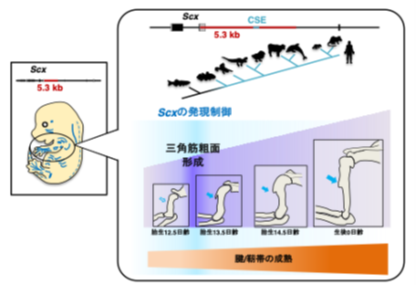
本研究により、ScxIt has been revealed that an evolutionarily conserved enhancer found within a 5.3kb genomic region that is responsible for regulating tendon- and ligament-specific expression of the deltoid muscle plays an important role not only in the formation of the deltoid tuberosity but also in determining the attachment position of the muscles that attach to it (Figure 4).
今後の展開
本研究では、Scxの腱・靱帯特異的発現を制御するエンハンサーを同定し、その機能的役割を明らかにしました。今後は、このエンハンサーに結合してScxの転写を制御する転写因子を同定することで、腱・靱帯およびその付着部の形成を制御する上流の分子メカニズムの解明を進めていきます。
また、腱・靱帯は損傷後に瘢痕組織を形成しやすく、本来の構造や機能を回復することが難しいことから、本研究で得られた知見は、将来的に腱・靱帯の機能的な再生を目指した新たな治療法の開発につながることが期待されます。
Reference materials
図1. 5.3kbおよび343bpのScxエンハンサーの活性
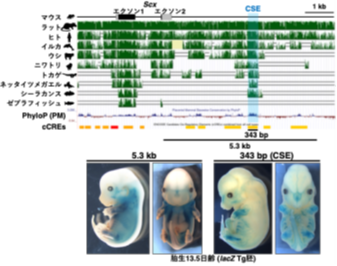
図2. CSE欠失マウスにおけるScxの発現低下
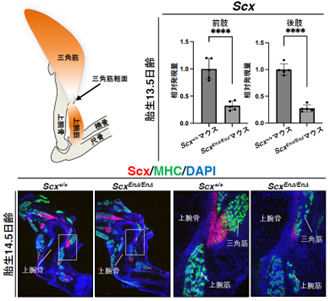
図3. CSE欠失による三角筋粗面の消失と筋付着部の上方移動
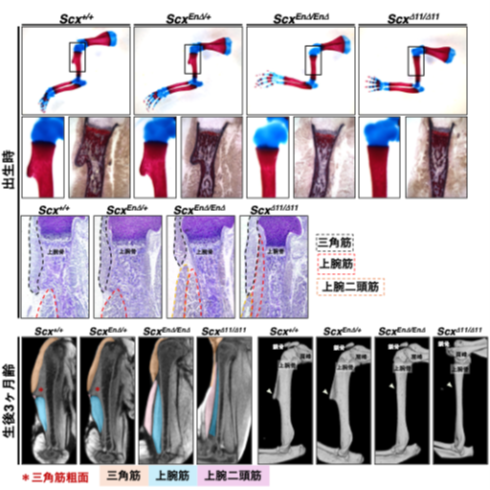
図4. 進化的に保存されたCSEによる時期特異的なScxの発現制御と三角筋粗面の形成
Figures 1-4 are adapted from figures published in Development (doi.org/10.1242/dev.205325).
用語説明
(※1) Scleraxis (Scx)
A transcription factor specifically expressed in tendon/ligament progenitor cells and tendon/ligament cells.ScxIn mice lacking this, significant maturation defects are observed in tendons, ligaments, and their attachments. In mice, the block of proliferation 1 (Bop1)の遺伝子座に反対向きに位置している。
(*2) Enhancer
特定の細胞や時期において、標的となる遺伝子の発現を調節・増強するDNA領域。転写因子などのタンパク質がこの領域に結合することで標的遺伝子の転写活性を制御する。
(※3)lacZTransgenic mouse (lacZTg mouse)
lacZGenetically modified mouse with a reporter gene introduced.lacZThe expression site becomes blue and visualized by X-gal staining.lacZIntroducing the minimal promoter/enhancer candidate region along with the gene,lacZBy analyzing the expression pattern of , the transcriptional activity of the enhancer candidate region can be verified.
(*4) Deltoid muscle
A muscle that attaches from the clavicle/scapula to the humerus. Its role is to move the upper arm horizontally and vertically. It is the strongest abductor muscle in the shoulder joint, and at the same time has a protective role by covering the shoulder joint and absorbing shock.
(*5) Skeletal micro CT imaging
A technology that continuously takes X-ray images of a sample from 360° directions and analyzes the internal structure of the sample two-dimensionally and three-dimensionally based on that information. Widely used in the analysis of hard tissues such as bones.
(*6) DiceCT method
A technology that stains and contrasts samples using iodine-based stains, etc., and images and analyzes soft tissues such as muscles using micro-CT. The tissue structure can be observed in any cross section, and the movement of muscle tissue can be evaluated in detail.
- Press release materials (496.44 KB)
- Publication journal (Development)
- Hiroshima University Researcher Guidebook (Professor Chisa Shuminami)
Department of Biomolecular Function, Department of Biomedical Sciences, Graduate School of Medical Sciences, Hiroshima University
Professor Chisa Shukuminami
Tel: 082-257-5628 Fax: 082-257-5629
E-mail: shukunam*hiroshima-u.ac.jp
URL: http://tnmd.hiroshima-u.ac.jp/j_html/j_index.html
Public Relations Group, General Affairs and Public Relations Department, Finance and General Affairs Office, Hiroshima University
Tel: 082-424-3701 FAX: 082-424-6040
E-mail: koho*office.hiroshima-u.ac.jp
Nagoya University General Affairs Department Public Relations Division
Tel: 052-558-9735 FAX: 052-788-6272
E-mail: nu_research*t.mail.nagoya-u.ac.jp
(Please convert * to half-width @)