本研究成果のポイント
- ヒト特有のRNA「pancEFHC1」(※1)がてんかん関連遺伝子EFHC1(※2)の働きを活性化して神経幹細胞(※3)の増殖を支えていることを発見し、てんかんの原因解明や新たな治療法開発につながる可能性を示した。
概要
In order to elucidate the mechanism of human epilepsy, which is difficult to reproduce in animals, graduate student Sota Nishida (who at the time of the research was in his second year of a doctoral course in the Graduate School of Integrative Life Sciences) and professor Takuya Imamura of the Graduate School of Integrative Life Sciences focused on "non-coding RNA (ncRNA)" (*4), which acts without making proteins. In this study, we discovered that the human-specific ncRNA ``pancEFHC1'' activates the function of the epilepsy-related gene EFHC1, and also revealed that EFHC1 promotes the proliferation of neural stem cells while suppressing intracellular stress and inflammation. These results showed that a decrease in the function of non-coding RNA and EFHC1 leads to a decrease in the proliferation of neural stem cells, suggesting a relationship with the onset of epilepsy.
今回の成果は、ヒト特有のRNAが脳の発達や疾患に関わる仕組みを明らかにしたもので、てんかんの原因解明や新たな治療法の開発への貢献が期待される。
本研究成果は、2026年8月21日に国際学術誌「Stem Cell Reports」に掲載されました。
論文情報
論文タイトル:A human-specific non-coding RNA for EFHC1, an epilepsy-associated gene, regulates neural stem cell proliferation for cortical development
雑誌名:Stem Cell Reports
掲載日:8月21日
著者:Sota NISHIDA, Boyang AN, Hayato UCHIDA, Shota ZENNO, Takumi NOJIMA, Arisa MAKIMURA, Fumihiro MORISHITA, Mizuki HONDA, Takuya IMAMURA*
Stem Cell Rep, 21:103049 (2026)
DOI:10.1016/j.stemcr.2026.103049
背景
Understanding brain developmental disorders and mental illnesses that occur in childhood is a social issue that has a major impact on the health and quality of life of the nation, and there is a strong need to establish treatment methods based on understanding their onset mechanisms. Epilepsy is a recurrent brain disease caused by abnormal and excessive neural activity, and it is said to affect 65 million people worldwide, and approximately 1 million people in Japan. Among these, Juvenile Myoclonic Epilepsy (JME) (*5), which is said to account for 5-10% of all epilepsy cases, mainly develops around puberty and is accompanied by symptoms such as myoclonic seizures, tonic-clonic seizures, and absence seizures.However, as with humans, there are only occasional reports of JME in dogs, and there are almost no reports of its occurrence in other animals. In other words, epilepsy including JME is a disease unique to humans, and it can be assumed that a wide range of molecular mechanisms specific to the human developmental period are involved in its onset. By functionally identifying and organizing information on elements that make up species differences from the developmental period, it will become the basis for experimental research, and by feeding back this information, it is thought that the rate-limiting development and advancement of new animal models that will contribute to the treatment of human diseases will be the rate-limiting factor.
Contents of research results
遺伝子のスイッチを制御しうるncRNAは、遺伝子とは異なり、タンパク質をコードする必要がないため、種間多様度が高い。このことに着目し、我々は、ヒトと他の霊長類、あるいは実験動物として用いられるマウスとを比較することで、動物種特異的な現象を同定する研究を推進してきた(参考資料1)。今回は、ヒトとマウスとの比較から、プロモーターと呼ばれる遺伝子のスイッチを担うゲノム領域に進化的に獲得され、EFHC1(EF-hand domain-containing 1)遺伝子を制御するヒト特異的ncRNAとして、pancEFHC1(promoter-associatedncRNA for EFHC1)を発見した。EFHC1遺伝子に変異をきたすとJMEとなるケースがよく認められており、てんかんの主要な原因遺伝子の一つとしてよく知られている。
In this study, we first revealed that the EFHC1 gene became highly expressed in human neural stem cells due to the acquisition of this human-specific ncRNA. On the other hand, in mouse neural stem cells, the expression of the same gene was suppressed to less than one-fifth due to the absence of ncRNA. In human neural stem cells, it has been revealed that when the pancEFHC1-EFHC1 set ceases to function (mice), stress is induced in intracellular organelles called the endoplasmic reticulum (*6), and p38MAP kinase signals, known as intracellular inflammatory signals, are released. Furthermore, by adding an endoplasmic reticulum stress reliever and a p38MAP kinase signal inhibitor to cells in which the EFHC1 gene expression had been altered, they were able to restore the original state of human neural stem cells.
以上より、ヒト特異的pancEFHC1はEFHC1遺伝子のスイッチONに機能することで、ヒトに特徴的な神経幹細胞の継続的増殖を担っており、このメカニズムが破綻することでヒト疾患発症にも関与する可能性が浮かび上がってきた(図)。また、このメカニズムを標的とした治療の実現可能性を提示することができた。
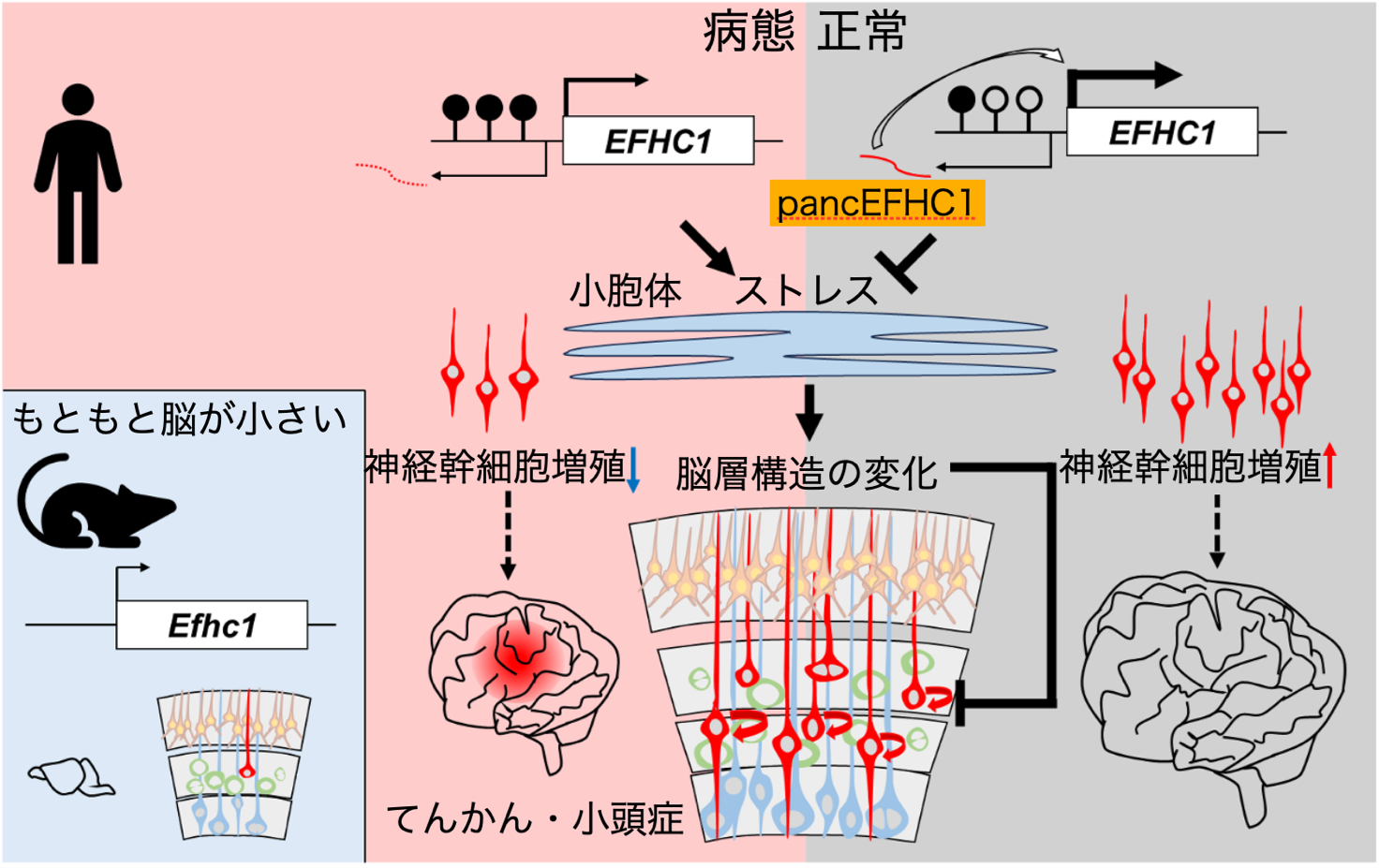
図:本研究のまとめ。ヒトの進化の過程で獲得したpancEFHC1は、神経幹細胞においてEFHC1遺伝子を狙い撃ちにして活性化し、これにより、細胞内ストレスがおこりにくくしている。一方で、この分子を失うと、神経幹細胞の増殖が低下し、病態発症を引き起こしうる。
今後の展開
従来の生命科学は生き物の共通性に注目し、動物種を超えて保存されていることが機能的に重要と捉えることで、さまざまなモデル動物を活用した理解が進んできた。
本研究では、この既存の概念から脱却し、数多の動物種特異的ncRNAがどのように表現型多型をもたらしたのかを解明できたのではないか、と考えている。このような取り組み例を増やしていくことは、特にヒト脳機能の解明に向けて、その複雑性と高寿命性を獲得した生命アルゴリズムの実体を明らかにすることにもつながる。さらに、獲得したばかりのRNAネットワーク進化が内包する脆弱性に着目し、その機能解明を通して、超高齢化社会における脳疾患の原因究明や、是正を指向した次世代医療の基盤創出を目指すことができると考えている。特に、今回発見したpancEFHC1以外にも多数のpancRNAが存在していることを発見していることから、これらの機能解明が重要である。
また今後は、本研究で明らかになったpancEFHC1とEFHC1の仕組みを活用し、てんかんなどの脳疾患に対する新たな治療候補薬の探索を進めるため、病気の状態を再現できる研究モデルの開発を行う予定である。具体的には、①ゲノム編集技術を用いて、てんかんの発症に関わる脳の領域をヒトに近い状態へ改変したモデルマウスの開発②ヒトiPS細胞から作製した脳オルガノイド(ミニブレイン)(※7)を用いた病態モデルの構築の2つのアプローチを進める。これにより、ヒトの脳に近い環境で病気の仕組みを詳しく調べるとともに、新たな治療候補薬の評価や探索につなげることが期待される。
参考資料
1. 広島大学プレスリリース
[Research results] Succeeded in producing iPS cells of bonobos (great apes) and gibbons (small apes) and cells that form the basis of limbs — Contributing to the promotion of the integration of primate development and evolution, biodiversity conservation, and zoo veterinary medicine — (February 20, 2026:https://www.hiroshima-u.ac.jp/news/95883)
用語解説
※1 pancEFHC1:本研究で注目したヒト特有のノンコーディングRNA。てんかん関連遺伝子EFHC1の働きを活性化し、神経幹細胞の増殖を支える役割を持つ。
※2 EFHC1:若年性ミオクロニーてんかん(JME)の原因遺伝子の一つとして知られる遺伝子。本研究では、脳のもととなる神経幹細胞の増殖を支える働きがあることが示された。
※3 神経幹細胞:脳や神経をつくる細胞のもとになる細胞。増殖しながら、将来さまざまな神経系細胞へと分化する。
※4 ノンコーディングRNA(ncRNA):タンパク質を作らず、RNAのまま働く分子。遺伝子の働きを調節するなど、さまざまな役割を持つ。
※5 若年性ミオクロニーてんかん(JME):主に思春期頃に発症するてんかんの一種。全てんかん患者の約5-10%を占め、手足が急にピクッと動く発作などが特徴とされる。
※6 小胞体:細胞の中にある構造の一つで、タンパク質の合成や品質管理を担う。機能が低下すると細胞にストレスが生じる。
※7 脳オルガノイド(ミニブレイン):iPS細胞などから人工的に作製した小さな脳組織。病気の仕組みの解明や薬の評価に利用される。
■研究に関するお問い合わせ先
広島大学大学院統合生命科学研究科
教授 今村 拓也
TEL:082-424-7438
E-mail:timamura*hiroshima-u.ac.jp
■報道に関するお問い合わせ先
広島大学 広報グループ
TEL:082-424-4383
E-mail:koho*office.hiroshima-u.ac.jp
(*は半角@に置き換えてください)