Key points of this research result
- This is the first time in the world that we have observed a bias in electron spin, which was previously thought to be non-existent due to the properties of crystals.
- By combining experiments and first-principles calculations (*1), we found that the spin bias had not disappeared, but had simply become invisible due to ``quantum interference,'' where electron waves cancel each other out.
- This research provides a new perspective on how to observe quantum states, and is expected to lead to research into spintronics, a technology that processes information using both the electricity and spin of electrons, research into quantum materials, and the development of energy-saving next-generation electronic devices.
overview
In collaboration with the University of Wisconsin-Milwaukee, the research group led by Professor Taichi Okuda of the Hiroshima University Institute for Synchrotron Radiation Science, in collaboration with the University of Wisconsin-Milwaukee in the United States, used spin-angle-resolved photoelectron spectroscopy (Spin-ARPES) (*2) to closely observe the electronic state of the metal element bismuth (element symbol: Bi, atomic number: 83) that exists on the (110) surface of bismuth (Bi) crystals, in which the atoms are arranged in an orderly manner.
As a result, they discovered that spin polarization (*4), which was originally thought to cancel out and disappear due to crystal symmetry (*3), actually remained large.
Furthermore, by comparison with first-principles calculations, we found that within the electronic state of bismuth there are originally two waves with opposite spin polarizations, and because they cancel each other out (quantum interference (*5)), it appears that spin polarization does not exist. We discovered that one of these two wave functions (*6) is selectively observed in photoelectron spectroscopy, and as a result, for the first time in the world, we revealed the existence of spin polarization that was hidden by this quantum interference.
This research presents a new perspective for investigating the properties of electrons hidden in materials, and is expected to lead to future quantum materials research and the development of spintronic materials.
The results of this research were published in Physical Review Letters, a journal of the American Physical Society, on July 28th.
Paper information
Paper title: Unveiling the hidden spin-polarized Bi(110) surface states by spin-resolved photoemission
Posting date: July 28th
Author name: *Taichi Okuda1,2,3, Tatsuya Shishido4, Munisa Nurmamat1, Kazuki Tsunoda1, Eike Schwier1, Koji Miyamoto1, Michael Weinert4(*Corresponding author)
Affiliation:1Hiroshima University Institute of Synchrotron Radiation Science,2Hiroshima University Super Materials Center Contributing to Sustainability (WPI-SKCM2),3Hiroshima University Semiconductor Research Institute,4University of Wisconsin-Milwaukee, USA
Magazine: Physical Review Letters
DOI: https://doi.org/10.1103/3vs9-4y1y
background
Electrons have not only "charge" but also a magnetic property called "spin." In recent years, spintronics, which utilizes this spin, is expected to be a technology for realizing low-power electronic devices.
Bismuth, which has strong spin-orbit interaction (*6), is known to have spin-polarized electronic states on its surface. However, the direction of the spin is severely restricted by the symmetry of the crystal, and it has been thought that in some places with high symmetry, the spin component perpendicular to the plane is always zero.
However, until now, it was not known whether this state in which the spin becomes zero means that there really is no spin, or whether it is simply invisible for some other reason.
Contents of research results
The research group used a high-performance spin and angle-resolved photoelectron spectrometer at Hiroshima University's Institute of Synchrotron Radiation Science (HiSOR) to three-dimensionally measure the electron spin on the Bi(110) surface.
As a result, we confirmed for the first time that perpendicular spin polarization, which should be zero due to crystal symmetry, can be observed even in locations with high momentum space symmetry.
To understand this result, we applied the wave function unfolding method (*7) to first-principles electronic state calculations and found that one of bismuth's two surface electronic states is composed of two wave functions that propagate in opposite directions, each with opposite perpendicular spin polarization.
However, normally in places with high symmetry, these two waves cause quantum interference, and the spin polarization is completely canceled out and is not observed. However, in photoelectron spectroscopy, only one of the two waves is selectively observed due to the photoelectron emission process, so it has become clear that hidden spin polarization appears, which would normally be unobservable because they cancel each other out.
This phenomenon is very similar to the fact that when two sound waves with opposite phases are measured with a normal microphone, the sounds cancel each other out and cannot be heard, but when only one is picked up with a directional microphone, the sound is audible. In this research, we experimentally demonstrated this quantum mechanical phenomenon for the first time in the world, and discovered that the state where it was thought that ``there is no spin bias'' was actually hidden by ``quantum interference,'' where the wave states of electrons with upward and downward spin overlap and completely cancel each other out.
Future developments
This result showed that the behavior of electron spin, which could not be understood using conventional crystal symmetry alone, can be understood from the perspective of "quantum interference of wave functions." This idea may be applicable not only to bismuth but also to various quantum materials with strong spin-orbit interactions. Furthermore, the results demonstrate the possibility of visualizing electronic states that were previously thought to be unobservable using spin/angle-resolved photoelectron spectroscopy, and are expected to greatly contribute to research into new quantum materials and spintronic materials.
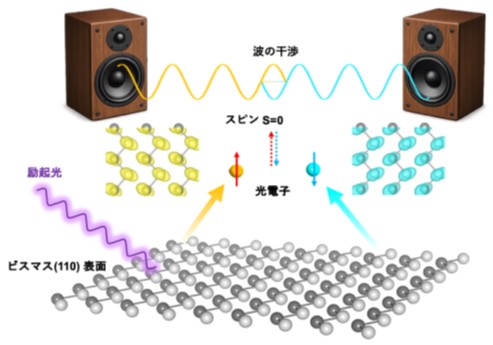
Figure 1: Quantum interference of wave functions and interference of sound waves from speakers. Waves (sound) of opposite phases emitted by the two speakers interfere at the center and disappear (the sound disappears). The waves (wave functions) of electrons on the bismuth surface have different upward and downward spins for waves going to the right and waves going to the left, but when they interfere (quantum interference), they cancel each other out and the spin polarization becomes zero. However, when we observed the waves going to the right and the waves going to the left separately using photoelectron spectroscopy, we observed separate spin-up waves and spin-down waves before interference. This revealed for the first time that hidden spin polarization exists even where the spin on the bismuth surface is not observed, and that the spin is simply invisible due to wave function interference.
Glossary
*1. first principles calculation
This is a method of using a computer to calculate how electrons move within a material, using only the laws of physics, without conducting any experiments.
*2. Spin-angle resolved photoelectron spectroscopy (Spin-ARPES)
When light shines on a material, electrons inside the material are emitted due to the photoelectric effect. At this time, the electrons that have not been scattered are emitted while retaining information about the electronic state inside the material according to the law of conservation of energy. Angle-resolved photoelectron spectroscopy is a method that directly observes the relationship between the binding energy and momentum of electrons inside a solid, that is, band dispersion, by analyzing the kinetic energy and emission angle of emitted electrons. Furthermore, by adding a spin detector, it is possible to separate and observe not only the kinetic energy and momentum of electrons, but also the electron spin, making it possible to investigate the detailed electronic structure of magnetic materials. In this research, measurements are performed using a low-energy electron diffraction (VLEED) spin detector independently developed by the Institute of Synchrotron Radiation Science, Hiroshima University.
*3. crystal symmetry
This is the property that even if a crystal is rotated or reflected in a mirror, it cannot be distinguished from the original.この対称性は電子状態の性質を強く制限し、特定の場所ではスピン偏極がゼロになることが理論的に導かれます。
*4. spin polarization
A state in which the electron spin is biased in one direction. If the number of upward and downward spins is equal, the spin polarization will be zero, and if there are more of either, there will be a finite spin polarization.
*5. Wave function and quantum interference
In quantum mechanics, electrons are both particles and waves, and their state is represented by something called a wave function. When two or more wave functions overlap, a phenomenon occurs in which they strengthen or cancel each other, similar to waves, and this phenomenon is called "quantum interference." In this research, we discovered that two wave functions with opposite spin polarization cancel each other out through quantum interference, making it appear that no spin polarization exists, and by selectively observing each wave function using photoelectron spectroscopy, we revealed the originally hidden spin polarization.
*6. spin-orbit interaction
This is a quantum mechanical effect where electron motion and spin interact. When this effect is strong, the spin of the electron is strongly linked to the direction of motion, and a characteristic electronic state appears.
*7. Wave function unfolding method
Electrons in a material spread out as waves according to the periodic structure of the crystal. The wave function unfolding method is a method that analyzes the complex overlapping wave functions of electrons by dividing them into their original wave components. In this study, by using this method, we revealed that a single electronic state is composed of two wave functions moving in opposite directions, each with opposite spin polarization.
Acknowledgment
This research was supported by the Japan Society for the Promotion of Science (JSPS) Grant-in-Aid for Scientific Research A "Advancement of highly efficient spin-resolved photoelectron spectroscopy and three-dimensional spin analysis of spintronic materials" (problem number: 23244066, principal investigator: Taichi Okuda) and a grant from the National Science Foundation of the United States (problem number DMREF 2323857).
- Press release materials (457.57 KB)
- Journal in which the article was published (Physical Review Letters)
- Hiroshima University Researcher Guidebook (Professor Taichi Okuda)
[Regarding research]
Hiroshima University Institute of Synchrotron Radiation Science Professor Taichi Okuda
Tel: 080-6586-9796
E-mail: okudat*hiroshima-u.ac.jp
[Regarding reporting]
Hiroshima University Finance and General Affairs Office Public Relations Department Public Relations Group
TEL: 082-424-4383 FAX: 082-424-6040
E-mail: koho*office.hiroshima-u.ac.jp
(Please replace * with half-width @)