Key points of research results
- It has become clear that the pathological characteristics of atopic dermatitis caused by T cells (Note 1) may be determined by T cell receptors (Note 2).
- Potentially useful for developing new treatments targeting T cells and T cell receptors.
overview
A research group led by Professor Osamu Kaminuma of Hiroshima University's Atomic Bomb Radiological Research Institute (Department of Disease Model Analysis), in collaboration with Director Kimiko Inoue of the RIKEN Bioresource Research Center (Integrated Developmental Engineering Research and Development Office), has clarified part of the mechanism that causes differences in the symptoms of atopic dermatitis.
In allergic diseases such as atopic dermatitis, even if the disease develops in response to the same allergen (allergy-causing substance), the manner in which the symptoms appear and the severity vary from person to person. However, the factors that cause this difference have not been fully elucidated.
In this study, we compared atopic dermatitis-like pathology caused by tick antigens using two strains of nuclear transfer cloned mice (Note 3) in which T cells throughout the body express T cell receptors that recognize tick antigens. As a result, both mice developed atopic dermatitis-like symptoms accompanied by the production of IgE antibodies (Note 4), but itching behavior and the expression of some cytokines (Note 5) locally in the skin were clearly different between the two strains. Furthermore, when we extracted T cells from both strains and compared their antigen responsiveness, we found significant differences in their proliferation responses and cytokine expression patterns.
These results have revealed that even in allergic reactions caused by the same antigen, the way symptoms appear and individual differences may be determined in part by differences in the T cell receptors that recognize the antigen.
This research result was published in the international academic journal "Allergology International (Q1)" on June 24, 2026, with the publication fee subsidized by Hiroshima University.
Paper information
Paper title
Distinct Allergen-Specific T Cell Receptor Clonotypes Drive Divergent Immune Programs in A Cloned Mouse Model of Atopic Dermatitis
author
Uyanga Enkhbaatar, Kento Miura, Norimasa Yamasaki, Sawako Ogata, Ryoken Yamanaka, Fatemeh Beygom Mirkatouli, Anarkhuu Bold-Erdene, Tomofumi Numata, Tomoharu Yasuda, Kazumitsu Sugiura, Megumi Sasatani, Takashi Yamamoto, Kimiko Inoue, Atsuo Ogura, Osamu Kaminuma*
*: Corresponding author
DOI: 10.1016/j.alit.2026.06.001
background
Nowadays, many people are suffering from various allergic diseases. However, the characteristics of the disease vary from person to person, and treatment methods also vary from person to person. Until now, it has been thought that the diversity of pathological conditions is strongly related to internal factors such as atopic predisposition and external factors such as food and living environment. On the other hand, in the body of an allergy patient, the number of T cells that express T cell receptors that recognize the causative antigen and respond when the antigen enters the body, which is involved in the onset and severity of the disease, is increasing. However, in each patient and even within the same patient, the antigen-reactive T cells that have increased in number express different T cell receptors. Until now, it was not clear how these different T cell receptors affect allergic pathology.
Contents of research results
In this study, we used a mouse model of atopic dermatitis to examine the effects of differences in antigen-specific T cell receptors on its pathology. To conduct this experiment, we used nuclear transfer cloned mice derived from antigen-reactive T cells, which we developed for the first time in the world. Two types of cloned mouse lines were created by transplanting the cell nuclei of two types of T cells, which react to the same tick antigen but express different antigen-specific T cell receptors, into normal mouse eggs from which the nucleus had been removed. Most of the T cells that emerge in these mice express the same tick antigen-specific T cell receptors that the donor T cells expressed, but these are different in both strains. Repeated application of tick antigens to the skin of these mice induced atopic dermatitis pathology accompanied by IgE antibody production and inflammatory cell infiltration in both strains (Figure 1). However, in one cloned mouse strain, clear pruritic behavior was induced as the disease progressed, whereas in the other strain it was not (Figure 2). At that time, the expression of IL-22, a cytokine involved in itching behavior, in the skin was different between the two strains. When T cells were extracted from each mouse and cultured with tick antigens, the proliferation responses and cytokine expression patterns were clearly different. Because they have genetic backgrounds of inbred mice (Note 6) with completely identical genetic information, the only difference between these two cloned mouse strains is the T cell receptor. Therefore, it has become clear that even if T cells react to the same antigen, the pathological conditions of atopic dermatitis caused by different T cell receptors involved in antigen recognition exhibit different characteristics.
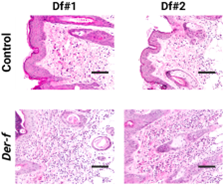
Figure 1: Tick antigen (Der-f) was applied to investigate the pathological conditions that develop. Both strains exhibited atopic dermatitis-like pathology with inflammatory cell infiltration.
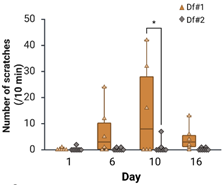
Figure 2: Pruritic behavior induced by tick antigen application was compared between cloned mouse strains. Clear itching behavior was observed in Df#1, peaking on the 10th day of the experiment, but not in Df#2.
Future developments
It has become clear that T cell receptors, in addition to internal factors such as atopic predisposition and external factors such as food and housing environment, may determine the characteristics of allergic pathology. This result may be useful in the development of new treatments targeting T cells and T cell receptors. In the future, it will be important to conduct a more detailed analysis of how different T cell receptors are involved in different pathological conditions.
Glossary
Note 1) T cells: Lymphocytes that are commanders that control the entire immune system, and that promote the production of IgE antibodies and issue instructions for attacks.
Note 2) T cell receptor: An immune protein on the surface of T cells that has the role of identifying foreign substances (antigens).
Note 3) Nuclear transfer cloned mouse: A mouse with exactly the same genes as the original mouse, created by removing the nucleus containing the genetic information (blueprint) from the cells of one mouse and placing it in another egg.
Note 4) IgE antibody: An immune protein that functions as a "sensor" that detects antigens and induces allergic symptoms.
Note 5) Cytokine: An information transmission (message) substance released by immune cells etc. that allows cells to communicate with each other.
Note 6) Inbred mouse: A mouse strain in which brother-sister mating is repeated over many generations, so that all individuals have the exact same genes, like identical twins (clones).
- Press release materials (321.52 KB)
- Publication journal (Allergology International)
- Hiroshima University Researcher Guidebook (Professor Osamu Kaminuma)
[Research inquiries]
Hiroshima University Research Institute for Radiation Biology and Medicine, Disease Model Analysis Research Department
Professor Osamu Kaminuma
Tel: 082-257-1556 FAX: 082-255-8339
E-mail: okami*hiroshima-u.ac.jp
[Contact for press inquiries]
Hiroshima University Public Relations Group
Tel: 082-424-4518
E-mail: koho*hiroshima-u.ac.jp
RIKEN Public Relations Department Press Office
Tel: 050-3495-0247
E-mail: ex-press*ml.riken.jp
(Please replace * with half-width @)