Key points of this research result
- A total of 2,689 people, 1,524 adults and 1,165 children, were diagnosed with the new coronavirus infection (COVID-19) from March 2020 to June 2024 at a single medical institution in Hiroshima Prefecture (a medical institution designated for type 2 infectious diseases). Subjects will be asked about the presence or absence of post-infection symptoms, their duration, and the impact on their daily lives using self-administered questionnaires, and will be analyzed by age group and infection period (wild strain epidemic period, alpha strain epidemic period, delta strain epidemic period, Omicron strain epidemic period -2022, Omicron strain epidemic period -2024).*1The long-term course was analyzed.
- The prevalence of symptoms after contracting COVID-19 varies depending on the time of infection, and was highest during the Delta strain epidemic, and decreased by about half during the Omicron strain epidemic. This trend did not change in the Omicron sublineage that was prevalent in 2024.
- The rate of post-infection symptoms in children remained at about one-third to one-quarter of that in adults throughout the entire epidemic, and among the subjects, no children were found to have problems with daily life for more than two years after infection.
- Approximately 20% of adults who were infected before the Omicron epidemic period (wild strain epidemic period, Alpha strain epidemic period, Delta strain epidemic period) still had some symptoms two years after infection, and approximately 10% of adults infected during the Omicron epidemic period continued to have some symptoms, and symptoms that remained for more than two years hardly improved during the observation period of this study. However, the possibility of further improvement beyond the observation period cannot be ruled out.
overview
● Hiroshima University Graduate School of Medical Sciences A research group led by Fumi Sugiyama, Lecturer in Epidemiology and Disease Control, and Director/Vice President Junko Tanaka, will conduct research from March 2020 to June 2024 with the cooperation of Hiroshima City Funiri Municipal Hospital and Hiroshima Prefectural Center for Infectious Diseases and Disease Control (Hiroshima CDC). We conducted a retrospective cohort study of 2,689 adults and children diagnosed with COVID-19 to date, and clarified the long-term course of post-infection symptoms (so-called "sequel effects") by epidemic period and age group. The prevalence of post-infection symptoms was highest during the Delta strain epidemic period, and decreased by about half during the Omicron strain epidemic period. This trend did not change with the Omicron sublineage that was prevalent in 2024. Additionally, the prevalence of symptoms among children remained at about one-third to one-quarter of that among adults throughout the entire epidemic. However, approximately 20% of adults infected before the Delta strain period continue to have symptoms more than two years after infection, indicating the need for long-term follow-up and support. The results of this research were published in PLOS One on May 8, 2026.
● This research is a project to establish an inspection research system through collaboration between Hiroshima University and Hiroshima Prefecture, as well as the National Research and Development Corporation. Japan Agency for Medical Research and Development (AMED) Research Project to Promote the Development of Innovative Medicines for Emerging and Re-Emerging Infectious Diseases ``Advanced research aiming to create new evidence from the perspectives of epidemiology, clinical medicine, virology, and medical systems based on the Hiroshima Prefecture government-academia collaboration COVID-19 research system (R3)'' ``Surveillance and epidemiology research based on the government-academia collaboration COVID-19 research system with an eye to crisis management for new infectious disease epidemics (R4)'' ``Development and expansion of long-term cohort research infrastructure This project was supported by the ``Development and Practical Application of a Prognosis Prediction Method for Post-COVID-19 Symptoms (R6-8)''.
Published paper
■ Magazine: PLOS ONE (Q1. IF: 2.6)
■ Paper title:
Differences in the long-term course of post COVID-19 symptoms in adults and children across epidemic periods: A retrospective cohort study in Japan, 2020–2024
■ Author name:
Aya Sugiyama1*, Toshiro Takafuta2, Kanon Abe3, Yayoi Yoshinaga1, Ko Ko1, Tomoki Sato2,4, Tomoyuki Akita1, Masao Kuwabara5, Shingo Fukuma1, Junko Tanaka1
1 Department of Epidemiology Disease Control and Prevention, Graduate School of Biomedical and Health Sciences, Hiroshima University, Hiroshima, Japan
2 Hiroshima City Funairi Citizens Hospital, Hiroshima, Japan
3 Department of Preventive Gerontology, Center for Gerontology and Social Science, National Center for Geriatrics and Gerontology, Aichi, Japan
4 Department of Pediatrics, Hiroshima City Funairi Citizens Hospital, Hiroshima, Japan
5 Hiroshima Prefecture Center for Disease Control and Prevention, Hiroshima, Japan* Corresponding author
■ DOI: 10.1371/journal.pone.0348954
background
It is widely known that COVID-19 causes post-morbid symptoms (so-called "aftereffects") that persist for a long time after infection. The World Health Organization (WHO) reports that symptoms generally improve over time, often resolving within 4 to 9 months, but that approximately 15% of patients remain symptomatic 12 months after infection.
Since the emergence of the Omicron strain (from December 2021), there have been a number of reports that the frequency of post-infection symptoms has decreased. However, there are few studies that have compared the long-term course of the disease across multiple epidemic periods, including wild, alpha, delta, and omicron strains, and there remains particularly little evidence regarding the omicron sublineage that appeared after 2022. Additionally, there were not enough studies comparing children and adults under the same study conditions. Furthermore, data on the long-term course beyond two years after infection are limited worldwide.
This research group has been conducting a continuous cohort survey of post-morbidity symptoms since 2020 through joint research with medical institutions in Hiroshima Prefecture. This time, the previously reported cohort*2By conducting a follow-up survey on patients newly diagnosed in 2024 and an additional survey on newly diagnosed patients in 2024, we built long-term follow-up data covering all epidemic periods from wild strains to Omicron-2024, and addressed these issues.
Contents of research results
■Target and method:
The analysis target was 2,689 people (1,524 adults and 1,165 children) who were diagnosed with COVID-19 from March 2020 to June 2024 at medical institutions designated for type 2 infectious diseases in Hiroshima Prefecture. The infection period is divided into five epidemic periods based on Hiroshima Prefecture's genome surveillance data.*1Classified into. The presence, type, duration, and impact on daily life of post-infection symptoms were collected using a self-administered questionnaire, and interval censored survival analysis (Turnbull method) was conducted.*3In addition to estimating the temporal trend using the Cox proportional hazards model,*4We investigated factors associated with symptom disappearance.
■Differences depending on the epidemic period:
The rate of post-infection symptoms at 6 months after infection was highest among adults during the Delta strain epidemic period (47%), and was approximately halved during the Omicron strain epidemic period -2022 (23%) and Omicron strain epidemic period -2024 (21%) (Figure 1). The proportion of symptoms that interfered with daily life was also highest (26%) during the Delta strain epidemic. No substantial differences were observed in the frequency, duration, or symptom profile of post-infection symptoms in the Omicron substrains that were prevalent in 2024 (EG.5.1, HK.3, JN.1, etc.) compared to the Omicron strains in 2022.
■Differences between adults and children:
The prevalence of symptoms in children remained at about one-third to one-fourth of that in adults throughout the entire epidemic. No children in this study had symptoms that interfered with daily life after 2 years of infection. On the other hand, among adults, symptoms persisted even two years after infection in approximately 20% of those infected during the pre-Omicron epidemic and approximately 10% of those infected during the Omicron epidemic.
■Long-lasting symptoms and symptom profile:
Symptoms that persisted for more than two years after infection showed little improvement during the observation period of this study, but the possibility of further improvement beyond the observation period cannot be denied. Regarding the types of symptoms, olfactory and taste disorders were characteristic during the Delta strain epidemic, whereas coughing was relatively common during the Omicron strain epidemic.
■Factors related to symptom prolongation:
Analysis using a Cox proportional hazards model independently identified that infection during the delta strain epidemic period (adjusted hazard ratio 0.79 compared to the wild strain epidemic period), middle-aged and older age (adjusted hazard ratio 0.33 for those aged 50-69 years compared to those under 12 years old), female sex, and requiring oxygen administration during the acute phase were factors that significantly delayed symptom resolution after infection.
Future developments
This study showed that the long-term course of symptoms after contracting COVID-19 differs significantly depending on the epidemic period and age group. Since symptoms persist for more than two years in a certain percentage of adults even during the Omicron strain epidemic, ongoing medical and social support is needed for patients who still suffer from post-infection symptoms.
Based on the data from the long-term follow-up cohort constructed in this study, we aim to develop and put into practical use a tool for predicting the prognosis of post-morbidity symptoms that can be easily used by the general public and medical professionals.
Reference materials
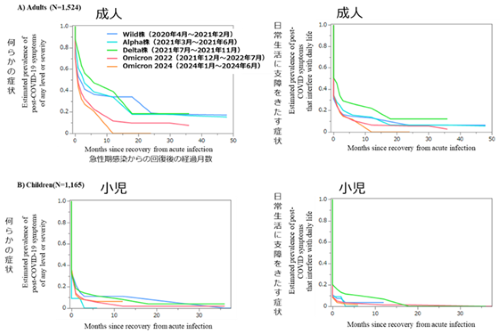
Figure 1. Changes in the prevalence of COVID-19 symptoms (at least one symptom) over time -Analysis by time of infection-
Glossary
*1 The definition of each infection period is based on Hiroshima Prefecture's genome surveillance data.
Wild strain epidemic period (March 2020 to February 2021), Alpha strain epidemic period (March to June 2021), Delta strain epidemic period (July to November 2021), Omicron strain epidemic period -2022 (December 2021 to July 2022), Omicron strain epidemic period -2024 (January to June 2024).
*2 The basic database for this research is reported in the following paper.
Sugiyama A, Takafuta T, Sato T, et al. Natural course of post-COVID symptoms in adults and children.Sci Rep. 2024 Feb 16;14(1):3884. doi: 10.1038/s41598-024-54397-y.
*3 Interval censored survival analysis (Turnbull method) is a statistical method used when it is not possible to determine when symptoms disappeared, but only within a range of 3 to 6 months, rather than the exact date. Because this study collected symptom duration over a range of months, this method was used to estimate the prevalence at each time point.
*4 Cox proportional hazards model is a statistical method that simultaneously considers multiple factors that affect when and how likely a certain event (such as disappearance of symptoms) will occur, and expresses the degree of influence of each factor as a numerical value (hazard ratio). If the hazard ratio is greater than 1, it means that the event is likely to occur, and if it is less than 1, it is unlikely to occur. In this study, we simultaneously considered age, gender, epidemic period, and acute stage severity and used them to estimate factors related to the disappearance of post-infection symptoms and their degree of influence.
- Press release materials (910.32 KB)
- Article publication journal (PLOS ONE)
- Hiroshima University Researcher Guidebook (Lecturer Fumi Sugiyama)
Aya Sugiyama, Lecturer, Epidemiology and Disease Control, Graduate School of Medicine
Tel: 082-257-5162 Fax: 082-257-5164
E-mail: aya-sugiyama*hiroshima-u.ac.jp
(Please replace * with half-width @)