Key points of this research result
- After kidney transplantation, newly generated donor-specific antibodies cause antibody-related rejection reactions and affect the long-term survival of the transplanted kidney.
- ドナー・患者間のHLA適合性および、患者の濾胞性ヘルパーT細胞関連の遺伝学的背景が、ドナー特異的抗体の産生に関連することを明らかにした。
- 本研究成果は、腎移植後の拒絶反応をより正確に予測し、患者ごとに最適な免疫抑制療法を選択する個別化医療につながることが期待される。
overview
A research group led by Professor Hideki Ohdan of the Department of Gastrointestinal and Transplant Surgery at the Hiroshima University Graduate School of Medical Sciences, Dr. Yukitoshi Shidawara, and Dr. Kentaro Ide of the Hiroshima Prefectural Hospital investigated the risk of production of de novo donor-specific antibodies (dnDSA), which newly appear after kidney transplantation, in 210 patients who underwent kidney transplantation at Hiroshima University Hospital. dnDSA causes antibody-related rejection and affects long-term survival of transplanted kidneys.
研究グループは、世界的に広く用いられているドナー・患者間のHLA分子レベルでの適合性解析(HLA molecular mismatch)に加えて、患者の遺伝的変異(一般集団にも広く存在する一塩基多型:SNP)に着目し、抗体産生を補助する濾胞性ヘルパーT細胞(Tfh細胞)関連遺伝子について解析しました。
その結果、ドナー・患者間のHLA適合性だけでなく、患者のTfh細胞関連の遺伝学的背景がdnDSA産生に関連することが明らかとなりました。ドナー側の免疫学的情報と患者側の遺伝学的情報を組み合わせてdnDSA産生リスクを評価した点は、本研究の大きな特徴です。本研究成果は、腎移植後の拒絶反応を予防する免疫抑制療法を実施する上で、dnDSA産生リスク評価の精度向上や、将来的な個別化免疫抑制療法につながることが期待されます。
The results of this research were published in the international academic journal "Frontiers in Immunology."
In addition, this research result was supported by Hiroshima University for publication fees.
Paper information
Paper title: Donor–recipient HLA molecular mismatch and T follicular helper-related genetic variants are associated with dnDSA development after kidney transplantation
Author: Hidetoshi Shidahara, MD, Kentaro Ide, MD, PhD*, Aiko Yamaoka, Yuki Imaoka, MD, PhD, Seiichi Shimizu, MD, PhD, Hiroyuki Tahara, MD, PhD, Masahiro Ohira, MD, PhD, Yuka Tanaka, PhD, Hideki Ohdan, MD, PhD*
DOI: 10.3389/fimmu.2026.1875029
background
De novo donor-specific antibodies (dnDSA), which newly appear after kidney transplantation, cause antibody-related rejection and are known to be an important factor that prevents long-term survival of transplanted kidneys. However, even among patients with similar HLA compatibility, some patients produce dnDSA and others do not, and the factors that determine these differences have not been fully clarified. In recent years, analysis methods that evaluate differences at the HLA molecular level (HLA molecular mismatch) between donor and recipient (the person receiving a kidney transplant) have been attracting attention, but it has not been possible to fully explain the differences in the patient's own immune response.
Contents of research results
In this study, we analyzed 210 patients who underwent kidney transplantation at Hiroshima University Hospital. HLA compatibility between donor and patient was evaluated using three types of analysis methods: HLA-EMMA, PIRCHE-T2, and Eplet mismatch, collectively referred to as HLA molecular mismatch. Additionally, regarding the genetic background related to follicular helper T cells (Tfh cells) that assist in antibody production, we analyzed SNPs in CXCR5 and CTLA4, which are factors involved in the expression of Tfh cells.
As a result, dnDSA production against HLA class II was observed in 20 patients (9.5%) during the follow-up period. Among the three types of HLA molecular mismatch, HLA-EMMA showed the highest prediction performance. It was also revealed that the risk of developing dnDSA was approximately 8 times higher in the high HLA-EMMA group. Additionally, Tfh cell-related genetic background was also an independent risk factor. By combining the two, we demonstrated that the risk of developing dnDSA can be stratified with higher accuracy.
Until now, the importance of HLA molecular mismatch, which is an immunological factor on the donor side, has been recognized, but this study is unique in that it shows that in addition to this, the genetic background related to the patient's own immune response is also important. It has been shown that combining information from both the donor and patient sides may lead to more accurate immunological risk assessment.
Future developments
The risk assessment method presented in this study will need to be verified in an independent population in the future. As verification progresses, it is expected that this will be applied to personalized medicine that more accurately predicts the risk of rejection after kidney transplantation and selects the optimal immunosuppressive therapy for each patient.
Additionally, this study showed that the genetic background associated with Tfh cells is involved in dnDSA production, but the detailed mechanism is still unclear. In the future, it is expected that functional analysis of Tfh cells will lead to elucidation of the onset mechanism of rejection reactions and the search for new preventive methods and therapeutic targets.
Reference materials
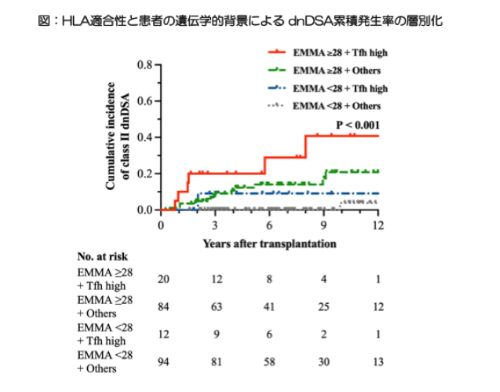
Figure) We classified patients into four groups based on the size of the difference at the HLA molecular level between donors and patients, and the genetic background related to Tfh cells of the patients. The highest rate of donor-specific antibodies (dnDSA) occurred after kidney transplantation in the group with large differences at the HLA molecular level (EMMA≥28) and also in the Tfh cell-related high-risk group (Tfh high). These results demonstrate the possibility of more accurately assessing the risk of developing dnDSA by combining information from the donor and patient sides.
- Press release materials (250.01 KB)
- Publication journal (Frontiers in Immunology)
- Hiroshima University Researcher Guidebook (Professor Hideki Ohdan)
Graduate School of Medical Sciences, Department of Gastrointestinal and Transplant Surgery
Professor Hideki Ohdan
Tel: 082-257-5220 FAX: 082-257-5224
E-mail: hohdan*hiroshima-u.ac.jp
(Please replace * with half-width @)