Key points of this research result
- A significant association was found between regular mealtimes and lower postpartum depression symptoms.
- No relationship was found between skipping breakfast and postpartum depression symptoms.
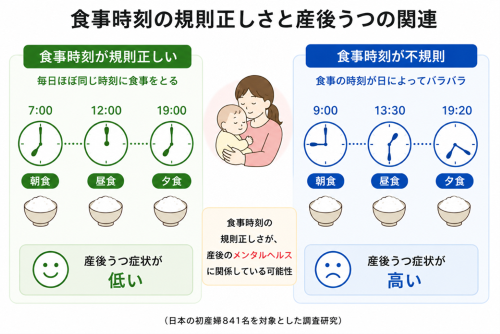
overview
Hiroshima University Graduate School of Medical Sciences, Department of Public Health (Associate Professor Masaru Tahara), in collaboration with Waseda University (Professor Emeritus Shigenobu Shibata) and Combi Co., Ltd. Life Science Division (Headquarters: Taito-ku, Tokyo; President and CEO: Yasuji Matsuura), conducted a study aimed at clarifying the relationship between postpartum mental health and regularity of mealtimes among women in Japan who have their first child between 0 and 12 months old.
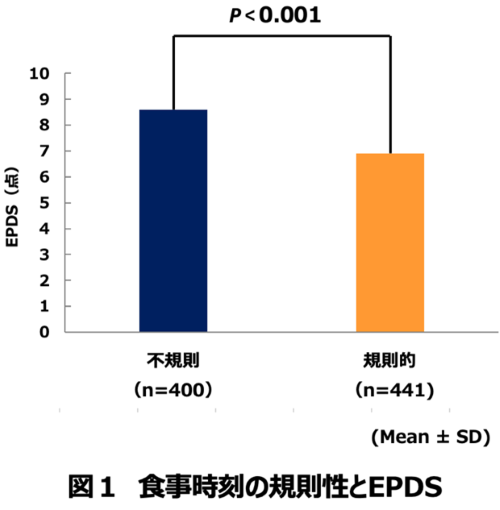
The results of this study revealed that people with regular mealtimes had significantly lower scores on the Edinburgh Postnatal Depression Questionnaire (EPDS) (*1), an indicator of postnatal depression symptoms, than those with irregular meal times. On the other hand, no significant relationship was found between breakfast intake frequency and EPDS score. This study shows that not only the content of meals, but also the perspective of ``when to eat'' may be important when considering postpartum mental health.
(*1) EPDS: The higher the score, the stronger the depressive symptoms.
Published paper
Paper title: Association between mealtime regularity and breakfast frequency with postpartum depression in first-time Japanese mothers: a cross-sectional study
Author: Yu Tahara1, Yuko Makioka2, Yun-Peng Lo1, Tatsuhiko Kubo1, Shigenobu Shibata1, 3
1 広島大学大学院医系科学研究科公衆衛生学、2 コンビ株式会社、3 早稲田大学
Magazine: BMC Pregnancy and Childbirth
DOI番号:https://doi.org/10.1186/s12884-026-09262-3
背景
産後うつは、出産後の女性の約12~17%が経験するとされ、本人の生活の質だけでなく、育児にも影響を及ぼす重要な課題です。しかし、有効な予防・改善方法は十分に確立されていません。
私たちの研究グループは、「いつ食べるか」という食事のタイミングを考える時間栄養学の研究を進めてきました。特に、これまでに一般就労者を対象とした研究で、食事時刻の不規則さが、生活習慣の乱れや睡眠障害とともに、抑うつや不安といったメンタルヘルスの低下と関連することを報告してきました(文献1)。
During the child-rearing period, the rhythm of daily life is likely to be disrupted due to nighttime breastfeeding and caring for the child. Therefore, in this study, we aimed to establish a new approach to supporting health during childcare by clarifying the relationship between postpartum mental health and regularity of meal times.
Contents of research results
日本国内の生後0~12カ月の第一子を持つ女性841人を対象に、匿名のWeb調査を実施しました。産後のメンタルヘルスは、エディンバラ産後うつ病質問票(EPDS)を用いて評価しました。また、自己記入式の質問票で、食事時刻の規則性と朝食の摂取頻度を調べました。分析にあたっては、健康状態や睡眠の特徴、パートナーの勤務日数など、食事以外に影響を及ぼす可能性のある要因を考慮しました。その上で、一般化推定方程式という統計手法を用いて、EPDSスコアと食事習慣との関連を検討しました。
The results confirmed that people who had regular meal times had significantly lower EPDS scores than people who had irregular meal times (Figure 1). Furthermore, the analysis results using generalized estimating equations showed that the regularity of meal times was more closely related to EPDS scores than whether or not breakfast was eaten.
これらの結果から、食事内容だけでなく「食べる時刻」という観点が、産後のメンタルヘルスにおいて新たな行動改善の手がかりとなる可能性が示唆されました。
今後の展開
It is known that the risk of developing postpartum depression is high during the first year after giving birth. This study suggests that adjusting your eating habits may help alleviate this problem. In the future, based on the results of this study, we will further promote initiatives to support the physical and mental health of children during childcare.
研究資金
本研究は、コンビ株式会社及び国立研究開発法人科学技術振興機構(創発的研究支援事業、JPMJFR205G、研究代表者:田原優)による助成を受けて実施されました。
References
(1) Tahara Y, Makino S, Suiko T, Nagamori Y, Iwai T, Aono M, et al. Association between Irregular Meal Timing and the Mental Health of Japanese Workers. Nutrients. 2021;13(8).
- 報道発表資料(343.17 KB)
- Article publication journal (BMC Pregnancy and Childbirth)
- 広島大学研究者ガイドブック (田原 優 准教授)
[Research inquiries]
Hiroshima University Graduate School of Medical Sciences Department of Public Health
准教授 田原 優
Tel: 082-257-5166
E-mail:yutahara*hiroshima-u.ac.jp
【報道に関するお問い合わせ先】
広島大学 広報グループ
TEL:082-424-3701
E-mail:koho*office.hiroshima-u.ac.jp
(Please replace * with half-width @)