1. Key points of research results
・Associate Professor Masahiro Tsujimoto of the Japan Aerospace Exploration Agency (JAXA) and Makoto Uemura of the Hiroshima University Space Science Center The research team led by the associate professor applied Doppler tomography, which investigates the movement of gas three-dimensionally, to the iron fluorescence emission lines (*1, 2) of binary neutron stars observed by the space telescope's X-ray Spectroscopic Imaging Satellite (XRISM), and identified the emission region of the emission line using X-rays for the first time in the world.
・Very massive celestial objects such as black holes and neutron stars sometimes orbit in pairs with ordinary stars (*3). At this time, when the gas from the other star is sucked into a compact celestial body such as a black hole, extremely strong X-rays are generated.
・When a star pairs with an ordinary star to form a binary star system that revolves around each other, the material from the pair of stars falls onto the compact object, creating an extremely bright X-ray source.
・By observing the change in wavelength of the emission line (Doppler shift) (*4) due to this binary star movement for one period, it is possible to represent the invisible flow of gas as an "image", similar to a medical CT scan. This technique is called Doppler tomography.
・Until now, Doppler tomography could not be applied in the X-ray band for a long time due to the performance limitations of observational equipment, but with the advent of the extremely high-performance space telescope "XRISM", this method can now be used in X-rays as well.
・This result shows that X-ray Doppler tomography, which was first realized using the space telescope XRISM, is an effective method for investigating in detail how fast gas moves around black holes and neutron stars.
2.Research content
In the Universe, there are dense objects that have a very large mass concentrated in a very small area, and these objects are called compact objects. Black holes and neutron stars are typical examples. These celestial bodies often form binary star systems in which two stars rotate due to their mutual gravity (Figure 1). In such a binary star system, the compact object's strong gravitational pull pulls gas from the other star and forces it into the center. The flowing gas spreads around the celestial body like a disk, releasing energy as it falls. Therefore, this entire mechanism is observed as a celestial object that emits very bright X-rays. However, this gas flow is so far away that even a telescope cannot directly see it like in a photograph.
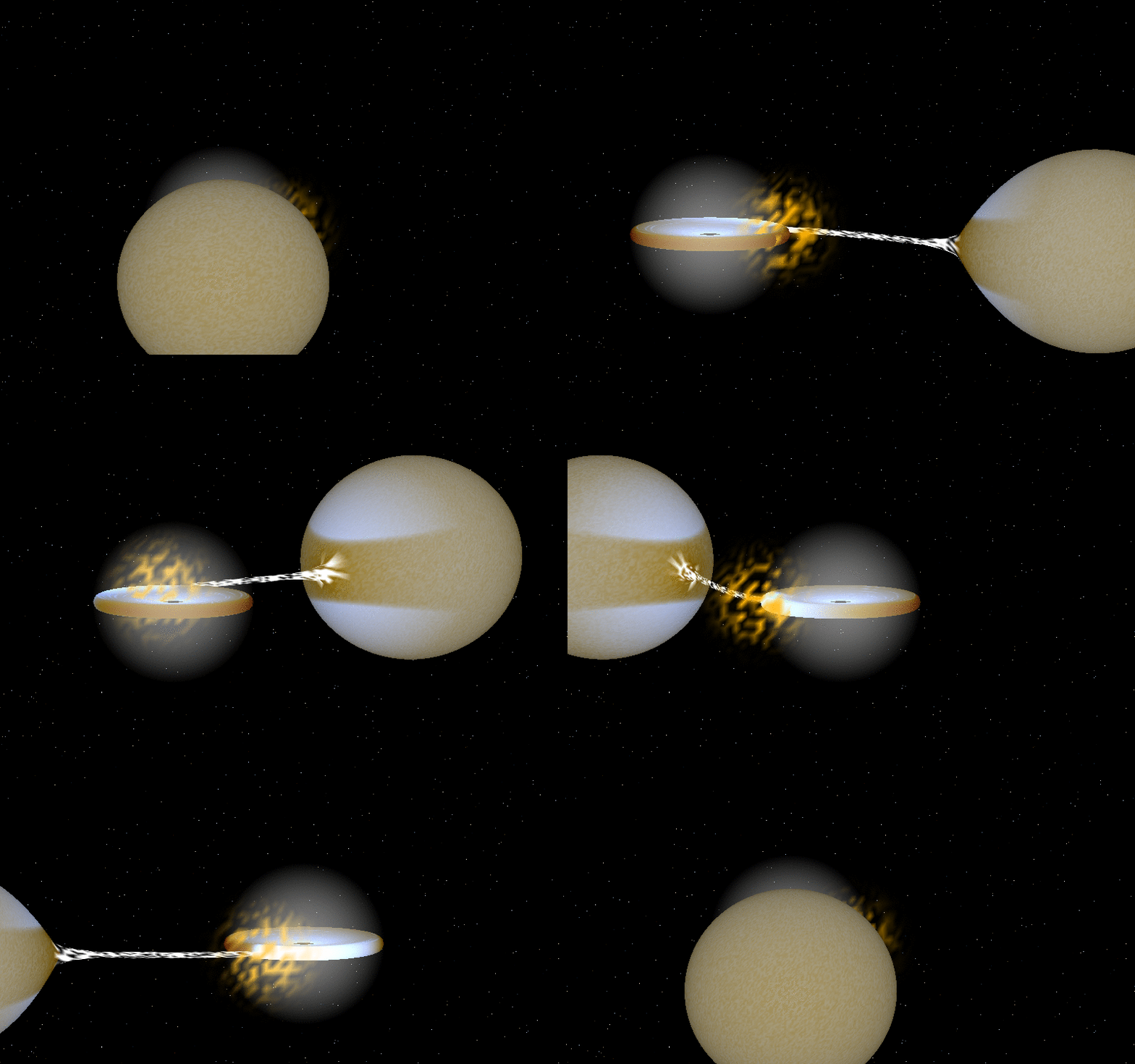
Figure 1: An image of a compact binary star system. Mass flows from one star to the compact object, and a disk and high-temperature material exist around the compact object. (Source: Created by Naoto Samejima, 2nd year master's student, Institute of Space and Astronautical Science, Department of Astronomy, Graduate School of Science, The University of Tokyo, using BinSim)
On the other hand, in a binary star system, not only the celestial body but also the surrounding matter moves in its orbit under the influence of gravity, so the energy of light changes slightly (Doppler shift) according to the movement of the matter. By examining this change over the orbital period of the binary star, we can reveal in which direction and at what speed the radiation from the flowing material is strong, that is, the "velocity distribution" of the material. The fact that matter flowing through a binary star system is observed from various directions is similar to a CT scan, which examines the human body from various directions and creates cross-sectional images of the inside. This technique is called Doppler tomography (Figure 2 left). Doppler tomography is a method that has been established primarily using visible light, but it has long been impossible to achieve this using X-rays because it is difficult to simultaneously obtain a sufficient amount of light and the ability to finely distinguish energy. A document from more than 20 years ago states: Doppler tomography using X-ray Fe lines ... may become possible with the new X-ray satellites. (Halraftis et al. 2001).
Now, with the space telescope XRISM, this dream has finally come true. The X-ray spectrometer onboard the satellite is a precision device that can distinguish speeds approximately 3/100,000 times the speed of light, making it possible to apply Doppler tomography using X-rays. As a result of observing a neutron star binary system named 4U 1822–371 in the constellation Cannabis with XRISM, it was found that the central energy of the iron fluorescence emission line fluctuates periodically as the binary star orbits (Figure 2, right). Using this data, we used Doppler tomography to image the velocity distribution of the material. As a result, we found that the fluorescent X-rays of iron were emitted not from the symmetrical disk or star surface, but from a region where material flowing from the companion star collided with the disk around the compact object and was dispersed above the disk (Figure 3). This is the first result in which we have used X-rays to "image" the flow of matter around a compact celestial body and directly pinpoint the location of the radiation. While visible light Doppler tomography has mainly revealed the flow of relatively low-temperature materials that emit visible light, X-ray Doppler tomography captures intense X-rays near compact celestial bodies and highlights glowing materials. This method is expected to make it possible to investigate in detail how matter flows around black holes and neutron stars, and what kind of structure they have.
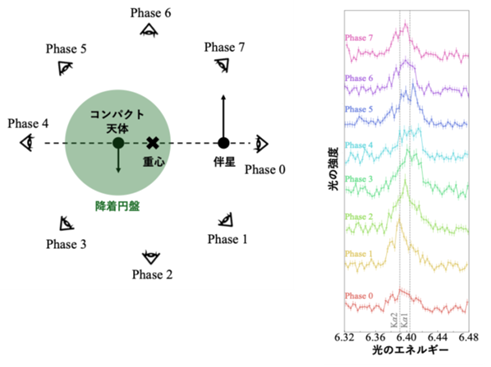
Figure 2: (Left) Conceptual diagram of Doppler tomography. Because the binary star system revolves around its center of gravity, observers can view the system from various angles, much like a medical CT scan, and measure the shift in light energy (Doppler shift) depending on the speed of movement. (Right) Spectra of iron fluorescence lines for each phase of the binary star's orbit observed with XRISM. It can be seen that the central energy of the emission line changes depending on the direction from which the binary star system is viewed (Doppler shift). (Source: Created by Naoto Sameshima, 2nd year master's student, Institute of Space and Astronautical Science, Department of Astronomy, Graduate School of Science, The University of Tokyo, based on Sameshima et al. (2026))
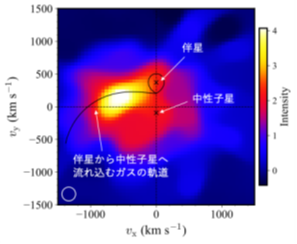
Figure 3: Velocity map of iron fluorescence emission lines obtained by the first X-ray Doppler tomography. Note that the vertical and horizontal axes are speed, and this is a speed map, not a general location map. (Source: Created by Naoto Sameshima, 2nd year master's student, Institute of Space and Astronautical Science, Department of Astronomy, Graduate School of Science, University of Tokyo, based on Sameshima et al. (2026))
This research is a joint research with JAXA.
Glossary
- Emission line: Bright light emitted by atoms or ions at a specific wavelength. It provides clues for investigating the state of matter around celestial bodies.
- Iron fluorescence emission line: An X-ray emission line that is emitted when the electrons inside an iron atom are blown away by X-rays, and then the electrons on the outside fill the empty space inside. It is used to investigate matter around neutron stars and black holes.
- Ordinary star: An ordinary star that does not have any special properties like a black hole or neutron star.
- Doppler shift: A phenomenon in which the observed wavelength (energy) shifts when a celestial body that emits light or a substance that emits emission lines moves toward or away from the observer. This principle is similar to the sound of an ambulance siren, which sounds higher when it approaches and lower when it moves away.
Paper information
● Title: X-ray Doppler tomography of Fe Kα emission line in low-mass X-ray binary 4U1822-371
● Original title: X-ray Doppler tomography of Fe Kα emission in a low-mass X-ray binary 4U1822–371 — a localized reflector at the accretion stream–disk overflow
● Journal: Publications of the Astronomical Society of Japan, psag033,
● DOI: https://doi.org/10.1093/pasj/psag033
- Publications of the Astronomical Society of Japan
- Hiroshima University Researcher Guidebook (Associate Professor Makoto Uemura)
Hiroshima University Space Science Center
Makoto Uemura Associate Professor
Tel: 082-424-3468 Fax: 082-424-0717
e-mail: uemuram*hiroshima-u.ac.jp
Hiroshima University Public Relations Group
Tel: 082-424-4383 FAX: 082-424-6040
e-mail: koho*office.hiroshima-u.ac.jp
(Please replace * with half-width @)