Key points of this research result
- Variants of unknown significance (VUS) detected in large numbers in cancer genome testing(*1)= Genetic changes whose relationship to cancer is not clear" will be analyzed by computer to create a system to prioritize candidates for diagnosis and treatment.
- By clarifying the pathological significance of these VUS through research, it is expected that they will be applied to the selection of more appropriate cancer treatments and the risk assessment of hereditary tumors.
overview
With the spread of cancer genomic testing, pathogenic variants useful for treatment are being identified.(*2)A major issue is that while a large number of variants are detected, many times as many variants of unknown significance (VUS), which are difficult to interpret, are detected.
Teru Nakahara, a specially appointed academic researcher at Hiroshima University Hospital's Department of Medical Genetics, and colleagues are involved in the selection of effective therapeutic drugs such as platinum agents and PARP inhibitors, which are the causative genes of hereditary breast and ovarian cancer (HBOC).BRCA1/2gene(*3)We focused on VUS.
Comprehensive cancer genome profiling (CGP) of 2172 cases at Hiroshima University Hospital (cancer genome medical center hospital) and 12 affiliated facilities(*4)Analyze test results and use computer to predict pathogenicity (in silicoanalysis(*5)) evaluated the impact of each variant on gene function. Based on the results, we constructed an evaluation framework that prioritizes the extraction of candidates that will lead to future functional analysis.
The results of this research were published in the European Journal of Human Genetics (Q1), the official journal of the European Society of Human Genetics, with support from Hiroshima University for article publication fees.
Paper information
Magazine: European Journal of Human Genetics (published March 2, 2026)
Paper title: A Prioritization Framework forBRCA1/2Variants of Uncertain Significance Identified by Comprehensive Genomic Profiling
author:Hikaru Nakahara1, Hiroaki Niitsu1*, Asuka Toshida1, Keisuke Goto2, Masami Yamauchi3, Khilola Saipova1, C. Nelson Hayes4, Nobuyuki Hinata2, Shiro Oka4, Takao Hinoi1
1. Hiroshima University Hospital Genetics Department
2. Department of Urology, Hiroshima University Graduate School of Medical Sciences
3. Prefectural Hiroshima Hospital Clinical Oncology Department
4. Department of Gastroenterology, Hiroshima Graduate School of Medical Sciences
*Corresponding author
DOI: 10.1038/s41431-026-02058-1
background
In recent years, the spread of comprehensive cancer genomic profiling (CGP) has made it possible to comprehensively analyze genomic abnormalities in cancer, and treatment selection based on genomic abnormalities such as genetic variants has become possible for various cancer types.
On the other hand, many of the detected variants are "variants of unknown significance (VUS)," and their clinical significance is unclear, posing major challenges in their interpretation and clinical application. Although VUS is generally not treated as a pathogenic variant, it may actually contain mutations that affect the function of the gene.
BRCA1/2is an important gene that is directly linked to the selection of effective therapeutic drugs such as platinum drugs and PARP inhibitors, and is also the causative gene of hereditary breast and ovarian cancer (HBOC). Evaluation of its pathogenicity is important for determining treatment strategies, diagnosing hereditary tumor syndromes, and analyzing relatives. With the widespread use of CGP, many cases have been reported not only from HBOC-related tumors but also from non-HBOC-related tumors.BRCA1/2While variants are detected, many VUSs are also detected, and interpretation of their pathogenicity is a clinical challenge.
Against this background, this studyBRCA1/2Focusing on genes, we aimed to build a framework to efficiently extract variants that are likely to have clinical significance from VUS and link them to experimental functional analysis.
Contents of research results
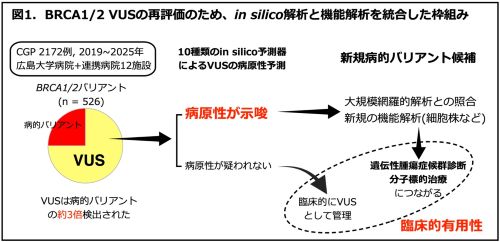
In this study, we analyzed CGP data of 2172 cases conducted at Hiroshima University Hospital and 12 affiliated facilities. the result,BRCA1/2526 variants were identified in the gene, of which 153 were VUS. This shows that VUS is approximately three times more common than pathogenic variants, highlighting the magnitude of the challenge for clinical interpretation.
For these VUS, 10 typesin silicoWe performed an integrated assessment using a pathogenicity prediction tool, prioritized the extraction of variants that may have functional effects, and built a framework for matching with large-scale comprehensive analysis and prioritizing new experimental functional analysis.(Figure 1).
Although this method does not directly determine the pathogenicity of VUS, it is expected that it will lead to re-analysis and re-evaluation of VUS analysis, which prioritizes subjects for future functional analysis and clinical verification. In order to verify the usefulness of this framework,BRCA2We focused on variants predicted to have splicing abnormalities. When we actually conducted a functional analysis of this variant, we found thatin silicoSplicing abnormality as predicted by analysis(*6)has been confirmed(Figure 2).
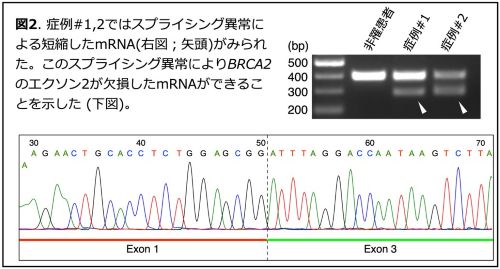
In both cases of this variant, platinum-based anticancer drugs or PARP inhibitors were found to have a high therapeutic effect, and this type of VUS re-evaluation framework is considered to be an example that can lead to actual treatment.
Future developments
We plan to investigate whether the framework for VUS reevaluation developed in this study can be applied to other genetic tumor syndromes and genetic diseases.
Also,in silicoWe will continue our efforts at Hiroshima University Hospital to incorporate analysis into daily cancer genome treatment and improve the accuracy of VUS interpretation.
In the future, clarifying the clinical significance of VUS is expected to lead to expanded treatment options and appropriate surveillance and genetic counseling for hereditary tumors.
Terminology explanation
(*1) Variant of unknown significance (VUS)
Previously, the term "genetic mutation" was used to refer to changes in the base sequence of a gene, but since it does not necessarily cause disease, the term "variant" is now used as a neutral term. Variants whose relationship to disease is unclear are called VUS.
(*2) Pathogenic variant
Among variants, this refers to those that are clearly involved in the onset of the disease.
(*3)BRCA1/2variant
BRCA1/2 has the function of repairing DNA damage. When this function breaks down, genetic damage increases, resulting in the development of cancer.BRCA1/2Pathogenic variants are particularly found in breast cancer, ovarian cancer, pancreatic cancer, and prostate cancer, and are also a criterion for selecting therapeutic agents.
(*4) Comprehensive cancer genome profiling (CGP)
A test that comprehensively analyzes numerous cancer-related genes from cancer tissue and cancer patient plasma.
(*5)in silico
A method of performing simulation and data analysis using a computer
(*6) Splicing abnormality
When making proteins based on genetic information, the parts that serve as templates are joined together one after another. This is called splicing. When this splicing becomes abnormal, a normal template cannot be formed by correct splicing, resulting in the production of proteins that do not have normal functions.
- Press release materials (599.59 KB)
- Publication journal (European Journal of Human Genetics)
- Hiroshima University Researcher Guidebook (Hiroaki Niitsu Specially Appointed Lecturer)
Hiroaki Niitsu, Specially Appointed Lecturer, Department of Genetic Medicine, Hiroshima University Hospital
Tel: 082-257-5965 Fax: 082-257-2019
E-mail: hniitsu*hiroshima-u.ac.jp
(Please replace * with half-width @)