Key points of this research result
- One of the "odor components" (volatile substances) that are naturally released by microorganisms in the soil during their life process.*1It has been revealed that 2,5-dimethylpyrazine (dimethylpyrazine) promotes the growth of Arabidopsis.
- It was discovered that this ingredient promotes the growth of Arabidopsis by increasing its absorption of nitrogen (nitrate and ammonium).
- A new plant growth promoter (biostimulant) that can be used in closed cultivation environments such as greenhouses and plant factories.*2) is expected to lead to the development of
overview
A research group led by Professor Akihiro Ueda, Associate Professor Hisashi Omura, Assistant Professor Mami Nampira, graduate student Theint Thida, graduate student Matias Siueia Junior, and graduate student Jia-cheng Li from the Graduate School of Integrative Life Sciences at Hiroshima University has clarified the mechanism by which microbial volatile organic compounds (mVOCs) released by microorganisms in soil promote the growth of Arabidopsis.
Many microorganisms live around plants and emit various volatile substances (mVOC). However, it was not fully understood which substances stimulate plant growth and why.
The research group conducted a detailed study of the substances commonly released by five types of microorganisms that promote plant growth, and found that a component called 2,5-dimethylpyrazine (2,5-D), a type of mVOC, has the ability to promote the growth of Arabidopsis.
Furthermore, when this substance was applied to plants (2,5-D treatment), in addition to increasing the nitrogen concentration in the above-ground parts of Arabidopsis, the genes that take up nitrate and ammonia became active in the roots, which resulted in an increase in nitrogen and chlorophyll within the plant, promoting growth.
The results of this research were published in the international academic journal "Journal of Experimental Botany."
Paper information
Publication name: Journal of Experimental Botany
Title: Microbial volatile organic compound enhances Arabidopsis growth through activation of nitrate and ammonium transport
Author name: Theint Thida, Mami Nampei, Matias Siueia Junior, Li Jiacheng, Hisashi Omura, Akihiro Ueda
DOI: https://doi.org/10.1093/jxb/erag076
Research support
This research was supported by Japan Society for the Promotion of Science (JSPS) KAKENHI Grant Numbers 23K21254 and 25K02142.
background
Microorganisms that promote plant growth are called plant growth-promoting microorganisms. Plant growth-promoting microorganisms themselves and plant growth-promoting substances released from plant growth-promoting microorganisms are called biostimulants, and are expected to be applied to agriculture.
In this research, we attempted to identify mVOC, which has the ability to promote plant growth, from among the volatile substances (mVOC, microbial volatile organic compounds) emitted by microorganisms, with the aim of developing a new biostimulant that promotes plant growth. We also aimed to clarify the mechanism by which mVOCs, which have the ability to promote plant growth, promote plant growth.
Contents of research results
In order to identify mVOCs that have the ability to promote plant growth, we first co-cultured Arabidopsis and microorganisms in a Petri dish to prevent them from coming into contact with each other, and selected microorganisms that promote Arabidopsis growth (Figure 1). After selecting 70 types of microorganisms, it was found that 5 types of microorganisms promote the growth of Arabidopsis. 16S rDNA analysis revealed that these five types of microorganismsAcinetobactersp. WCHAc060042,Cereibacter sphaeroidesTS,Pseudomonas putidaYH-2,Acinetobacter tjernbergiaeDSM 14971,PseudomonasIt turned out to be sp. CA10.
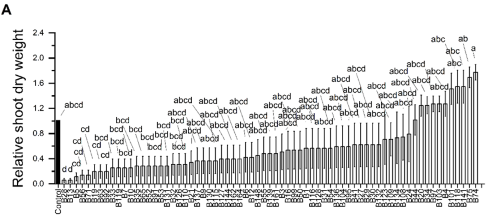
Figure 1 Selection of plant growth promoting microorganisms
Comprehensive analysis of mVOC released from these five types of microorganisms (Volatilome analysis)*3) SPME-GC-MS*4(Solid phase microextraction - gas chromatography mass spectrometry) method detected a total of 172 types of mVOC, of which 7 types of mVOC were found to be commonly emitted by these 5 types of microorganisms. A detailed analysis of these seven mVOCs revealed that 2,5-dimethylpyrazine (2,5-D) contributes to the growth promotion of Arabidopsis.
In order to clarify the growth promotion mechanism of Arabidopsis thaliana possessed by 2,5-D, we conducted a comprehensive analysis of essential elements in the body (Ionome analysis).*5), it was confirmed that there was an increase in the concentration of nitrogen in the aboveground parts, as well as an increase in the concentration of photosynthetic pigments chlorophyll and carotenoids. Furthermore, in order to comprehensively identify gene groups that change during 2,5-D treatment, we conducted RNA sequencing analysis (Transcriptome analysis).*6) and quantitative gene expression analysis using real-time PCR, we found that expression of genes encoding nitrate transporters and ammonia transporters was induced (Figure 2). The above results indicate that 2,5-D promotes the growth of Arabidopsis roots by improving their ability to acquire nitrogen nutrients such as nitrate and ammonia.
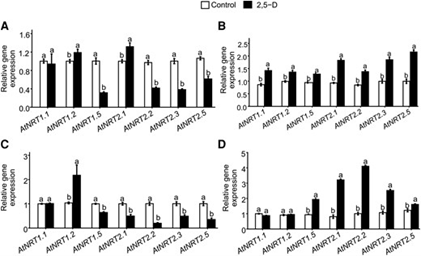
Figure 2 Induction of expression of nitrate transporter gene group after 2,5-D treatment (A: Above ground part 24 hours after treatment, B: Root 24 hours after treatment, C: Above ground part 14 days after treatment, D: Root 14 day after treatment)
Future developments
There are a variety of mVOC species emitted by microorganisms, and some of them still affect plant growth. While investigating the physiological effects of other mVOCs, we hope to develop mVOC-based biostimulants that can be put to practical use in agricultural production sites such as greenhouses and plant factories.
Glossary
(*1) Volatile substances:
A general term for compounds that easily vaporize at room temperature and pressure. Familiar examples include formaldehyde and gasoline.
(*2) Biostimulant:
A general term for microorganisms and compounds that are useful for improving plant growth and stress tolerance. Also called biostimulant.
(*3) Volatilome analysis:
A method to collect and comprehensively identify volatile substances. GC-MS is used.
(*4) SPME-GC-MS:
SPME (solid phase microextraction) is a method that coats the tip of a fiber with a polymer to collect and concentrate various volatile substances. Coatings with different polymers can trap and concentrate different volatile substances. GC-MS is a gas chromatograph-mass spectrometer, which consists of a gas chromatograph that can separate gas components and a mass spectrometer that measures the mass of the separated components. By collecting and concentrating samples using SPME, more substances can be detected by GC-MS analysis.
(*5) Ionome analysis:
A method to comprehensively investigate the concentration of various elements. Inductively coupled plasma emission spectrometers and organic elemental analyzers are used.
(*6) Transcriptome analysis:
A method to comprehensively investigate the expression changes of gene groups within an organism. RNA seq is one such analysis method.
- Press release materials (484.33 KB)
- Journal of Experimental Botany
- Hiroshima University Researcher Guidebook (Professor Akihiro Ueda)
Akihiro Ueda, Professor, Bioresource Science Program, Graduate School of Integrated Life Sciences
Tel: 082-424-7963 FAX: 082-424-7963
E-mail: akiueda*hiroshima-u.ac.jp
(Please replace * with half-width @)