The National Agriculture and Food Research Organization, Hiroshima University, Gunma Prefecture, and Tohoku University have developed a formula to easily estimate methane emissions from dairy cows' gastrointestinal fermentation, using milk composition information, including milk fatty acid composition, that is widely collected from Japanese dairy farmers. This result makes it possible to understand the methane emissions of large numbers of cows at dairy farms, and is expected to lead to the creation of dairy cows with lower methane emissions through genetic improvement.
Methane emissions from gastrointestinal fermentation caused by cow burping are one of the major sources of greenhouse gas emissions in the agricultural sector. Genetic improvement of cattle is currently attracting worldwide attention as a method for reducing methane.
Genetic improvement of methane emissions requires large-scale and continuous collection of data on individual methane emissions. To accurately measure methane emissions from cow burping, a chamber1)special facilities are required. In addition, the sniffer method is a relatively simple evaluation method.2)Although these methods are being popularized mainly by research institutions, they all require exhaled gas analysis. Therefore, in order to collect data on a nationwide scale, there has been a need to develop an estimation method that can be used even by farmers who cannot measure exhaled breath.
Therefore, the Livestock GHG Reduction Consortium, which is represented by the National Agriculture and Food Research Organization (NARO), has determined that the fatty acid composition of milk is3)We focused on the relationship between methane and developed a formula to estimate information on methane from milk composition information, including milk fatty acid composition. Milk composition information is obtained through dairy herd testing, in which more than half of dairy farmers nationwide participate.4)By using the developed estimation formula, it is possible to understand the amount of methane emissions from cows at dairy farming sites. Furthermore, this result is expected to serve as a foundation for the continuous collection of information on methane, with the aim of genetically improving cattle that emit less methane.
Social background of development and history of research
In Japan, the gastrointestinal tract (rumen) of ruminants is5)) Methane derived from fermentation accounts for approximately 27% of greenhouse gas emissions in the agricultural sector (Japan Greenhouse Gas Inventory Report 2025). Methane derived from bovine rumen fermentation is attracting increasing attention as one of the targets for reducing greenhouse gases, and research is being conducted to reduce it using various approaches.
Currently, one method of reducing methane emissions that is attracting attention is the use of improved breeding to genetically create cows that emit less methane. Livestock are a genetically diverse population, and breeding and improvement of livestock focuses on the genetic part of the ability (genetic ability).6)), and by selecting males based on this estimation, we aim to improve the ability of livestock groups. In Canada, methane-related indicators have already been introduced to evaluate the genetic ability of dairy cows, and efforts are being made to create cows that emit less methane. Generally, in dairy cow improvement, the genetic potential of a sire is estimated from records collected from dairy farmers nationwide. Therefore, in order to genetically improve methane, it is necessary to continuously collect a large amount of information on methane in individual cattle, and it is necessary to create an environment where this information can be stably obtained from a large number of farmers.
On the other hand, in livestock production sites, it is not easy to measure methane emissions from cow burps. Generally, the equipment and equipment used to measure methane are expensive, and implementing them does not bring direct economic benefits to farmers. Therefore, it is necessary to develop a technology that can collect methane emissions from farmers without using special measuring equipment.
More than half of the dairy farms in Japan participate in dairy herd certification in Japan, as it leads to improved management through optimization of dairy cattle feeding management and breeding management, and records of milk composition, etc. from participating farms are collected every month. The collected records are also used to estimate the genetic potential of the bulls, and to select highly capable bulls. If methane emissions can be estimated from this record, it will be possible to estimate methane emissions under normal breeding conditions and collect large amounts of methane information continuously without using measurement equipment. Therefore, in this study, we worked to develop a formula that can estimate methane emissions, etc. by utilizing records of milk components (milk composition information) collected in dairy cow herd testing. In particular, we focused on information on fatty acid composition in milk, which has recently begun to be collected in dairy cow herd testing and is believed to be related to fermentation in the rumen, and aimed to improve estimation accuracy. Using the estimation formula developed in this study, it is possible to estimate information regarding methane not only from records that will be collected in the future, but also from past records that have already been accumulated, and it is expected to be possible to evaluate genetic ability regarding methane emissions using a large amount of data at once.
Research content and significance
1. Estimation formula for information on methane
At the Gunma Prefectural Livestock Experiment Station and Hiroshima University, a device for measuring exhaled gas concentration using the sniffer method was attached to a milking robot to measure the methane and carbon dioxide concentrations contained in the exhaled breath of dairy cows during milking. These concentrations obtained using the sniffer method are only part of the information on exhaled breath, so it is not possible to measure methane emissions, etc. Therefore, in addition to the methane concentration and carbon dioxide concentration, the daily methane emissions and methane conversion efficiency can be calculated using Suzuki et al.'s formula (Animal Science Journal, 2021) based on the measured body weight, milk yield, and milk composition information.7)was calculated (here, this value is referred to as the calculated value). Among the records obtained, data for first to third births and milking days of 6 to 305 days were used to create a new estimation formula. We created a formula to estimate daily methane emissions and methane conversion efficiency from body weight, milk yield, and milk composition information other than methane concentration and carbon dioxide concentration, and found that the degree of freedom adjusted coefficient of determination was8)We were able to create four estimating formulas with 0.6 or higher (Table 1).
Comparing the values calculated by the sniffer method and the estimated values using the four developed formulas, we found that the plots were distributed around the dotted line where the calculated and estimated values matched, confirming that both methane emissions and methane conversion efficiency could be estimated without bias from low to high values (Figure 1).
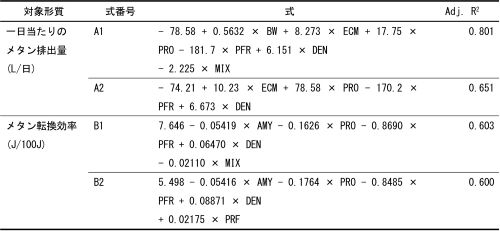
BW: Body weight (kg), ECM: Energy-corrected milk yield (kg/day), AMY: Milk yield (kg/day), PRO: Milk protein rate (%),
PFR: Milk protein percentage/milk fat percentage, DEN: De novo fatty acid percentage in milk fat (%), MIX: Mixed fatty acid percentage in milk fat (%), PRF: Preform fatty acid percentage in milk fat (%), Adj.R2:Determination coefficient adjusted for degrees of freedom
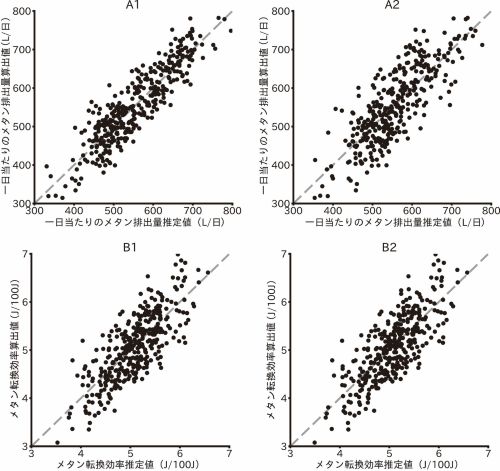
Figure 1 Plot diagram of calculated values and estimated values for each development formula
The gray dotted line is the part where the calculated value and estimated value match.
2. Bias in estimates due to parity and number of days of milking
For the values calculated by the sniffer method and the estimated values by the estimation formula using the fatty acid composition in milk, we calculated the average values for each parity and number of days of milking, and examined whether there were any biases due to conditions. As a result, the formulas for A1, B1, and B2 showed changes in average values that were generally similar to the calculated values, and it was found that there was no bias in the estimated values due to parity or number of days of milking (Figure 2). These formulas are considered to be able to provide unbiased and accurate estimates for first to third births and milking days of 6 to 305 days. On the other hand, formula A2 tends to overestimate during the entire lactation period for first births and early lactation for second births, and tends to underestimate during late lactation for second births and the entire lactation period for third births. This is likely because body weight was not included as a variable in the formula for A2, and changes in food intake and methane emissions accompanying the growth of the cow could not be adequately reflected.
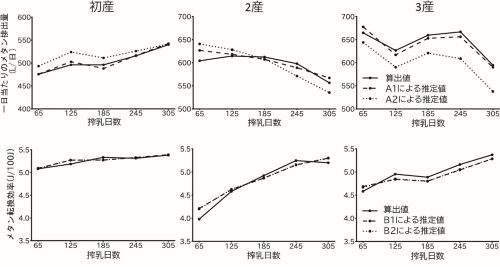
Figure 2 Average values of calculated and estimated values for each parity and number of days of milking
The number of days for milking is classified as follows. 65: 6-65 days, 125: 66-125 days, 185: 126-185 days, 245: 186-245 days, 305: 246-305 days.
3. Estimation formula by birth year when there is no body weight measurement
Body weight is not an item collected on all farms. Therefore, in order to reduce the bias in the estimated value of A2 that was revealed in Figure 2, we created a formula to estimate the amount of methane emissions per day for each production year (Table 2). When we similarly checked the bias using these formulas, we found that the calculated value was closer to the average value estimated by A2 (Figure 3). Based on this, if measurements of body weight are not available, it is thought that using an estimation formula based on birth order will give a more accurate estimate of the amount of methane emissions per day.
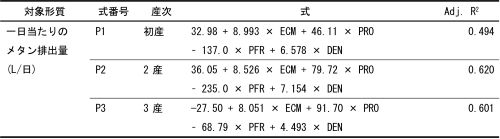
ECM: Energy-corrected milk yield (kg/day), PRO: Milk protein rate (%), PFR: Milk protein rate/milk fat rate,
DEN: De novo fatty acid percentage (%) in milk fat, Adj.R2:Determination coefficient adjusted for degrees of freedom
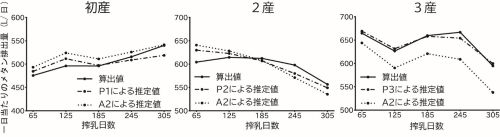
Figure 3 Calculated values for each parity and number of days of milking, and average values of estimated values by parity formula
The classification of milking days is the same as in Figure 2.
Future plans/expectations
In this study, we developed a formula to estimate information on methane using the fatty acid composition in milk, milk yield, etc. This result enables the estimation of information on methane from items normally collected in dairy herd testing, and is expected to contribute to the large-scale and continuous collection of records on methane in order to improve the breeding of cattle that emit less methane. We also believe that by showing farmers methane emissions in numbers, they will be able to get a feel for the methane emissions of cows.
When estimating daily methane emissions, the accuracy is affected by the presence or absence of body weight data, so if body weight can be measured, we recommend using formula (A1) that includes body weight. If weight cannot be measured, it is appropriate to use formulas based on birth date.
Furthermore, since the estimation formula for this result was created based on data from two test farms, it is necessary to consider its applicability at the farm level in the future. Furthermore, since the data is derived from a limited number of farms, the applicability may be poor due to regional differences and other feeding conditions. For this reason, we are currently collecting data on a nationwide scale and working to develop estimation formulas that are more versatile and accurate.
Explanation of terms
1) Chamber
This is a standard method in which cows are placed in a room called a chamber where the inflow and exhaustion of outside air is controlled, and the methane emitted is collected and measured. Methane emissions can be measured with high accuracy, but the disadvantage is that the construction and operation costs of the facility are high.
2) Sniffer method
The sniffer method is one of the techniques for measuring methane. A portion of the exhaled air from a cow is collected and the methane concentration (CH4, ppm), carbon dioxide concentration (CO2, ppm). Because only a portion of exhaled breath can be collected and measured, this method alone cannot directly measure methane emissions. Therefore, in this study, the daily methane emissions and methane conversion efficiency are calculated using the following estimation formula reported by Suzuki et al. (Animal Science Journal, 2021, doi:e13637).
Methane emissions per day (L/day) = - 507 + 0.536×BW + 8.76×ECM + 5,029×CH4/CO2
Methane conversion efficiency (J/100 J) = 2.91 - 0.0498×ECM + 51.0×CH4/CO2
ECM = (AMY × (376×FAT + 209×PRO +948))/3,138
BW: Body weight (kg), ECM: Energy-corrected milk yield (kg/day), AMY: Milk yield (kg/day), PRO: Milk protein rate (%), FAT: Milk protein rate (%)
3) Fatty acid composition in milk
Milk fat contains multiple fatty acids with different numbers of carbons. Fatty acids with 4 to 14 carbon atoms are called de novo fatty acids, which are mainly synthesized through fermentation in the rumen and are derived from roughage. Fatty acids with carbon numbers of 15, 17, 18 or more are called preformed fatty acids and are derived from body fat or concentrated feed. Fatty acids with 16 carbon atoms that do not fall under any of these are called mixed fatty acids (LIAJ News No.187, 2021).
4) Dairy herd certification
Cow herd testing is a project that collects and analyzes monthly milk yield and milk composition records for the cows of participating dairy farms, and returns the results to the dairy farmers to help with feeding management, breeding management, milk quality/hygiene management, and genetic improvement. This is being carried out mainly by the Livestock Breeding Corporation. As of November 2025, 52.4% (5,812) of dairy farms and 59.6% (488,643 cows) of multiparous cows nationwide have joined.
5) Lumen
Of the four stomachs a cow has, the rumen is called the rumen. Ingested feed is broken down by a wide variety of microorganisms within the rumen and used as nutrition for the cow. During the decomposition process, gases such as methane and carbon dioxide are produced and emitted as burps.
6) Genetic ability
It refers to abilities that are inherited from parents to children. Since it is impossible to measure genetic ability, it is estimated statistically from phenotypic values such as body weight, excluding environmental influences.
7) Methane conversion efficiency
This is an indicator that shows the ratio of the amount of energy lost as methane to the total amount of energy ingested by the cow. It shows how much of the ingested energy is used for methane production.
8) Coefficient of determination adjusted for degrees of freedom
This is an index that shows the goodness of fit of an estimation formula called the coefficient of determination, and is an index that has been corrected for an increase in the coefficient of determination due to an increase in the number of variables in the estimation formula. The closer it is to 1, the better the fit.
Published paper
Authors: R. Tatebayashi, A. Nishiura, F. Terada, T. Tomaru, T. Obitsu, Y. Uemoto, T. Suzuki, I. Nonaka, Y. Saito, O. Sasaki,
Title: Prediction of enteric methane related traits using body weight and milk traits containing the ratios of De novo, Mixed, Preformed fatty acids in milk fat in Holsteins (2026)
Published journal: Animal Science Journal 97:e70219
https://doi.org/10.1111/asj.70219
Livestock Research Division, National Agriculture and Food Research Organization
Chief Researcher Osamu Sasaki
Area Director: Saiko Nonaka
Group leader Tomoyuki Suzuki
Cooperation Coordinator: Akiko Nishiura
Researcher Yuriko Saito
Researcher Ryoki Tatebayashi
Fuminori Terada
Hiroshima University Graduate School of Integrated Life Sciences
Professor Tsuyoshi Obisu
Gunma Prefecture Livestock Experiment Station Feed Environment Section
Tomohisa Tomaru
Tohoku University Graduate School of Agriculture
Professor Yoshinobu Uemoto
Budget: Ministry of Agriculture, Forestry and Fisheries commissioned project research “Development of climate change mitigation technology in the agricultural sector (development of climate change mitigation technology in the livestock sector)” JP17935124 and “Technology development for reducing GHG emissions from livestock farming” JPJ011299
Patent pending
- Press release materials (780.59 KB)
- Journal where the article was published (Animal Science Journal)
- Hiroshima University Researcher Guidebook (Professor Taketo Obisu)
Research Promotion Officer: Kazuo Ishii, Director, Livestock Research Division, National Agriculture and Food Research Organization
Researcher: Akiaki Tatebayashi, Researcher, Cattle Precision Management Research Area, Livestock Research Division
Public relations person: Yukie Maruo, External Affairs Team, Research Promotion Office, Research Promotion Department, Livestock Research Division
TEL: 029-838-8292
Press e-mail: sh-koho-nilgs*naro.go.jp
This material is distributed to the Agricultural Policy Club, Agriculture and Forestry Press Association, Agricultural Technology Club, Tsukuba Research City Press Association, Miyagi Prefectural Government Press Association, Education, Culture, Sports, Science and Technology Press Association, Science Press Association, Tohoku Electric Power Press Club, and Gunma Prefecture Tosui Club.
*The National Agriculture and Food Research Organization (NARO) is the communication name (common name) of the National Agriculture and Food Research Organization, a national research and development agency.
We ask that you use the name ``NARO'' as the name of our organization in newspaper, TV, etc. reports.
(Please replace * with half-width @)