Key points of this research result
- Developed machine learning technology (ZENomix) that predicts spatial transcriptome from single-cell measurement data of mutants without supervised data
- ZENomix predicts spatial transcriptomes of mutants with high accuracy
- A novel Nodal-regulated gene was identified using a spatially variable gene screening method using ZENomix.
- By applying it to single-cell measurement data of mutants and diseases, it is expected to have a wide range of applications in biology/disease research.
Research overview
Knowing where and how genes work in the body is important for elucidating the mechanisms of disease and life. In recent years, using a measurement technology called "spatial transcriptomics," it has become possible to comprehensively visualize where genes are active in tissues as a spatial map. This is called a "spatial transcriptome" and has been actively used in biological/disease research in recent years. However, this technology is currently only usable in limited environments due to its high cost and complicated operation.
This time, Assistant Professor Yasuyuki Okochi of Nagoya University Graduate School of Medicine, Professor Naoki Honda (concurrently appointed professor of Graduate School of Integrative Life Sciences, Hiroshima University), Associate Professor Takateru Matsui of the Center for Life Science Research, Nara Institute of Science and Technology, and RIKEN Center for Biosystems Dynamics Research A research group led by team director Takeshi Kondo has developed ZENomix, a new machine learning method that predicts spatial transcriptomes without supervised data from gene expression data measured by single-cell RNA sequencing (RNA-seq).
ZENomix is a Maternal-zygotic oep (MZoep) was shown to accurately predict the spatial transcriptome of mutant zebrafish early developing embryos. Using ZENomix predictions, we also succeeded in discovering eight new genes whose expression is suppressed by Nodal, a signal factor that promotes differentiation into mesendoderm (*1). The predicted spatial expression pattern of the discovered genes isin situThis was consistent with experimental measurements using hybridization methods.
The biggest feature of ZENomix is that it can predict spatial gene expression patterns in tissues with diseases or mutations, just by having spatial data on healthy (wild-type) tissues. There is no need to acquire disease-specific spatial gene expression data. By using ZENomix, it is possible to add a spatial perspective to the huge amount of single-cell RNA-seq data accumulated around the world. ZENomix is expected to be used in the future as a technology that will greatly accelerate the elucidation of disease pathology and research in developmental biology.
The results of this research will be published in the international academic journal “Patterns” on June 12, 2026.
background
Knowing where and how genes work in the body is important for elucidating the mechanisms of disease and life. Gene expression data (*2) is obtained to understand the function of genes. In recent years, using a measurement technology called "spatial transcriptomics," it has become possible to comprehensively visualize where genes are expressed in tissues as a spatial map. This is called a "spatial transcriptome (*3)" and has been actively used in biological/disease research in recent years. However, this technology is currently only usable in limited environments due to its high cost and complicated operation.
On the other hand, by using the single-cell RNA sequencing (RNA-seq) method (*4), it is possible to obtain comprehensive gene expression data for each cell. The single-cell RNA-seq method is used in many laboratories, but during the measurement process it is necessary to disassemble the tissue down to the single cell level, making it impossible to know where in the tissue the measured cells were originally located. Until now, methods have been proposed to reconstruct the spatial transcriptome by assembling single-cell RNA-seq data like a puzzle, but the problem was that in order to apply this method to the spatial transcriptome of a disease or variant, spatial gene expression data of the disease/variant that forms the picture of the puzzle is required.
Research results
In this study, we developed ZENomix, a method that predicts mutant spatial transcriptomes by reconstructing mutant single-cell RNA-seq data without puzzle pictures by using healthy (wild type) spatial expression data as auxiliary data (wild type spatial reference) (Figure 1).
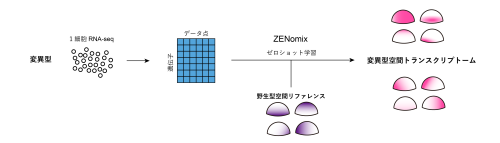
Figure 1: ZENomix overview diagram
ZENomix is based on the simple idea that there must be common spatial information in both wild-type and mutant gene expression data. Based on this idea, by correcting the difference between wild type and mutant gene expression data using machine learning, we transfer the spatial information contained in the wild type data to the mutant data and reconstruct the mutant spatial transcriptome. The research group named this series of calculation processes ZENomix (Figure 2).
First, the research group created simulation data using Alzheimer's disease model mouse olfactory bulb data and verified whether ZENomix could accurately predict variant spatial transcriptomes. We also applied it to human cerebral cortex data and verified that it can be applied to various spatial data.
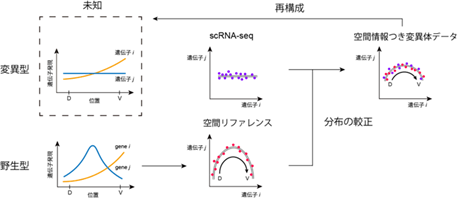
Figure 2: Variant spatial transcriptome prediction mechanism
Next, Maternal-zygotic oep (MZoep) We investigated whether ZENomix could predict the mutant spatial transcriptome using actual single-cell RNA-seq data using mutant (*5) early developing zebrafish embryos (Figure 3A). The predictions made by ZENomix accurately reproduced gene expression changes that were known experimentally in previous studies.
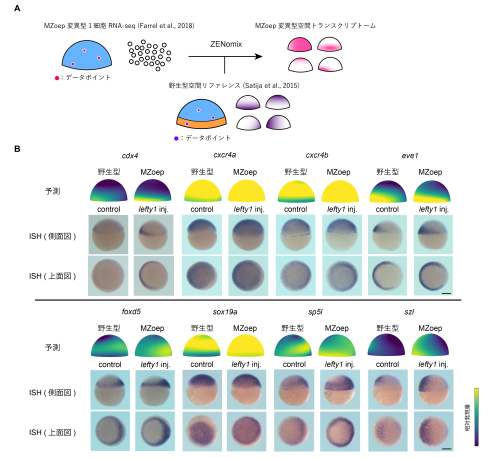
Figure 3: Application of ZENomix to MZoep mutant zebrafish early embryo data
A. Schematic diagram of the experiment. MZoep mutant 1 cell RNA-seq data and wild-type spatial data were used to predict the mutant spatial transcriptome.
B. Eight new genes whose expression is suppressed by Nodal signaling discovered from ZENomix predictions.in situVerification results using the hybridization (ISH) method are shown below the predictions.
MZoep mutants are known to lack Nodal signaling. Therefore, we used the prediction results of ZENomix to screen for genes whose expression is suppressed by Nodal signaling. As a result, 11 previously unknown genes emerged as candidates for genes whose expression is suppressed by Nodal.in situWhen we experimentally verified the spatial expression patterns of these genes using a hybridization method, the expression of 8 out of 11 genes exactly matched our predictions (Figure 3B). This shows that ZENomix can discover novel genes important for diseases and variants.
Future developments
The analysis method ZENomix developed in this study can predict spatial gene expression patterns in tissues with diseases or mutations, as long as there is spatial data from healthy (wild type) tissues. There is no need to acquire disease-specific spatial gene expression data. By using ZENomix, it is possible to add a spatial perspective to the huge amount of single-cell RNA-seq data accumulated around the world. ZENomix is expected to be used in the future as a technology that will greatly accelerate the elucidation of disease pathology and research in developmental biology.
Support/Acknowledgment
This research was conducted with the support of the following research project.
・JST moonshot R&D project goal: By 2050, realize a society that can predict and prevent diseases at an extremely early stage JPMJMS2024-9
・JST CREST JPMJCR25Q2
・AMED Neuroscience Integration Program (Individual Priority Research Project) JP25wm0625322, JP25wm0625210
・JSPS Scientific Research Grant 21H03541, 25K24423, 22H02821, 21K19265
Terminology explanation
*1) Mesendoderm:A group of cells that will produce skeletal muscles and the gastrointestinal tract in the future.
*2) Gene expression data:Data that quantitatively measures how much mRNA of a certain gene is present in cells. By examining the expression level of a gene, it is possible to find out how much that gene is working within a cell.
*3) Spatial transcriptome:Data that is measured by linking gene expression data with spatial information. The location within a tissue is important for a cell's function, and it is possible to investigate how genes function in tissues through cells.
*4) Single-cell RNA sequencing (RNA-seq) method:An experimental technique that comprehensively obtains gene expression data for all genes in each cell. It is possible to investigate gene expression with unprecedented resolution, and its use has expanded rapidly in recent years.
*5) Maternal-zygotic oep (MZoep) Variant:oepA zebrafish mutant in which a gene has been knocked out.oepThe gene is necessary for the transmission of the Nodal signaling pathway, and it is known that Nodal signaling is deleted in MZoep mutants.
Paper information
Magazine name: Patterns
Paper title: Zero-shot reconstruction of mutant spatial transcriptomes
Authors: Yasuyuki Okochi (Nagoya University Graduate School of Medicine), Takateru Matsui (Nara Institute of Science and Technology, Life Science Research Center), Shunta Sakaguchi (Nagoya University Graduate School of Medicine), Takeshi Kondo (RIKEN Biosystems Research Center), Naoki Honda (Nagoya University Graduate School of Medicine, Hiroshima University Graduate School of Integrative Life Sciences, Nagoya University One) Medicine Life-Drug Discovery Co-Creation Platform)
DOI: 10.1016/j.patter.2026.101521
- Press release material (2.11 MB)
- Article publication journal (Patterns)
- Tokai National University Organization HP
- Hiroshima University Researcher Guidebook (Specially Appointed Professor Naoki Honda)
[Researcher contact information]
Nagoya University Graduate School of Medicine Medical Education and Research Support Center
Assistant Professor Yasuyuki Okochi
TEL: 052-744-1980
E-mail: okochi.yasushi.z8*f.mail.nagoya-u.ac.jp
Nara Institute of Science and Technology Graduate School of Advanced Science and Technology
Life Science Research Center (also Bioscience Area, Life System Dynamics Laboratory)
Associate Professor Takaaki Matsui
TEL: 0743-72-5472
E-mail: matsui*bs.naist.jp
RIKEN Center for Biosystems Dynamics Research, Developmental Genome Systems Research Team
Takefumi Kondo
TEL: 078-306-3048
E-mail: takefumi.kondo*riken.jp
[Press contact]
General Affairs Section, General Affairs Division, Nagoya University School of Medicine/Graduate School of Medicine
TEL: 052-744-2228 FAX: 052-744-2785
E-mail: iga-sous*t.mail.nagoya-u.ac.jp
Nara Institute of Science and Technology Planning and General Affairs Division External Relations Planning Section
TEL: 0743-72-5112 FAX: 0743-72-5011
E-mail: s-kikaku*ad.naist.jp
RIKEN Public Relations Department Press Office
TEL: 050-3495-0247
E-mail: ex-press*ml.riken.jp
Hiroshima University Public Relations Group
TEL: 082-424-4383 FAX: 082-424-6040
E-mail: koho*office.hiroshima-u.ac.jp
(Please replace * with half-width @)