Key points of this research result
- Many of the proteins that make up our bodies function properly when small sugar chains called sugar chains are added to them. The ``transporter'' for delivering sugar chains to proteins is a lipid called dolichol (*1), and if dolichol is not produced properly, abnormal protein function occurs, resulting in diseases such as congenital disorders of glycosylation (CDGs) (*2). In recent years, in humans, a new gene involved in dolichol synthesis has been identified.DHRSXThe gene (*3) was identified, and a three-step circuitous pathway for dolichol biosynthesis (*4) was proposed, but it was unclear whether this pathway is conserved in other eukaryotes.
- In this study, we used Saccharomyces cerevisiaeTDA5Gene (*5) is humanDHRSXWe discovered that it has the same function as a gene (it is a functional orthologue (*6)).TDA5In yeast lacking the gene, in addition to being susceptible to tunicamycin (*7), which inhibits glycosylation, abnormal glycosylation of the glycoprotein CPY (carboxypeptidase Y) (*8), accumulation of polyprenol (*9), the precursor of dolichol, and decreased amount of dolichol were confirmed. All these phenotypes are humanDHRSXIt was recovered by gene expression. From these results,TDA5The gene isDHRSXIt was suggested that it has the same function as the gene and is involved in dolichol synthesis.
- This discovery shows that the three-step circuitous pathway for dolichol biosynthesis that was newly proposed in humans in 2024 is conserved in Saccharomyces cerevisiae, and is an achievement that will lead to an understanding of the basic life mechanisms common to eukaryotes.
overview
The research group of Kazuki Hanaoka (3rd year doctoral student), Kuya Matsunaga (2nd year master's student), Soichiro Shimizu (2nd year master's student) of the Graduate School of Integrated Life Sciences, Hiroshima University, Minato Sakai (4th year undergraduate student) of the Faculty of Biological Production, Associate Professor Harald Pichler of Graz University of Technology, and Professor Koichi Funato are working on budding yeast.TDA5is humanDHRSXThey discovered that the genes have the same function, and revealed that the three-step circuitous pathway for dolichol biosynthesis, which was revised in 2024, is also conserved in Saccharomyces cerevisiae.
In this study, we focused on the biosynthesis of dolichol, a lipid necessary for protein glycosylation. Dolichol is an important lipid that supports glycosylation synthesized in the endoplasmic reticulum, and abnormalities in its synthesis cause congenital glycosylation disorders (CDGs) in humans. In 2024, in humansDHRSXwas discovered to be involved in dolichol biosynthesis, and a new three-step circuitous pathway for dolichol biosynthesis was proposed, but it was not known whether this circuitous pathway was evolutionarily derived from humans or whether it is a widely conserved mechanism among eukaryotes.
This research group is conducting research on Saccharomyces cerevisiae.TDA5is humanDHRSXWe found that it has the same function as (it is a functional orthologue).TDA5In yeast lacking CPY, the sensitivity to tunicamycin, an inhibitor of glycosylation, was increased, and in addition to abnormal glycosylation of the glycoprotein CPY, accumulation of polyprenol, the precursor of dolichol, and a decrease in the amount of dolichol were observed. These abnormalities are humanDHRSXofTDA5Since it was recovered by expressing it in defective yeast,TDA5butDHRSXIt was shown that it has the same function as .
The results of this study suggest that the three-step circuitous pathway for dolichol biosynthesis proposed for humans in 2024 is conserved in Saccharomyces cerevisiae. This indicates that the circuitous pathway is not unique to humans, but is a fundamental mechanism widely conserved in eukaryotes. Furthermore, the results of this research indicate the possibility of using yeast as a human disease model or as a model organism for drug screening, and are expected to lead to an understanding of the pathogenesis of congenital glycosylation disorders (CDGs) caused by abnormalities in dolichol biosynthesis and the development of therapeutic drugs.
This research was published in the international scientific journal ``Proceedings of the National Academy of Sciences of the United States of America (PNAS)'' on May 27th.
Paper information
Publication journal name: Proceedings of the National Academy of Sciences of the United States of America (PNAS)
Paper title: The revised three-step detour pathway in dolichol biosynthesis is evolutionarily conserved in budding yeast
Author name: Kazuki Hanaoka†, Kuya Matsunaga†, Souichirou Shimizu, Soshi Sakai, Harald Pichler, Kouichi Funato*
(†Co-lead author)(*Corresponding author)
DOI: https://www.pnas.org/doi/10.1073/pnas.2613147123
background
Dolichol is an essential lipid that supports protein glycosylation in eukaryotic cells including humans, plants, and yeast. Therefore, abnormalities in dolichol biosynthesis cause growth failure in yeast and congenital glycosylation disorders (CDGs) in humans.
Until now, it was thought that dolichol was synthesized from polyprenol through a one-step reduction reaction. This model is the gene responsible for CDGs in humans.SRD5A3(*10) and its yeast orthologDFG10It has been strongly supported by the discovery of (*11) (Cell, 2010). However, in 2024, DHRSX was newly discovered through analysis of human CDGs patients, and a three-step circuitous pathway for dolichol biosynthesis was proposed, converting polyprenol to polyprenal (*12), polyprenal to dolical (*13), and dolicol to dolichol (Cell, 2024). In humans, DHRSX is thought to be responsible for the first and last steps, and SRD5A3 is responsible for the intermediate steps.
However, no factor corresponding to DHRSX has been found in yeast, and it remains unclear whether this three-step circuitous pathway is a special mechanism evolved in humans, or a basic biosynthetic mechanism widely conserved in eukaryotes, including yeast.
Contents of research results
This time, the research group focused on a group of genes in Saccharomyces cerevisiae that encode the same short-chain dehydrogenase (SDR) protein family (*14) as human DHRSX, and searched for yeast factors that correspond to DHRSX. the result,TDA5We found that the deletion strain was highly sensitive to tunicamycin, an inhibitor of glycosylation, and that the glycosylation of the glycoprotein CPY was abnormal. These results areTDA5is involved in dolichol biosynthesis.
next,TDA5is humanDHRSXWe verified that it is a functional ortholog of . Therefore, humansDHRSXthe yeastTDA5When expressed in a defective strain,TDA5The tunicamycin sensitivity and CPY glycosylation abnormality of the defective strain were restored.
In addition, when the amounts of polyprenol and dolichol were measured,TDA5In the defective strain, polyprenols significantly accumulated, and on the contrary, dolichol levels were significantly reduced. These phenotypes alsoDHRSXwas recovered by expression of (Figure 1). From these results,TDA5teethDHRSXSimilarly, it was strongly suggested that it may be involved in the conversion of polyprenol to polyprenal and the conversion of dolical to dolichol.
Additionally, known dolichol biosynthetic factors in yeastDFG10We also analyzed the relationship betweenDFG10teethSRD5A3It is known as the yeast orthologue ofTDA5andDFG10could not compensate for each other's deficiencies. Also,TDA5Deficiency andDFG10In double-deficient strains that combine deletions, stronger glycosylation abnormalities were observed than in single-deficient strains. These results areTDA5andDFG10This suggests that they not only work in the same reaction pathway, but also play different roles in the dolichol biosynthesis pathway.
In light of the above, this study is an important result in demonstrating that the three-step circuitous pathway for dolichol biosynthesis proposed in humans is conserved in Saccharomyces cerevisiae, and that it is a fundamental biological mechanism widely shared by eukaryotes.
Future developments
In this paper,DFG10Dolichol was not completely eliminated even under conditions where it was lost, suggesting that there may be another bypass pathway in yeast in addition to the revised three-step circuitous pathway. Therefore, identifying this unknown bypass pathway and the factors involved will be an important future challenge (Figure 2).
In addition, the yeast findings obtained in this study are expected to lead to a better understanding of the mechanisms of development of related diseases, including human congenital glycosylation disorders (CDGs), and to drug development.
Reference materials
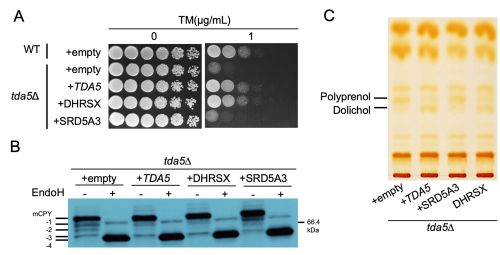
Figure 1.TDA5Tunicamycin sensitivity, CPY glycosylation abnormalities, polyprenol and dolichol abnormalities in the deletion strain are similar to those in humans.DHRSXrecovered by the expression of
TDA5is humanDHRSXIn order to verify whether it is a functional ortholog ofTDA5Defective stock (tda5Yeast on Δ)TDA5, humanDHRSX, humanSRD5A3were expressed, and the sensitivity to the glycosylation inhibitor tunicamycin (TM) (A), the abnormality of CPY glycosylation (B), and the amount of polyprenol and dolichol (C) were investigated. Tunicamycin susceptibility was assessed by spot assay using a serial dilution method. Abnormal glycosylation of CPY is analyzed by Western blotting and observed as immature bands (-1 to -4) detected in a ladder pattern below mature CPY (mCPY). Polyprenol and dolichol contents were evaluated by lipid analysis using thin layer chromatography.TDA5In the defective strain, yeastTDA5or humanDHRSXWhen expressed, tunicamycin sensitivity, abnormal CPY glycosylation, polyprenol accumulation, and decreased dolichol levels were all restored.
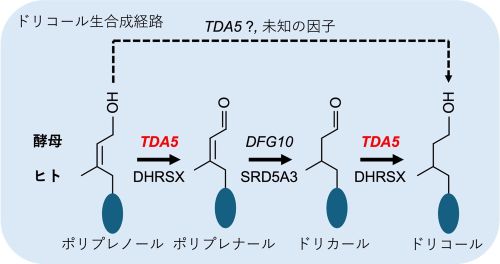
Figure 2. A model for the dolichol biosynthetic bypass pathway in Saccharomyces cerevisiae and humans
In humans, a three-step circuitous pathway for dolichol biosynthesis involving DHRSX and SRD5A3 has been proposed (Cell, 2024). This study was carried out in Saccharomyces cerevisiae.TDA5butDHRSXfunctions as a gene corresponding toDFG10showed that it is involved in a similar circuitous pathway.TDA5may be involved in the conversion of polyprenol to polyprenal and dolical to dolichol. In addition, the existence of a bypass pathway by an unknown factor was suggested in yeast.
Glossary
*1 Dolicall
A long-chain polyisoprenoid lipid present in eukaryotic cells. In the endoplasmic reticulum, it acts as a carrier for sugar chain precursors when adding sugar chains to proteins, and is essential for sugar chain modification.
*2 Congenital Disorders of Glycosylation (CDGs)
A group of congenital diseases caused by abnormalities in genes involved in glycosylation. Glycosylation is necessary for the function of many proteins, so abnormalities can affect various organs throughout the body, including the nervous system, liver, and muscles, causing developmental disorders and multiorgan symptoms. Dolichol biosynthesis abnormality is also one of the causes.
*3DHRSX
A protein that was discovered in 2024 as a factor involved in dolichol biosynthesis through analysis of human patients with congenital glycosylation disorders. It is believed to be responsible for the first and last reaction steps in the revised three-step dolichol biosynthesis pathway.
*4 3-step circuitous pathway for dolichol biosynthesis
A new dolichol biosynthesis pathway proposed in humans. Previously, a one-step reaction from polyprenol to dolichol was considered to be the main pathway, but in this revised route, polyprenol is converted to dolichol via polyprenal, dolichol, and so on.
*5TDA5
A gene present in Saccharomyces cerevisiae. This study showed that it acts as a functional ortholog of human DHRSX and is involved in dolichol biosynthesis.
*6 Ortholog
Genes that are derived from a common ancestral gene and have similar functions between different species. In general, basic functions are conserved even after species diverge during the evolutionary process.
*7 Tunicamycin
A drug that inhibits N-linked glycosylation of proteins. Mutant strains exhibiting defects in dolichol biosynthesis exhibit high sensitivity to tunicamycin.
*8 CPY(Carboxypeptidase Y)
A glycoprotein present in the yeast vacuole. It is widely used as an indicator to investigate abnormalities in glycosylation.
*9 Polyprenol
A long-chain polyisoprenoid lipid that is the starting material for the three-step dolichol biosynthesis. In the three-step circuitous pathway of dolichol biosynthesis, it is converted to dolichol via polyprenol, polyprenal, and dolichol.
*10SRD5A3
It is one of the causative genes of congenital glycosylation disorders, and is thought to be responsible for the conversion of polyprenal to dolikar in the revised three-step detour pathway.
*11DFG10
in Saccharomyces cerevisiaeSRD5A3Ortholog of.
*12 Polyprenal
One of the intermediates in the three-step circuitous pathway of dolichol biosynthesis. Produced when polyprenol is oxidized.
*13 Dorikar
One of the intermediates in the three-step circuitous pathway of dolichol biosynthesis. It is produced from polyprenal and further reduced to dolichol.
*14 One of the short-chain dehydrogenase (SDR) family enzymes responsible for redox reactions. Involved in the conversion of various lipids and metabolites in vivo.DHRSXorTDA5is a gene encoding an enzyme belonging to this family.
- Press release materials (940.02 KB)
- Journal (Proceedings of the National Academy of Sciences of the United States of America (PNAS))
- Hiroshima University Researcher Guidebook (Professor Koichi Funato)
(regarding research)
Food Life Science Program, Graduate School of Integrated Life Sciences, Hiroshima University
Professor Koichi Funato
Tel: 082-424-7923
E-mail: kfunato*hiroshima-u.ac.jp
(Regarding reporting)
Hiroshima University Public Relations Office
E-mail: koho*office.hiroshima-u.ac.jp
(Please replace * with half-width @)