Key points of this research result
1. Using genome editing technology that allows pinpoint editing of genes (DNA) at targeted locations, we succeeded in modifying metabolism to increase the health-related components contained in perilla.
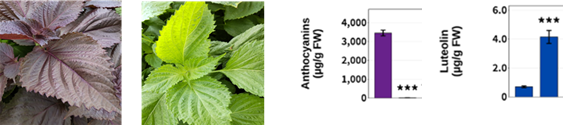
2 The appearance changed from "red" to "green" and the amount of "luteolin", which has anti-inflammatory and antioxidant effects, increased approximately 6 times.
3. It is expected to be put to practical use as a high value-added food and pharmaceutical material.
overview
Hiroshima University (Graduate School of Integrated Life Sciences, Professor Hidemasa Bono), Mishima Foods Co., Ltd., Hiroshima Prefectural Institute of Technology (Agricultural Technology Center) The research group led by Shuji Matsushita (Senior Researcher) has successfully developed a new green perilla strain that has about six times the normal content of luteolin (*2), a health-related component contained in perilla, by using CRISPR-Cas9 (*1), a genome editing technology that allows pinpoint editing of genes (DNA) at targeted locations. This is an innovative result that will dramatically increase the usefulness of perilla, following the "whole genome sequencing of perilla" achieved by this research group in 2023.
Perilla (Perilla frutescens) is a high-value horticultural crop that has been widely cultivated in East Asia since ancient times. In this research, we investigated the enzyme ``flavanone 3-hydroxylase'', which is an important branching point in producing red pigments (anthocyanins).F3H)" (*3) and made pinpoint changes to it through genome editing. As a result, not only did the red pigment disappear from red perilla and it turned bright green, but as a result of changes in the balance of metabolic pathways, the amount of luteolin, which has antioxidant and anti-inflammatory effects, increased approximately six times. Furthermore, an increasing trend was observed in the content of ``rosmarinic acid,'' which has a strong antioxidant effect.
The results of this research are the first in the world to demonstrate the usefulness of "metabolic engineering" to produce the desired components in perilla, which has a complex genome structure (allotetraploid), and will lead to the development of high-value-added varieties in the future.
The genome editing technology used in this research is different from "genetic recombination," which involves introducing foreign genes, and is a technology that modifies some of the genes originally found in perilla.
・Paper title: CRISPR-Cas9 disruption of flavanone 3-hydroxylase produces a green phenotype and alters flavone metabolites in allotetraploid perilla
・Author: Shuji Matsushita, Michiharu Nakano, Suguru Chokyuu, Masaki Kurao, Ayane Fujita, Junko Kimura, Chinatsu Nagata, Takeshi Ishikawa, Keita Tamura, Hidemasa Bono
・Publication magazine name: Frontiers in Plant Science
・DOI number: 10.3389/fpls.2026.1877946
background
Perilla of the Lamiaceae family (Perilla frutescensvarcrispa) is a vegetable and herbal medicine that has been popular in East Asia, including Japan, for a long time. In Japan, ``red perilla'' contains abundant natural pigments anthocyanins that give plants their red, purple, and blue colors, and is used for coloring pickled plums and furikake, etc., and ``green perilla'' is a green perilla that is widely used for sashimi toppings and raw food due to its refreshing aroma and appearance, and each has high commercial value.
More than 400 physiologically active substances (components that are good for health) have been found in perilla, and it has also been used in traditional Chinese medicine to treat colds, gastrointestinal disorders, and anxiety. The main active ingredients are known to include ``luteolin'' and ``rosmarinic acid'' (*4), which have anti-inflammatory and antioxidant effects, and ``perilaldehyde,'' which has a unique scent.
However, because perilla has an extremely difficult to understand genome structure called allotetraploid (a complex genetic structure consisting of two different genomes), it has been technically extremely difficult to increase or decrease only specific useful components through conventional cross-breeding.
In recent years, genome editing technology has attracted attention as an effective method to address these issues. Genome editing technology is being researched, developed, and put into practical use around the world as an innovative technology that dramatically accelerates the improvement of crop varieties compared to conventional cross-breeding.
Contents of research results
Based on red perilla, the research group used genome editing technology to precisely modify the gene for F3H (flavanone 3-hydroxylase), a key enzyme in the anthocyanin synthesis pathway.
1 Dramatic color change from red to green
Perilla with the F3H gene no longer functioning can no longer produce the red pigment anthocyanin, resulting in a dramatic change from red perilla to ``bright green'' perilla (which looks like blue perilla).
2 Significantly improved component profile (luteolin increased approximately 6 times)
Metabolite analysis revealed an approximately 6-fold increase in luteolin content compared to the wild type. Furthermore, there was also a tendency for the accumulation of rosmarinic acid, another useful polyphenol, to increase at the same time.
3 Supported by comprehensive gene expression analysis
When we performed transcriptome analysis to comprehensively examine the functions of all genes in plants, we confirmed that the expression patterns of genes involved in phenylpropanoid and flavonoid synthesis pathways changed in a manner consistent with changes in metabolites.
Future developments
The results of this research have demonstrated that it is possible to accurately control the component switch hidden in perilla, opening up new possibilities for the perilla crop itself. In the future, we will utilize the strain we have developed to further deepen our understanding of the complex functions of perilla. In the future, based on this knowledge, we will conduct research and development to utilize perilla as a high-value-added functional food with enhanced health-related components and as a new naturally derived material for pharmaceuticals.
Glossary
*1 Genome editing technology “CRISPR-Cas9”:
Technology that allows pinpoint editing of just the targeted location of genes (DNA)
*2 Luteolin:
A yellow flavonoid found in plants, a healthy ingredient with antioxidant and anti-inflammatory properties.
*3 Flavanone 3-hydroxylase (F3H)
An enzyme that plays an important role in the anthocyanin synthesis pathway in plants
*4 Rosmarinic acid
A natural polyphenol found in plants of the mint family, which has antioxidant, anti-inflammatory, and allergy-suppressing effects.
- Press release materials (299.06 KB)
- Publication journal (Frontiers in Plant Science)
- Hiroshima University Researcher Guidebook (Professor Hidemasa Bono)
Professor Hidemasa Bono, Graduate School of Integrated Life Sciences
Tel: 082-424-4013
E-mail: bonohu*hiroshima-u.ac.jp
(Please replace * with half-width @)