Liver fibrosis is a common pathological pathway in most chronic liver diseases, and its essence is the excessive deposition of extracellular matrix in the liver. Macrophages play a central regulatory role in the occurrence and regression of liver fibrosis, but their functional selection mechanism between promoting scar formation and driving scar regression has long been unresolved.
Recently, scientific research teams including the Institute of Biophysics of the Chinese Academy of Sciences used single-cell RNA sequencing, spatial transcriptomics, immunofluorescence imaging and other technologies to reveal a new mechanism by which macrophages reverse liver fibrosis.
The study identified a subpopulation of macrophages called Rem2. Unlike profibrotic scar-associated macrophages (SAMs), Rem2 specifically and highly expresses three surface receptors, FCGR4, ITGA4, and ITGAL, which are closely related to phagocytic function. Through single-cell sequencing and spatial transcriptomic analysis, the team found that Rem2 began to appear during the progression stage of liver fibrosis and continued to expand during the regression stage of fibrosis, becoming the highest proportion of macrophage subpopulation in the liver during the regression stage, and its number exceeded SAMs by more than ten times. Spatial localization analysis further showed that Rem2 can specifically accumulate in the fibrotic microenvironment where collagen is deposited, suggesting a direct physical interaction between it and scar tissue.
Mechanistic studies have shown that Rem2 directly recognizes and binds fibronectin through ITGA4, and recognizes collagen I labeled by endogenous IgG2a antibodies through FCGR4, mediating antibody-dependent phagocytic clearance. In vivo functional experiments have confirmed that blocking FCGR4 or ITGA4 receptors during the fibrosis regression phase will delay the regression of fibrosis; while eliminating ITGA4-positive Rem2 cells will hinder scar clearance.
This study proposes a new model of "macrophage receptor-mediated phagocytic clearance of extracellular matrix", which expands the classic understanding that macrophages mainly rely on secreted enzymes to exert pro-resolution functions, and expands macrophage-mediated fibrosis reversal from the "enzymatic" paradigm to a new "phagocytosis" paradigm. This achievement provides a new theoretical framework for understanding the reversal of tissue fibrosis, and also provides potential new targets such as FCGR4 and ITGA4 for the development of anti-fibrosis drugs.
Relevant research results were published in the Proceedings of the National Academy of Sciences (PNAS)上 。研究工作得到国家自然科学基金委员会、科学技术部、中国科学院等的支持。
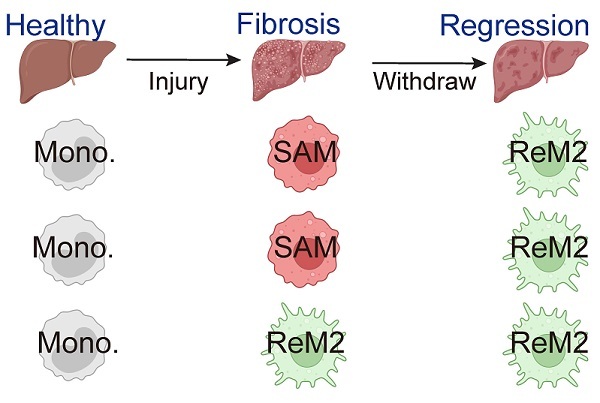
SAM/ReM2群体模型图
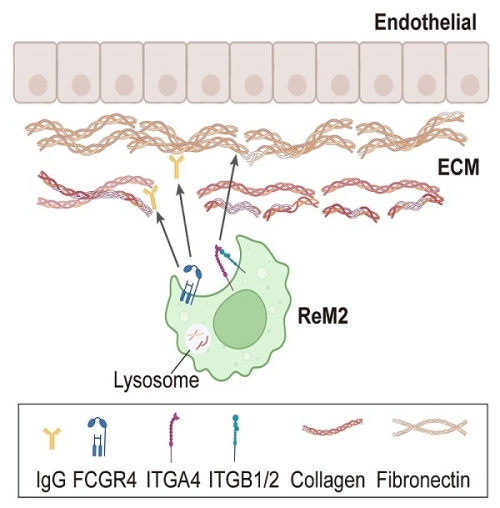
ReM2介导ECM降解的机制图
Source: https://www.cas.cn/syky/202609/t20260901_5119425.shtml