Antiviral natural immunity is a highly conserved immune response mechanism formed by long-term evolution of organisms, and plays a key role in resisting viral invasion. During the process of viral infection, the innate immune system recognizes pathogen-related molecular patterns through pattern recognition receptors, initiates a series of cell signal transduction pathways, activates the key transcription factor IRF3, and then induces the expression of antiviral genes such as interferons and pro-inflammatory cytokines. Therefore, analyzing the regulatory mechanism of antiviral natural immunity in fish and screening and identifying key target genes that affect fish disease resistance traits can provide important molecular targets for the cultivation of new disease-resistant fish varieties. It is one of the important strategies to enhance the antiviral ability of fish and effectively resist viral infection.
The research team of the Institute of Hydrobiology, Chinese Academy of Sciences used multi-omics data to jointly analyze in the early stage and screened out a series of molecular targets that affect fish disease resistance traits, including SET7, PHD2, SIRT3, SIRT5, SMYD3 and other protein post-translational modification enzymes. Lysine methyltransferase SET7 was originally identified as an enzyme that catalyzes histone H3K4 methylation, a modification that is involved in various gene activation processes. Follow-up studies have found that SET7 can also catalyze the methylation modification of a variety of non-histone proteins, thereby regulating various biological processes such as cellular stress response, DNA damage repair, cell proliferation and differentiation.
近日,科研团队发现SET7可抑制抗病毒天然免疫反应,且依赖其甲基转移酶活性。在体实验表明,set7敲除的斑马鱼其抵御鲤春病毒血症病毒和草鱼呼肠孤病毒感染的能力明显增强。团队进一步利用小鼠模型证实了SET7的这一调控模式在脊椎动物中的功能保守性。
Mechanistic studies have shown that SET7 can directly bind to IRF3, a key transcription factor in the anti-viral innate immune pathway, and mediate the monomethylation modification of the 98th lysine residue, thereby inhibiting the phosphorylation and dimerization of IRF3, thereby weakening the expression of anti-viral genes such as interferon, and playing an important role in inhibiting the innate immune response during infection by RNA viruses and DNA viruses.
团队还利用SET7和IRF3双敲除的动物模型,从遗传学层面验证了SET7调控抗病毒天然免疫的作用机制。
相关研究成果发表在《美国科学院院刊》(PNAS)上。研究工作得到国家自然科学基金委员会、科学技术部、中国科学院等的支持。
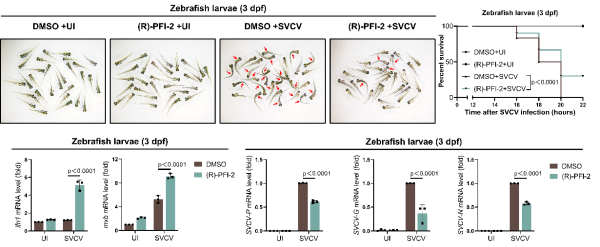
The specific inhibitor of SET7 (R)-PFI-2 significantly enhances the antiviral ability of zebrafish
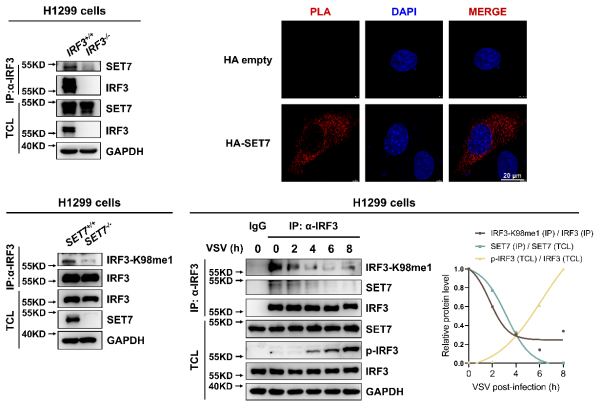
SET7 binds and methylates IRF3
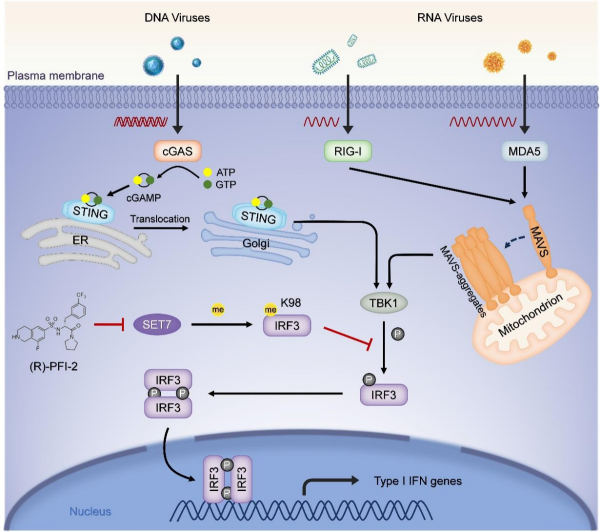
SET7在抗病毒天然免疫应答中的作用模型
Source: https://www.cas.cn/syky/202608/t20260827_5119137.shtml