Lipid nanoparticles (LNP) are important delivery carriers for nucleic acid drugs such as messenger ribonucleic acid (mRNA), and their in vivo delivery behavior is highly dependent on surface interface properties. Polyethylene glycol (PEG) modification can improve the stability of LNPs and facilitate their crossing of biological barriers, but it will weaken the interaction between particles and cells and reduce the efficiency of cellular uptake and intracellular delivery. Since LNPs have different requirements for surface properties during in vivo transport and cell delivery stages, traditional static PEG modification is difficult to take into account, forming a "PEG dilemma" that restricts the improvement of delivery efficiency.
Recently, a scientific research team from the Institute of Chemistry, Chinese Academy of Sciences, based on molecular design, introduced an oxonorbornadiene (OND) linking group with adjustable thermal cracking kinetics between PEG and lipids to construct a series of temperature-responsive PEG lipids. This type of PEG lipid has a stable structure under low-temperature storage conditions and undergoes controllable cleavage at 37°C, driving PEG to gradually fall off the LNP surface. By adjusting the chemical structure of the OND linking group, the study can continuously regulate the PEG shedding kinetics without changing the PEG body and lipid anchoring groups, achieving programmed PEG shedding from fast to slow.
研究发现,PEG脱落速率可适配不同的mRNA递送方式。PEG快速脱落有利于协调肺部吸入给药过程中黏液穿透与后续细胞摄取之间的矛盾,而适中的PEG脱落速率则能够更好地平衡静脉给药后的体内循环、肿瘤富集和后续细胞摄取。
This study provides a solution to the “PEG Dilemma”"It provides new chemical strategies and also provides new ideas for designing delivery systems with specific interfacial dynamics according to different biological barriers.
相关研究成果发表在《美国化学会志》(Journal of the American Chemical Society)superior. The research work is supported by the National Natural Science Foundation of China, the Ministry of Science and Technology, and the Chinese Academy of Sciences.
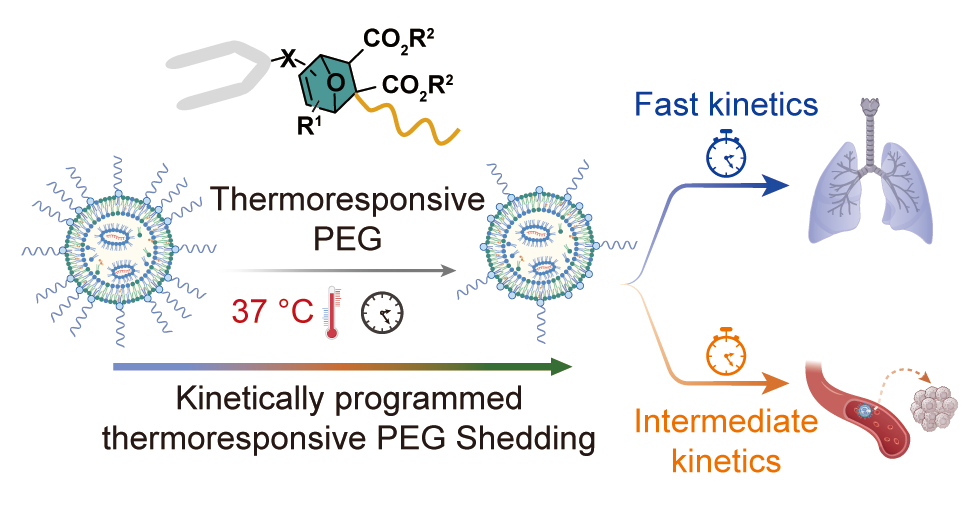
Programmable thermoresponsive PEG shedding strategy to improve lipid nanoparticle-mediated mRNA delivery
Source: https://www.cas.cn/syky/202608/t20260821_5118784.shtml