磁重联普遍发生于日冕、恒星冕、行星磁层、吸积盘及实验室等离子体等磁化等离子体系统,是解析太阳与恒星大气磁能积累和爆发释放的关键物理过程。磁重联导致磁能快速释放,转化为等离子体的动能和热能。目前,二维磁重联过程的认识已较为清楚,三维磁重联仍认知不足。
太阳耀斑是开展三维磁重联观测研究、验证理论模型的典型天体物理爆发现象。耀斑带由磁重联加速产生的高能粒子在低层大气中沉积能量而形成,其精细结构(又称亮核)的动力学演化是诊断日冕电流片中磁重联过程的探针。
近日,中国科学院国家空间科学中心等利用IRIS卫星过去12年超高时间分辨率(1至2秒)的观测数据,发现耀斑带亮核表现出快速“眨眼”过程,即单个亮核发生准周期地明暗变化,周期约为6至24秒。亮核的最短加热时长仅约2至3秒,说明能量仅沉积在耀斑带亮核很小的局地区域,且能量持续注入时长仅有数秒。同时,部分亮核沿耀斑带发生滑动运动,滑动速度为20至1800公里/秒。
In the three-dimensional case, magnetic reconnection exhibits different observational characteristics from two-dimensional magnetic reconnection. The most typical observational characteristic is the apparent sliding motion of the reconnected magnetic field lines. Existing theoretical models believe that the reconnection current sheet generates a large number of small magnetic islands due to tearing mode instability. The formation and merger of the magnetic islands cause magnetic reconnection to have pulse burst characteristics. This study found that the bright core of the flare belt has sliding and "blinking" processes at the same time, revealing that magnetic reconnection has dual properties of magnetic island mediation and three-dimensionality, confirming the theoretical model of three-dimensional pulse burst magnetic reconnection.
相关研究成果发表在《天体物理学杂志》(The Astrophysical Journal)上。研究工作得到国家自然科学基金和中国科学院相关项目等的支持。
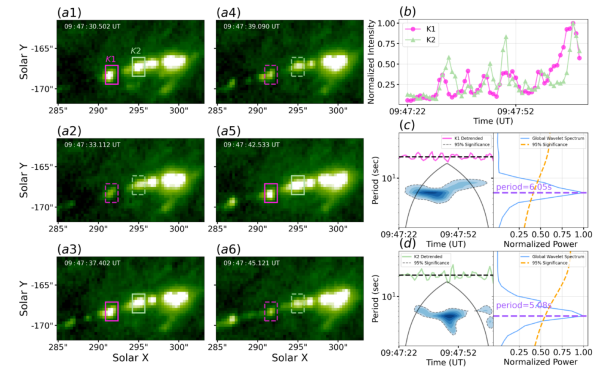
The "blinking" process of the bright core of the flare belt (left) and periodic analysis (right)
Source: https://www.cas.cn/syky/202608/t20260831_5119330.shtml