The first cell fate decision of a fertilized mammalian egg is a core scientific issue in developmental biology and is also relevant to embryo quality assessment in assisted reproduction. Although previous studies have revealed that the two-cell stage non-coding RNA LincGET mediates fate bias, the key protein factors that regulate this process have not yet been identified.
Recently, the Beijing Institute of Genomics, Chinese Academy of Sciences (National Center for Bioinformatics), in collaboration with the Center for Excellence in Molecular Cell Science and other scientific research teams, identified RBBP7, the earliest asymmetric protein to function in the two-cell stage of mammals, and revealed a new mechanism by which it regulates differences in histone modifications through asymmetric translation to determine cell lineage deviation.
The study found that in mouse two-cell embryos, RBBP7, as a core component of the NuRD complex, specifically binds to the deacetylase HDAC1 to mediate H3K9ac deacetylation. When the intracellular RBBP7 protein content is negatively correlated with the H3K9ac modification level, knocking down Rbbp7 will weaken the difference in H3K9ac modification levels between the two cells, and at the same time upregulate the expression of the inner cell mass (ICM) marker gene Sox2, prompting the cells to differentiate toward the inner cell mass fate, explaining that the "RBBP7-HDAC1-H3K9ac" regulatory axis determines the initial fate of the embryo.
The study further showed that although RBBP7 and LincGET show the same distribution direction in cells, they exert opposite regulatory functions.LincGET promotes ICM, while RBBP7 inhibits ICM. They do not regulate the expression of each other.Double knockout or simultaneous overexpression experiments showed that the mutual cancellation of the two functions can effectively reverse the directional shift of cell fate, suggesting that they jointly constitute a key regulatory node for ICM fate determination.This discovery reveals the symmetry-breaking network of RNA-protein cooperative checks and balances, providing a molecular basis for the retention of developmental plasticity in two-cell stage embryos.
To address the problem of analyzing translation heterogeneity in microembryonic samples, single-cell translational sequencing technology has been optimized and developed. At the same time, the team combined with in situ nascent protein tracing experiments and observed at the single-cell level that there was no significant difference in the abundance of Rbbp7 transcripts in the two cells at the late stage of the second cell cycle, but there was a significant imbalance in translation efficiency, which resulted in an asymmetric distribution of RBBP7 protein levels. This result demonstrates that translational regulation is a core factor in early embryonic protein heterogeneity.
This study identified the earliest functional asymmetric protein factor in mammals and expanded the embryonic symmetry breaking mechanism from "transcriptional regulation" to "translational regulation". The single-cell translational genome sequencing technology established in this study has broken through the bottleneck of micro-embryo translation map detection. At the same time, RBBP7 and H3K9ac can be used as embryonic potential markers, providing new tools and theoretical support for assisted reproduction embryo evaluation and analysis of developmental abnormality mechanisms. The sequencing data produced by the research have been integrated into the GSA database of the National Genome Science Data Center.
Relevant research results were published in Cell Discovery (Cell Discovery)superior. The research work is supported by the National Natural Science Foundation of China.
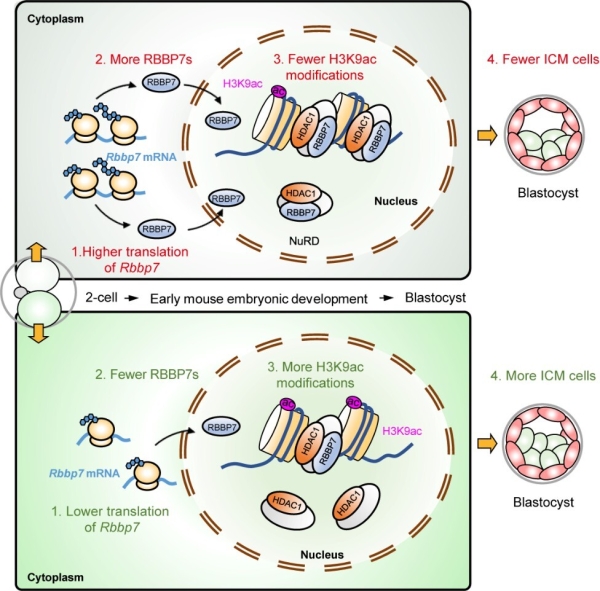
A novel mechanism by which RBBP7 asymmetric translation regulates cell fate decisions in mammalian two-cell embryos
Source: https://www.cas.cn/syky/202608/t20260818_5118521.shtml