催化剂烧结是多相催化过程中常见的失活机制之一。传统烧结理论主要基于表面能降低所带来的焓驱动力,认为金属纳米颗粒在高温下具有自发长大的热力学趋势,而高度分散的单原子和原子簇则难以长期稳定。然而,原位实验观察到金属纳米颗粒在特定反应条件和高温环境下发生再分散,这一现象难以用传统以焓为主导的烧结模型统一解释。如何从基础热力学层面理解纳米颗粒与原子级分散态之间的动态平衡,是认识催化剂高温稳定性及其工作态演化的重要科学问题。
Recently, the Shanghai Institutes for Advanced Study of the Chinese Academy of Sciences, together with scientific research teams such as the Shanghai Institute of Applied Physics, have made progress in research on the stability of entropy-driven atomically dispersed catalysts.
Starting from Gibbs free energy, the research established a new universal thermodynamics and kinetic theoretical framework, analogized the sintering and redispersion of the catalyst to a two-dimensional dissolution process, and derived a universal Gibbs free energy equation that takes into account configuration entropy. Experiments show that with appropriate loading and metal-carrier interaction, temperature rise can drive nanoparticles to redisperse through configuration entropy, achieving a reversible behavior of "cold sintering, hot dispersion".
By introducing the Boltzmann entropy formula, the study derived the Gibbs free energy difference formula including the "sintering term (enthalpy driven)" and the "dispersion term (entropy driven)". The analysis found that when the concentration of surface dispersed atoms is below the critical solubility (Cad), entropic effects reverse the sign of the free energy, making the atomically dispersed state thermodynamically more stable than nanoparticles. Based on this discovery, the team drew a two-dimensional contour phase diagram of Cad as a function of enthalpy change and temperature, clarifying the boundary conditions for entropy-driven dispersion to occur.
Research on PdO/CeO2As the research object, machine learning molecular dynamics simulations were used to intuitively demonstrate the dynamic process of small-sized particles rapidly dissociating into dispersed atoms at 800K (thermal dispersion) and repolymerizing at 600K (cold sintering). Based on the advanced technology of Cs-ESTEM secondary electron imaging, the team2及CO+O2Under the reaction atmosphere, Pd-CeO was captured in real time2The nanoparticles in the system disappear (convert to a highly dispersed state) at 500°C and re-precipitate and grow (cold sintering) at 200°C to 300°C. In-situ APXPS and synchrotron radiation XAFS further provide evidence of the electronic structure at the coordination level, which can eliminate artifacts caused by simple redox and confirm that the process is a purely entropy-driven thermodynamically reversible behavior.
该研究改变了“高温必然导致催化剂烧结”的传统认知,证实存在本征热力学稳定的原子级分散催化剂,且其数量随温度升高而增加。这一成果为理解催化剂动态演化及抗烧结催化剂理性设计提供了新的理论基础,并发展出调控热冲击合成、增大载体比表面积以及引入外场扰动等稳定化策略。
相关研究成果发表在《美国化学会志》(Journal of the American Chemical Societyy) on. The research work is supported by the National Natural Science Foundation of China and the Ministry of Science and Technology.
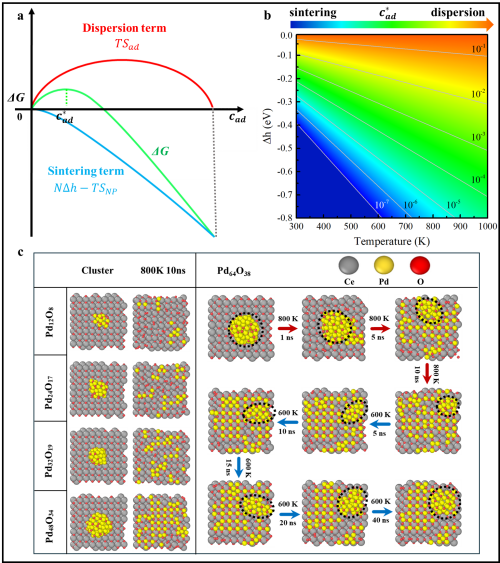
负载纳米颗粒烧结过程中熵效应的理论模型与模拟
Source: https://www.cas.cn/syky/202608/t20260827_5119140.shtml