Key points of this research result
- Probucol was used as a treatment for dyslipidemia (high cholesterol)*1discovered that it has the potential to reduce damage caused by lethal doses of radiation.
- Mice given probucol before exposure to radiation had improved survival rates.
- Probucol is active oxygen produced by radiation.*2It is thought to be effective by suppressing the effects of cancer and protecting bone marrow cells.
- In the future, it is expected that this technology will be applied to radiation accidents and the protection of people working at sites where radiation is handled.
overview
A research group led by Professor Yukihito Higashi of the Hiroshima University Atomic Bomb Radiation Medical Research Institute has discovered that antioxidant*3It has been revealed that the existing drug probucol, which has a chemical effect, increases the survival rate of mice exposed to lethal doses of radiation.
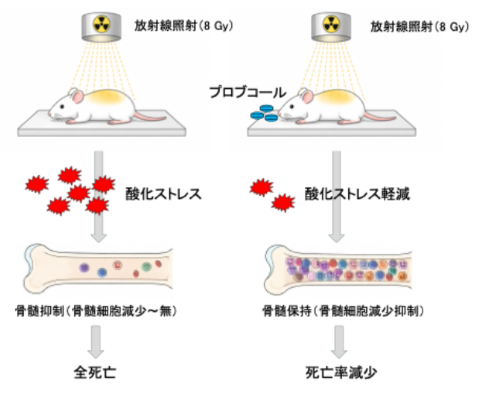
When exposed to radiation, a large amount of active oxygen is generated in the body, damaging DNA and bone marrow cells. In this study, mice given probucol before exposure to radiation suppressed this damage and retained more blood-producing bone marrow cells. In addition, blood production in the spleen became more active, improving survival rates. In the group that did not receive probucol (control group), all mice died within 30 days, while in the group that received probucol before exposure to radiation, about 40% of the mice survived after 30 days.
On the other hand, no improvement in survival was observed when the drug was administered after exposure to radiation. For this reason, probucol is not a drug that treats radiation damage, but rather a "radioprotectant" that protects the body before exposure to radiation.*4” has been shown to have the potential to be useful.
The results of this research were published in the international academic journal "Radiation Research" on June 22nd.
background
Radiation is widely used in the medical field, including cancer treatment, and in the industrial and research fields.
On the other hand, high-dose exposure from nuclear disasters, radiation accidents, or terrorism using radioactive materials can cause serious health problems, sometimes with fatal outcomes. Acute high-dose exposure is known to cause bone marrow death, gastrointestinal tract death, and central nervous system death depending on the exposure dose. In particular, bone marrow damage due to whole-body radiation exposure is one of the major pathological conditions of acute radiation syndrome.
High-dose exposure from whole-body irradiation severely damages hematopoietic stem cells and the bone marrow microenvironment, leading to severe pancytopenia, infection, bleeding tendency, and death.
Currently, treatments for severe radiation injuries center on supportive care such as blood transfusions and infectious disease control, and hematopoietic stem cell transplantation is difficult to widely apply due to issues with adaptation and donor availability.
Therefore, the development of safe and effective radiation protection agents is required.
Contents of research results
Mice were irradiated with a lethal dose of 8 Gy (gray), and probucol was administered to two groups: a pre-administration group in which probucol was administered orally every day for 4 days before irradiation, and a post-administration group in which probucol was administered for 4 days starting 4 hours after irradiation. A significant survival improvement was observed in the probucol-pretreated group compared to the control group. On the other hand, no difference was observed between the post-administration group and the control group. All groups developed severe pancytopenia after irradiation with 8 Gy. There were no significant differences in peripheral blood cell counts between the irradiation groups. In the control group, a significant decrease and hypoplasia of bone marrow cells was observed, whereas in the probucol pre-treated group, bone marrow cells were significantly preserved.
On the other hand, hematopoietic activity outside the bone marrow, which normally produces blood (extramedullary hematopoiesis), decreased due to radiation irradiation, but was significantly higher in the probucol pre-administration group compared to the control group. 8-OHdG, a marker of oxidative stress, significantly increased approximately 1.8 times after irradiation in the control group, but not in the probucol pre-administration group.
Future developments
Probucol is a drug that has been used clinically for many years and its safety has been established, so it may be applicable in the future to protection strategies for radiation workers and during radiation accidents.
Unfortunately, there are currently no safe and effective radioprotective agents, but this study shows the possibility of developing new radioprotective agents by reusing existing drugs, and we look forward to further preclinical research and consideration for clinical application in the future.
Paper information
Magazine: Radiation Research
Paper title: Antioxidant probucol reduces mortality in mice exposed to lethal doses of ionizing radiation.
Author: Tanigawa S, Higashi Y, et al.
DOI:10.1667/RADE-26-00251.1
This research was supported by J-PEAKS (Grant Number JPJS00420230011).
Glossary
*1 Probucol
This drug has been used as a treatment for dyslipidemia (high cholesterol). It is also known to have a strong antioxidant effect that suppresses the action of "active oxygen" that damages cells in the body.
*2 Active oxygen
It is highly reactive oxygen generated within the body. Normally, it works to attack bacteria, etc., but if it grows too much, it can damage DNA and cells. When exposed to radiation, a large amount of active oxygen is generated, which damages body tissues.
*3 Antioxidant effect
It works to prevent damage to cells and DNA by reducing active oxygen and weakening its function.
*4 Radiation protection agent
A drug used before exposure to radiation to reduce damage to the body caused by radiation. This is different from drugs that treat disorders after exposure to radiation.
- Press release materials (410.45 KB)
- Article publication journal (Radiation Research)
- Hiroshima University Researcher Guidebook (Professor Yukihito Higashi)
[Research inquiries]
Yukihito Higashi, Professor, Department of Regenerative Medicine Research and Development, Atomic Bomb Radiation Medical Research Institute
Tel: 082-257-5831 FAX: 082-257-5831
E-mail: yhigashi*hiroshima-u.ac.jp
(Please replace * with half-width @)