An international research team including Specially Appointed Assistant Professor Yoshinobu Sadamoto and Professor Makoto Oguri of the Center for Advanced Science at Chiba University, Professor Akio Inoue of Waseda University, Assistant Professor Takuya Hashimoto of the University of Tsukuba, and Associate Professor Hanae Inami of Hiroshima University are working on the ALMA telescope.Note 1)Using this method, we detected the emission line "[O I] 145㎛ (micrometer)" emitted by neutral oxygen from four objects in the galaxy about 700 to 800 million years after the birth of the universe.Note 2)was successfully detected. This is cold, neutral gas in a typical star-forming galaxy.Note 3)This is the farthest direct signal detected to date. Neutral gas is a direct material of stars, but the James Webb Space Telescope (JWST)Note 4)Because it is difficult to detect with visible and near-infrared telescopes, this observation is unique to ALMA. The results of this research open a new window of observation in elucidating how stars were born and grew in galaxies in the early universe. The results of this research were published in the academic journal Astrophysical Journal on June 15, 2026 (US Eastern Time). (Click here for the paper: 10.3847/1538-4357/ae5bad)
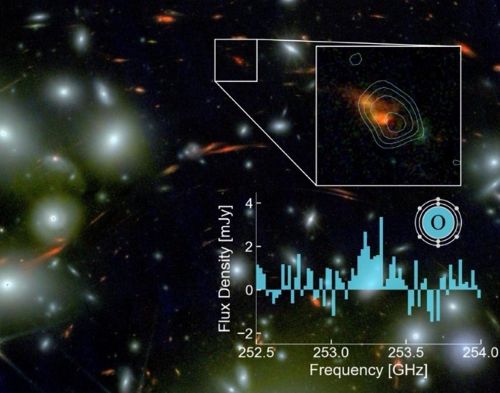
Figure: Galaxy A1689-zD1 (background) existing in the universe approximately 700 million years after the Big Bang, and emission lines (contours and spectra) from neutral oxygen detected by ALMA observations.
Research background
Stars are formed when "neutral gas" consisting of hydrogen atoms and molecules cools and gathers in galaxies, so in order to understand how galaxies are formed in the early universe, it is essential to investigate the properties of neutral gas, which is the direct material of stars. However, with visible and near-infrared telescopes such as JWST, which has achieved results in recent years, ionized gasNote 5)Although we can see stars and stars themselves, we cannot directly capture the cold neutral gas. Observations require radio telescopes such as ALMA, but direct observations of galaxies in the early universe have been extremely rare.
Key points of research results
・Succeeded in direct observation of "star material" from galaxies in the early universe:Using ALMA, we detected the emission line "[O I] 145 μm" from four star-forming galaxies (REBELS-38, A1689-zD1, REBELS-25, REBELS-18) about 700 to 800 million years after the birth of the universe, indicating the presence of neutral gas that is the direct material of stars. Isoemission lines have never been observed in star-forming galaxies in the early Universe, and this is the most distant example of typical star-forming galaxies detected.
・Galaxies in the early universe were sites of star formation that were "rich in star material":Analysis using a combination of multiple emission-line observations revealed that these galaxies contain a high density of neutral gas, similar to that of modern starburst galaxies. Furthermore, by combining this with the oxygen composition ratio measurement results from JWST, we succeeded in directly estimating the neutral gas mass.
・The widely used emission line “[C II] 158 μmNote 6)Confirm the “true identity” of “”:In this study, [N II] 205μm derived from ionized gasNote 7)We also observed emission lines and comparatively analyzed multiple far-infrared emission lines. Another widely observed emission line ([C II] 158 μm) has remained ambiguous as to its main origin, as it can be emitted by both neutral and ionized gases. Through comparison with the current observations, we succeeded in directly verifying for the first time that the radiation is mainly emitted from neutral gas. This opens the door to utilizing the accumulated [C II] observation data in research on neutral gases.
Future prospects
This observation revealed for the first time that neutral oxygen emission lines can be effectively observed even from galaxies in the early Universe. In addition, by confirming that it can be used in research on "star materials," we were able to open a new door to space research. In the future, we would like to conduct observations of more galaxies and clarify the overall picture of star formation in galaxies just after the universe began. In addition, by combining it with other telescopes such as JWST, we hope to be able to observe galaxies from multiple angles and elucidate how galaxies were born and grew from the beginning of the universe to the present day.
Glossary
Note 1) ALMA telescope (ALMA):The world's largest radio telescope was built in the Atacama Desert of Chile, South America, at an altitude of approximately 5,000 meters, and was built with the international cooperation of Japan, Europe, North America, and other countries.
Note 2) [O I] 145㎛:The light emitted by atoms and molecules at a specific wavelength is called an "emission line," and the type and state of the atom or molecule can be determined from that wavelength. [O I] 145㎛refers to the far-infrared emission line emitted by neutral oxygen atoms.
Note 3) Neutral gas:It is a cold gas whose electrons remain bound to the atomic nucleus, and is the direct material of stars.
Note 4) James Webb Space Telescope (JWST):A space telescope jointly developed by NASA and the European and Canadian space agencies. Launched in 2021, it will be able to reveal with high precision the properties of stars and ionized gas in galaxies in the early universe by observing near-infrared to mid-infrared light.
Note 5) Ionized gas:It refers to hot gas whose electrons have been stripped away by the intense ultraviolet light emitted by young, hot stars.
Note 6) [C II] 158㎛:[C II] 158㎛refers to the far-infrared emission line emitted by ionized carbon.
Note 7) [N II] 205μm:Refers to far-infrared emission lines emitted by ionized nitrogen.
Paper information
title:ALMA Observations of [OⅠ]145µm and [NII]205µm Emission lines from Star-Forming Galaxies at z 〜 7
author:Yoshinobu Sapporo, Akio Inoue, Rychard Bouwens, Hanae Inami, Renske Smit, Dan Stark, Manuel Aravena, Andrea Pallottini, Takuya Hashimoto, Masamune Oguri, and 15 others
Magazine name:Astrophysical Journal
DOI:10.3847/1538-4357/ae5bad
About the research project
This research was supported by Grants-in-Aid for Scientific Research (JP22K21349, JP23K13149).
- Press release materials (967.78 KB)
- Article publication journal (Astrophysical Journal)
- Hiroshima University Researcher Guidebook (Associate Professor Hanae Inami)
Chiba University Advanced Science Center Specially Appointed Assistant Professor Yoshinobu Sappomoto
Tel: 043-290-2749 Mail: y.fudamoto [at] chiba-u.jp
Chiba University Public Relations Office
Tel: 043-290-2018 Mail: koho-press [at] chiba-u.jp
Waseda University Public Relations Office
Tel: 03-3202-5454 Mail: koho [at] list.waseda.jp
University of Tsukuba Public Relations Department
Tel: 029-853-2040 Mail: kohositu [at] un.tsukuba.ac.jp
Hiroshima University Public Relations Office
Tel: 082-424-4383 Mail: koho [at] office.hiroshima-u.ac.jp
*Please replace [at] with @.

Chiba University Advanced Science Center
Astrophysics Laboratory