Key points of this research result
① This research group has previously discovered that in the biosynthetic pathway (*1), which is one of the intracellular substance transport routes, recycling endosomes (*3), which play the role of a recycling delivery center, come into contact with the Golgi apparatus (which plays the role of an intracellular delivery center) (*2), and after receiving biosynthesized proteins (cargo), the recycling endosomes leave the Golgi apparatus and transport them to the cell membrane. However, there was no way to observe the detailed process.
② Through genome editing (*4), we have developed a new method that allows drugs to freely manipulate the timing of cargo transport from the Golgi apparatus to recycling endosomes.
③ Using the above cells, we started transporting cargo from the Golgi apparatus to recycling endosomes, and observed it using super-resolution high-speed confocal laser microscopy (SCLIM) (*5). As a result, we discovered that recycling endosomes not only receive cargo from existing recycling endosomes, but also take in cargo while being newly created on the Golgi apparatus.
④ Three-dimensional electron microscopy (*6) revealed that newly born recycling endosomes are formed as bead-like structures containing a clathrin coating (a protein shell that covers and helps transport substances when they are transported within cells) (*7) extending from the Golgi apparatus. This research will deepen our understanding of the mechanism of intracellular protein transport, and is expected to contribute to the elucidation of diseases caused by transport abnormalities and drug discovery research in the future.
overview
The Golgi apparatus is a cellular organelle (*8) necessary for the biosynthesis of secreted proteins such as hormones and digestive enzymes, as well as membrane proteins, and plays a role like a ``distribution center'' that processes and sends out newly created proteins (cargo). On the other hand, recycling endosomes take in membrane proteins taken from the cell membrane through endocytosis (the process by which cells take in extracellular substances) (*9) and return them to the cell membrane. Thus, until now, the two were thought to work separately.
In previous research (Release 1), Professor Akiko Sato's group at the Hiroshima University Graduate School of Integrative Life Sciences and Visiting Principal Researcher Akihiko Nakano at the RIKEN Center for Photon Engineering discovered that recycling endosomes receive proteins (cargo) from the Golgi apparatus and transport them to the cell surface.
In this study, we newly created genome-edited cells in which the timing of transport of cargo from the Golgi apparatus to recycling endosomes can be reversibly controlled with drugs, and as a result of starting transport from the Golgi apparatus to recycling endosomes during microscopic observation, we found that new recycling endosomes were formed while enclosing the cargo in the Golgi region where the cargo is localized.
We also found that the cargo is transferred to the existing recycling endosome by fusion of the newly formed recycling endosome containing the cargo with the existing recycling endosome.
In addition, the research team was joined by senior engineer Kiminori Toyooka of the Research Center for Environmental Resources Science and engineer Makoto Maeda of the Hiroshima University Core Facility Center, and through three-dimensional electron microscopy observations, they discovered that the newly formed recycling endosomes are bead-like structures extending from the Golgi apparatus, and that part of this bead-like structure is coated with clathrin.
The results of this research were published in Nature Communications on July 27th (Monday) at 7:00 pm Japan time.
Paper information
Publication magazine name: Nature Communications
Paper title: Reversible control of post-Golgi transport by brefeldin A reveals recycling endosome maturation during glycosylphosphatidylinositol-anchored protein transport
Author name: Arata Takiguchi1, Ho Tung Shek1, Shogo Sasaki1, Tatsuya Tago1, Taisei Uehara1, Yumi Goto2, Kiminori Toyooka2, Kazuo Kurokawa3, Takuro Tojima4, Akihiko Nakano4,5, Makoto Maeda6, Takunori Satoh1,3#, Akiko K. Satoh1,3#
Affiliation: 1) Hiroshima University Graduate School of Integrated Life Sciences
2) RIKEN Center for Environmental and Resource Science, Technology Infrastructure Division, Mass Spectrometry/Microscope Analysis Unit
3) RIKEN Photonics Research Center Live Cell Super-Resolution Imaging Research Team (at the time of research)
4) RIKEN Photon Engineering Research Center Live Cell Super-Resolution Imaging Research Team (at the time of research, affiliated with the current Image Information Processing Research Team)
5) Tokyo University of Science, Institute for Advanced Research, Graduate School of Advanced Research
6) Hiroshima University Core Facility Center
# Corresponding author: Akiko Sato, Takuji Sato
DOI: 10.1038/s41467-026-75784-1
Posting date and time: July 27th (Monday)
background
The Golgi apparatus is a cellular organelle necessary for the biosynthesis of secretory proteins such as hormones and digestive enzymes, as well as membrane proteins, and plays the role of a ``distribution center'' that processes and sends out newly created proteins (cargo). On the other hand, recycling endosomes take in membrane proteins taken from the cell membrane through endocytosis (the process by which cells take in extracellular substances) and return them to the cell membrane. Until now, these two were thought to work separately.
In previous research (Release 1), Professor Akiko Sato's group at the Hiroshima University Graduate School of Integrative Life Sciences and Visiting Principal Researcher Akihiko Nakano at the RIKEN Center for Photon Engineering discovered that recycling endosomes receive proteins (cargo) from the Golgi apparatus and transport them to the cell surface.
This time, the research team succeeded in creating cells through genome editing that can reversibly control the timing of cargo export from the Golgi apparatus using drugs, and used these cells to closely observe the process of cargo transfer from the Golgi apparatus to recycling endosomes.
Contents of research results
It is widely known that when Brefeldin A (BFA) is administered to mammalian cells, the function of the protein GBF1, which is normally required for the formation of the Golgi apparatus, is inhibited, causing the Golgi apparatus to collapse and being absorbed into the endoplasmic reticulum. On the other hand, this research group has previously revealed that in Drosophila, BFA specifically inhibits Sec71, which is involved in post-Golgi transport, and thus only protein transport from the Golgi is stopped, while the Golgi itself is maintained (Release ②).
Therefore, in this study, by introducing a BFA-resistant mutation into the GBF1 gene of mammalian cells, we created a new cell line that does not disrupt the Golgi apparatus even when BFA is administered, and can selectively inhibit only BIG1/2, the human homolog of Sec71. In these cells, we showed that cargo proteins can be accumulated in the Golgi apparatus by adding BFA, and then cargo export from the Golgi apparatus can be started all at once by removing BFA.
Next, we used these cells to accumulate cargo in the Golgi apparatus and performed live observation using super-resolution high-speed confocal laser microscopy (SCLIM). When BFA was removed during observation to restart transport, we discovered that new recycling endosomes were formed while taking up the cargo in the Golgi region where the cargo is collected.
Furthermore, existing recycling endosomes contacted the Golgi apparatus and received cargo by fusing with these nascent recycling endosomes. Afterwards, recycling endosomes were observed to separate from the Golgi apparatus and transport cargo to the cell membrane while functioning as post-Golgi transport carriers.
In addition, by analyzing the localization and membrane structure of cargo before and after BFA removal using three-dimensional electron microscopy, it was revealed that a bead-shaped membrane structure extends from the Golgi apparatus, and cargo accumulates inside it. Part of this bead-like structure was coated with clathrin, and the localization of the clathrin adapter protein AP-1 was also confirmed.
As a result of generating AP-1-deficient cells and analyzing cargo transport, we found that while formation of new recycling endosomes occurs even in the absence of AP-1, recycling endosomes do not detach from the Golgi apparatus and continue to extend from the Golgi apparatus as elongated tube-like structures.
These results indicate that AP-1 may play a role in promoting the formation of clathrin-coated vesicles at the boundary between the Golgi apparatus and recycling endosomes, separating them. In other words, it has become clear that the separation mechanism mediated by AP-1 is important for newly generated recycling endosomes born in the Golgi apparatus to mature and become independent transport carriers.
Future developments
In this study, we showed that recycling endosomes, a type of endosome that is thought to function in endocytosis, are newly generated from areas of the Golgi where cargo accumulates as cargo is exported from the Golgi apparatus. In the future, we believe it will be important to clarify the mechanism by which recycling endosomes are newly formed from the Golgi apparatus. Additionally, the results of this study demonstrate the need to reconsider the relationship between the Golgi apparatus and endosomes and the definition of endosomes, and we believe it is important to encourage further discussion in the future.
Reference materials
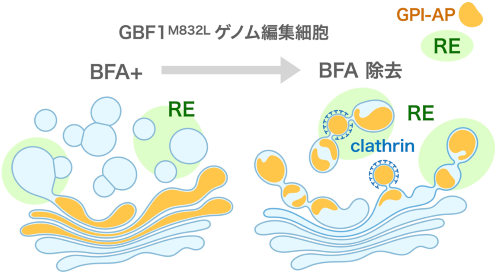
Figure: Genome-edited cells with a BFA-resistant mutation introduced into GBF1, which functions on the cis side of the Golgi apparatus
In these cells, BFA can reversibly inhibit BIG1/2, which functions in the trans-Golgi apparatus. After starting cargo transport from the endoplasmic reticulum and keeping the cargo in the trans-Golgi apparatus using BFA, by removing BFA, transport of the cargo to the RE can be started all at once at any timing. Live imaging using super-resolution microscopy and three-dimensional electron microscopy observation revealed that recycling endosomes are newly formed on the trans side of the Golgi apparatus while enclosing cargo (GPI-AP was used in this paper), and that recycling endosomes are bead-like structures containing a clathrin coat.
Glossary
(*1) Biosynthetic pathway
One of the intracellular substance transport routes. A pathway in which membrane proteins and secretory proteins are synthesized in the endoplasmic reticulum, sent to the Golgi apparatus, and then specifically transported from the Golgi apparatus to the cell membrane and various organelles.
(*2) Golgi apparatus
It is an organelle necessary for the biosynthesis of secretory proteins such as hormones and digestive enzymes, as well as membrane proteins, and receives new proteins from one end (cis face) and exports proteins from the other end (trans face).
(*3) Recycling endosome
A cell organelle that has the role of returning substances taken into cells by endocytosis (phagocytosis and pinocytosis) to the cell membrane.
(*4) Genome editing
A technology that destroys or alters gene function by cutting and modifying DNA sequences at targeted locations.
(*5) Super-resolution confocal live imaging microscopy (SCLIM)
A microscope developed by the RIKEN Photonics Research Center Live Cell Super-Resolution Imaging Research Team (team leader Akihiko Nakano (at the time of the research)). The combination of a cooled image intensifier, a high-speed, high-sensitivity camera, a high-speed piezo, a spinning disk confocal unit, and a three-color spectrometer achieves a high level of both temporal and spatial resolution. It is possible to observe the dynamics of minute organelles and protein molecules that move rapidly within cells.
(*6) 3D electron microscopy observation
A method that uses a computer to reconstruct numerous cross-sectional images obtained with an electron microscope to observe the three-dimensional structure of cells and organelles on a nanometer scale.
(*7) Clathrin coating
A region covered with the coat protein clathrin. Concentrates proteins for transport and is often subsequently isolated as clathrin vesicles. Clathrin vesicles play a role in selecting and transporting specific proteins and lipids within cells.
(*8) Cell organelle
Small structures within cells that each play a specific role to support the cell's life activities. Endoplasmic reticulum, Golgi apparatus, endosomes, mitochondria, etc.
(*9) Endocytosis
A process by which cells take in extracellular substances. Also called phagocytosis and pinocytosis.
Release ①:https://www.hiroshima-u.ac.jp/system/files/155919/20201217_pr03.pdf
Release ②:https://www.hiroshima-u.ac.jp/system/files/155867/20201217_pr02.pdf
- Press release materials (330.85 KB)
- Publication journal (Nature Communications)
- Hiroshima University Researcher Guidebook (Professor Akiko Sato)
Professor Akiko Sato, Graduate School of Integrated Life Sciences, Hiroshima University
TEL: 082-424-6507 FAX: 082-424-0759
E-mail: aksatoh*hiroshima-u.ac.jp
Hiroshima University Public Relations Office
TEL: 082-424-4383
E-mail: koho*office.hiroshima-u.ac.jp
RIKEN Public Relations Department Press Office
TEL: 050-3495-0247
Email: ex-press*ml.riken.jp
(Please replace * with half-width @)