Key points of the presentation
- After the 2016 Kumamoto Earthquake, we confirmed that ``surface aftereffect slip'' occurred in a 5.7km straight section along the fault, where the fault continued to move even after the earthquake, causing displacement on the ground surface. In this section, in addition to the deviation between the foreshock and mainshock of the Kumamoto Earthquake, three deviations occurred, including surface aftershock slip.
- As a result of multiple field surveys, it was revealed that surface aftereffect slip continued for 6 to 7 years after the main shock, and the cumulative displacement since the main shock reached 10 to 40 cm.
- At the southern locations, it was found that the amount of displacement due to surface post-slip was approximately the same as the amount of displacement during the main shock.
- Because surface aftereffect slips can cause further damage to infrastructure that has been repaired after an earthquake, we demonstrated the importance of considering their occurrence and end period in earthquake recovery planning.
overview
A research group led by Lecturer Yoshiya Iwasa of Fukuoka University of Education and Professor Yasuhiro Kumahara of Hiroshima University revealed the temporal changes in surface aftereffect slip that occurred after the 2016 Kumamoto Earthquake through repeated field surveys.
As a result of conducting surveys at seven points along a 5.7 km straight section along the Hinagu Fault, we found that surface aftershock slip has continued for 6 to 7 years since the main shock, and that the cumulative displacement since the main shock has reached 10 to 40 cm. Compared to previous studies, the duration was relatively long and the displacement was comparable. Additionally, in this section, in addition to the deviation between the foreshock and main shock of the Kumamoto Earthquake, three deviations occurred, including surface aftershock slip.
Surface aftereffect slips that continue for several years can reintroduce damage to surface and underground infrastructure that has been repaired after an earthquake. Therefore, when making post-earthquake recovery plans, it is considered essential to confirm whether surface aftereffect slip is occurring and to estimate when it will end.
background
In relatively large earthquakes caused by inland active faults, the fault may appear on the earth's surface, and this is called a surface earthquake fault. However, this deformation of the earth's surface does not necessarily end only at the time of an earthquake. Even after an earthquake, a phenomenon called "surface aftereffect slip" may occur along surface earthquake faults.
Surface aftereffect slips can last for several years and cause displacements of tens of centimeters. Understanding the temporal evolution of surface post-slip is critical for effective post-earthquake recovery, as this can lead to re-damage of structures that have been damaged in an earthquake and subsequently repaired.
Many earthquakes involving surface earthquake faults occur in Japan, but with the exception of the 2016 Kumamoto Earthquake, there have been very few cases in which surface aftereffect slip has been confirmed. Additionally, there are only a few cases in the world where quantitative displacement on the ground surface has been directly and continuously captured.
results
A total of six field surveys were conducted from March 2020 to September 2023. We repeatedly measured linear structures such as road white lines and block walls using a surveying device called a total station to capture changes in the structure's displacement over time.
As a result, surface post-slip such as cracks and right-lateral strike-slip displacements were confirmed at seven locations directly above the surface earthquake fault in a 5.7km straight section of the northern Hinagu fault (Figure 1). It was revealed that at points 2, 6, and 7, displacements of 5 to 9 cm had accumulated between 2017, when the linear structures were repaired, and September 2023 (Figures 2 and 3). In this section, surface earthquake faults have occurred in conjunction with the foreshocks and mainshocks of the Kumamoto Earthquake, and this means that three slips have occurred, including surface aftershocks.
Surface aftereffect slip is thought to be greatest immediately after the main shock. In order to estimate the amount of displacement due to surface post-slip immediately after the main shock, we measured the linear structures that recorded the displacement during the main shock and compared them with the amount of displacement measured immediately after the main shock. The measured data revealed that surface aftereffect slip continued for 6 to 7 years after the main shock, and the cumulative displacement amounted to 10 to 40 cm.
In addition, it was found that at points in the southern part of the fault (points where the amount of displacement during the main shock was small), the ratio of surface post-slip was large compared to the amount of displacement during the main shock, and in some points the amount of displacement was almost equal to the amount of displacement during the main shock. It has also been suggested that in trench excavation surveys and topographic surveys to investigate past earthquakes, it may be difficult to distinguish between displacement during the main shock and displacement due to post-earthquake surface slip.
The amount of displacement is decreasing logarithmically, and no new displacement was confirmed in the latest field survey in February 2025, so it is thought that the aftereffect slip has almost stopped.
Future prospects
This research shows that immediately after an earthquake caused by an inland active fault occurs, there is a risk that structures and infrastructure that have been repaired after the earthquake will be damaged again due to surface aftereffect slip that continues for several years.
In particular, since repairing important underground infrastructure such as water and gas requires a great deal of time and cost, we believe that it is essential to consider the effects of surface aftereffect slip when restoring infrastructure that crosses faults. It is hoped that this information will be useful in formulating countermeasures for infrastructure restoration after future earthquakes caused by inland active faults, such as adopting flexible structures that can withstand displacements of several tens of centimeters, or carrying out full-scale restoration after confirming that displacement has completely ceased.
attached file
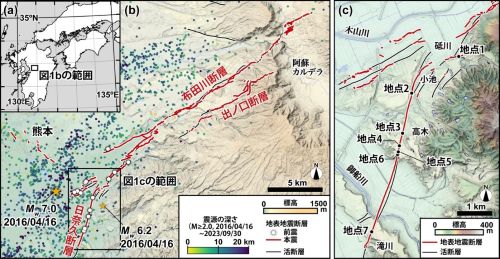
Figure 1 Points where surface post-slip was confirmed
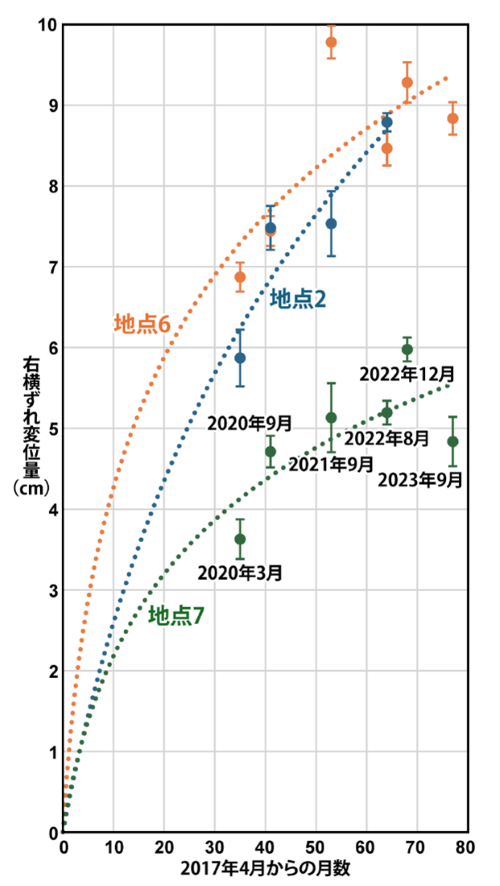
Figure 2 Time-series change in surface post-slip displacement
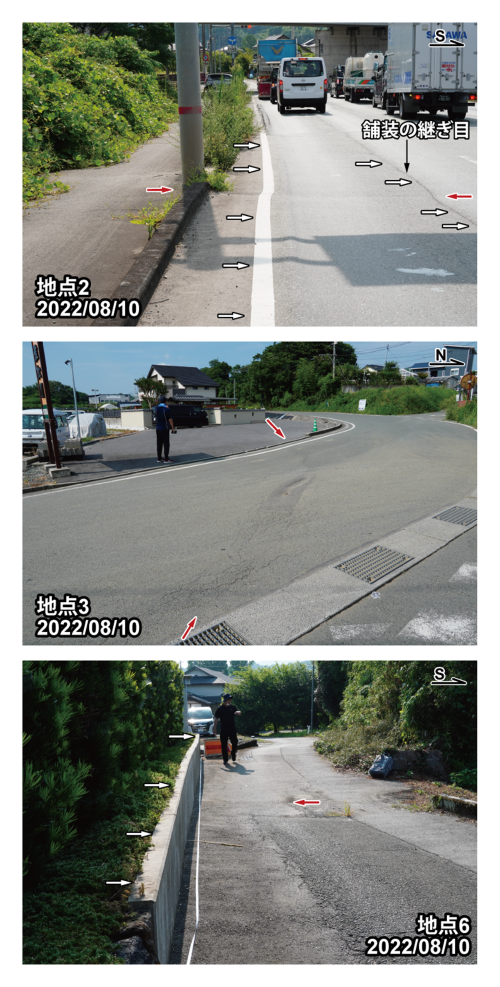
Figure 3 Surface aftereffect slip
At point 2, the joint between the white line and the pavement is undergoing right-lateral displacement. At point 3, the repair marks that were used to fill in the potholes in the road are even more depressed. At point 6, the block wall is undergoing right-lateral displacement. In both locations, displacement occurs at the locations where surface earthquake faults have occurred.
Paper information
Title: Temporal changes in surface afterslip along the 2016 Kumamoto earthquake rupture revealed by repeated field surveys
Author: Yoshiya Iwasa*, Yasuhiro Kumahara, Yuya Sumitani and Yuichiro Tabuchi
(* indicates corresponding author)
Author affiliation: Yoshiya Iwasa (Faculty of Education, Fukuoka University of Education), Yasuhiro Kumahara (Graduate School of Human and Social Sciences, Hiroshima University), Yuya Sumiya, Yuichiro Tabuchi (formerly Graduate School of Human and Social Sciences, Hiroshima University)
Magazine: Seismica
DOI: https://doi.org/10.26443/seismica.v5i1.2144
Acknowledgment
We would like to thank Mr. Fumitaka Sakamoto for his great cooperation in conducting the field survey for this research. I would like to thank you for writing this down. This research was supported by JSPS Scientific Research Grants (JP18H03601, JP20J22288, JP23K18735) and Fukada Field Research Grant.
- Press release material (1.78 MB)
- Article publication journal (Seismica)
- Hiroshima University Researcher Guidebook (Professor Yasuhiro Kumahara)
Fukuoka University of Education Faculty of Education Lecturer Yoshiya Iwasa
TEL: 0940-35-1299
Email: iwasa-y*fukuoka-edu.ac.jp
Yasuhiro Kumahara, Professor, Graduate School of Human and Social Sciences, Hiroshima University
Email: kumakuma*hiroshima-u.ac.jp
Fukuoka University of Education Management Policy Division
TEL: 0940-35-1205
Email: kouhou*fukuoka-edu.ac.jp
Hiroshima University Public Relations Office
TEL: 082-424-4518
Email: koho*office.hiroshima-u.ac.jp
(Please replace * with half-width @)