Key points of this research result
- For the first time, we have clarified that the hardness of oleogel*2, which is made from sunflower wax*1, a plant-derived ingredient that can harden oil in small amounts, is determined by variations in the lamellar period (interval of repeated layers)*3 within the crystal.
- We demonstrated that by changing the cooling and mixing methods during production, we can adjust the arrangement of these crystals and freely control the hardness and elasticity.
- This makes it possible to create texture designs for healthy and delicious alternative fats and oils that contain less saturated fatty acids, which are often found in butter and other foods.
overview
Haruna Mikami (then 2nd year master's student), Graduate School of Integrated Life Sciences, Hiroshima University, Associate Professor Haruhiko Koizumi, Professor Satoshi Ueno, Hiroshi Sekiguchi, High Brightness Photon Science Research Center (JASRI) A joint research group led by the principal researcher has clarified the physical mechanism that determines the hardness of oleogel formation, which turns vegetable oil into a solid using ``sunflower wax,'' which is attracting attention as a low-cost, healthy, and clean-label food material.
Oleogel, a solid form of vegetable oil, is expected to be used as an alternative oil to reduce the excessive intake of saturated fatty acids, which are often found in foods such as butter. Among them, sunflower wax has an excellent ability to firmly solidify oil with the addition of a small amount and can form a mechanically stable network, making it an easy-to-use and highly practical food material.
Through analysis using X-rays from a large synchrotron radiation facility (SPring-8 (BL40XU), Photon Factory), the research group discovered that two structures with slightly different periods coexist within the crystal supporting the oleogel. We found that the ratio of these two structures changes depending on the manufacturing process, and that this is directly linked to the hardness of the final oleogel. In particular, using SPring-8's powerful X-rays, we confirmed that this structural shift occurs from the very early stages of crystallization. This result provides theoretical support for food manufacturing, which has been done empirically to date, and accelerates the development of healthy foods with ideal texture.
The results of this research were published in the international academic journal "Food Chemistry" on June 17, 2026, Japan time.
background
Currently, in the food industry, research is progressing around the world on ``oleogel,'' which is a solid structure made from liquid vegetable oil, as an alternative to animal fats and oils that contain high amounts of saturated and trans fatty acids, which are concerned about their negative effects on health. Among these, plant-based waxes such as sunflower wax (SFW) are highly valued for their practicality as healthy alternative fats and oils because they are easy to obtain at low cost and can strongly retain oil with the addition of a small amount.
Until now, it has been known that the "cooling rate" during manufacturing affects the hardness (storage modulus) of the gel, and it has been reported that slowing the cooling makes the gel softer. However, the ``crystallographic causes'' of why the crystal network structure changes and the hardness changes remained unknown. In particular, the challenge was to clarify how not only the size of the crystal, but also the ``strain*4'' inside the crystal and the distribution of the ``lamellar period,'' in which molecules overlap in layers, are related to macroscopic texture.
Contents of research results
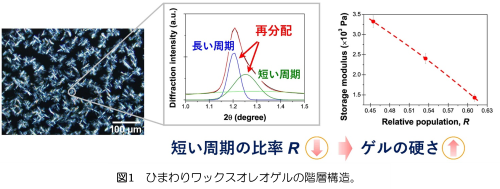
In this research, by using powerful synchrotron radiation X-ray diffraction (SAXD/WAXD) measurements*5, we found that inside the gel derived from sunflower wax, we found "long periods" in which the arrangement of molecules is the same (no polymorphic change), but the repeating interval of the layered structure (lamellar period) is slightly different. As a result of the ``short period'' analysis, it became clear that the hardness (storage modulus) of the gel is determined by the ratio (redistribution) of these two components, and that the ``distribution'' of the structure itself, rather than changes in the total amount of crystals or molecular packing, controls the physical properties.
A particularly important finding lies in the differences in the internal states of each crystal component. Crystallographic analysis revealed that the "short period" components accumulate more "strain" than the "long period" components, and that the "dislocation density*6", which indicates crystal defects, is significantly higher. The more this defect-rich component increases in the gel, the more the mechanical robustness of the entire crystalline network is compromised, resulting in a softer gel.
Furthermore, we demonstrated that adjusting the cooling rate and adding "shear" (stirring) during the manufacturing process is a powerful means of manipulating the ratio of these two components. For example, rapid cooling or stirring reduces the "short period" component that causes softness, homogenizes the structure, and significantly stiffens the gel's elasticity. Real-time measurements using SPring-8 confirmed that this structural misalignment occurs from the very early stages of crystallization, establishing a new crystallographic foundation that shows that optimizing manufacturing conditions is directly linked to designing the ideal texture.
Future developments
By utilizing the mechanism known as "lamellar periodic redistribution" revealed by this research, it will be possible to freely and precisely control the hardness of oleogel from the level of the crystal structure, which previously relied on empirical rules.
In the future, by applying this technology to the development of plant-based meat substitutes, it is expected that by using oleogel, whose hardness has been optimized using this method, in place of animal fats and oils, it will be possible to create the ``natural juiciness of meat'' and satisfying texture that has been difficult to reproduce with conventional meat substitutes. In the future, we will continue to expand the use of vegetable waxes other than sunflower wax, contributing to the creation of next-generation, sustainable foods that are both delicious and healthy while containing less saturated fatty acids.
Paper information
Title: “Lamellar Periodicity Population Redistribution and Elasticity in Sunflower Wax-based Oleogels”
Author name: Haruhiko Koizumi1*, Hana Mikami1, Hiroshi Sekiguchi2, Satoru Ueno1
Author affiliation: Hiroshima University Graduate School of Integrated Life Sciences1, Bright Light Science Research Center2
Corresponding author*
Magazine: Food Chemistry
Posting date: Wednesday, June 17, 2026
DOI: 10.1016/j.foodchem.2026.150081
This research was supported by the Lotte Foundation Encouragement Research Grant (A) (23-029). We also received a grant from Hiroshima University for article publication fees.
Glossary
*1 Sunflower wax
A plant-derived wax (wax component) extracted and refined from sunflower seeds. It functions as a ``low-molecular gelling agent'' that structures liquid vegetable oil into a solid state, and is attracting worldwide attention as a material for forming ``oleogel,'' a next-generation alternative oil and fat.
*2 Oleogel
A small amount of coagulant (wax, etc.) is added to liquid vegetable oil to make it solid while retaining the oil.
*3: Lamellar period
The width of the repeating structure in which molecules are stacked in layers in a crystal.
*4: Strain (crystal strain)
The degree to which the arrangement of atoms and molecules that make up a crystal is slightly deviated or distorted from its ideal state.
*5: Synchrotron radiation X-ray diffraction
A method that uses powerful X-rays to precisely examine the structure of substances at the atomic and molecular level.
*6: Dislocation density
An index that shows the amount of "misalignment (defects)" in a crystal. In this study, we showed that this dense crystalline component is the weak point of the gel.
- Press release materials (344.2 KB)
- Publication journal (Food Chemistry)
- Hiroshima University Researcher Guidebook (Associate Professor Haruhiko Koizumi)
Hiroshima University Graduate School of Integrated Life Sciences
Associate Professor Haruhiko Koizumi
Tel: 082-424-7935
E-mail: h-koizumi*hiroshima-u.ac.jp
High Brightness Photon Science Research Center Diffraction and Scattering Promotion Office
Principal Researcher Hiroshi Sekiguchi
E-mail: sekiguchi*spring8.or.jp
Hiroshima University Public Relations Office
TEL: 082-424-4383
E-mail: koho*office.hiroshima-u.ac.jp
Bright Light Science Research Center Utilization Promotion Department Dissemination Information Division
TEL: 0791-58-2785 / 050-3502-3763
E-mail: kouhou*spring8.or.jp
(Please replace * with half-width @)