overview
A research group led by Professor Shingo Fukuma of the Hiroshima University Graduate School of Medical Sciences, Associate Professor Keita Hirano of the Kyoto University Graduate School of Medicine, and Professor Keiichi Sumita of the University of California, Los Angeles (UCLA), conducted a nationwide study using health examination and medical receipt data in Japan, and revealed that the proportion of people with constipation increases as chronic kidney disease progresses.
In this study, we analyzed a total of 217,734 people (903,984 person-years) aged 20 to 74 for whom eGFR (estimated glomerular filtration rate), an indicator of renal function, could be determined from Japanese health checkup and medical receipt data from 2015 to 2023. As a result, constipation was observed in approximately 1 in 10 people overall, but compared to 9.4% of those with preserved renal function, it was 13.1% of those with slightly decreased renal function, 20.3% of those with further decline, 25.3% of those with significant decline, and 45.2% of those with the lowest renal function. In other words, in the group with the lowest kidney function, almost one in two people had constipation.
This association was observed even after taking into account factors such as age, gender, diseases such as diabetes and high blood pressure, and medication use, and when comparing people with preserved kidney function, the group with the lowest kidney function was approximately 2.5 times more likely to experience constipation.
The results of this research were published in Clinical Kidney Journal on March 11, 2026.

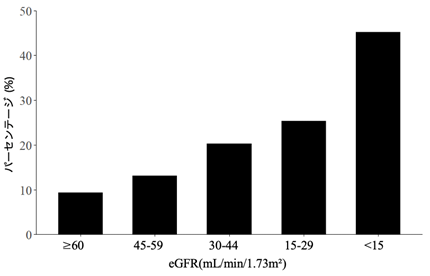
Rate of constipation by renal function (eGFR) category. The rate of constipation was higher in the group with lower renal function.
1. background
Constipation is a common symptom experienced by many people, but it is known to be more common in people with chronic kidney disease, especially those receiving dialysis. This is because patients with chronic kidney disease tend to have a combination of factors that can lead to constipation, including age, comorbidities such as diabetes, dietary and fluid intake restrictions, and medications they are taking.一方で、慢性腎臓病の進行と便秘がどの程度関係しているのかについては、これまで十分に分かっていませんでした。
2. Research methods/results
The research group analyzed a total of 217,734 people (903,984 person-years) who had kidney function data among those aged 20 to 74 who underwent health checkups between 2015 and 2023, using a large-scale health checkup and medical receipt database in Japan. Constipation was defined as having a medical diagnosis of constipation or being prescribed a laxative. Renal function was classified into 5 levels and compared based on eGFR.
As a result, the proportion of people with constipation increased as kidney function decreased. The rate was 9.4% in the group with preserved renal function, 13.1% in the group with slightly decreased renal function, 20.3% in the moderately decreased group, 25.3% in the severely decreased group, and 45.2% in the lowest group. This study showed that constipation is a very common problem for people with significantly reduced kidney function.
Moreover, decreased renal function was significantly associated with constipation, even after accounting for the effects of age, gender, BMI, blood pressure, comorbidities such as diabetes and cardiovascular disease, and medication use such as iron supplements, potassium-lowering drugs, phosphate binders, opioid analgesics, and antidepressants. The group with the lowest renal function was 2.44 times more likely to have constipation than the group with preserved renal function.
There were also differences in the types of drugs used to treat constipation. Overall, stimulant laxatives and magnesium-based and non-magnesium-based osmotic laxatives were often used, but in patients with advanced chronic kidney disease, magnesium preparations were less used and new constipation medications were more likely to be used. This indicates that drug selection changes depending on the state of renal function.
3. Ripple effects and future plans
This study shows that constipation is not just a problem for dialysis patients, but is an important symptom seen in various stages of chronic kidney disease. In particular, since the relationship between decreased kidney function and constipation could not be explained solely by age, other diseases, or the effects of medications, constipation may be a symptom of chronic kidney disease itself.
Constipation is generally overlooked as a mild symptom that improves on its own, but it is becoming known that it not only significantly lowers the quality of life and affects eating, medication, and daily life, but also that it is associated with the onset of heart disease and cerebral infarction. These results demonstrate the importance of early detection of constipation and appropriate treatment in patients with decreased renal function. Additionally, the types of laxatives used differ depending on the stage of progression of chronic kidney disease, suggesting the importance of safe and appropriate constipation management depending on kidney function.
On the other hand, this study was a cross-sectional analysis that examined the condition at a certain point in time, and it did not clarify the causal relationship, such as whether constipation occurs first or renal function decline comes first. In the future, we plan to investigate in more detail the temporal relationship and underlying mechanisms between constipation and decline in renal function, and consider whether interventions for constipation will lead to improved treatment of chronic kidney disease.
Glossary
chronic kidney disease腎臓の働きが慢性的に低下した状態を指します。 As the disease progresses, dialysis and kidney transplantation may be required and the risk of cardiovascular disease increases.
eGFRIt is an index of renal function calculated from serum creatinine level, age, gender, etc. Lower values indicate poorer kidney function.
constipationIn this study, it was defined as having either a diagnosis of constipation on a medical receipt or a prescription for laxatives.
Researcher's comments
This study showed that constipation increases with the progression of chronic kidney disease and is independently associated with decreased kidney function. Although constipation is a symptom that is often overlooked, it is an important problem that affects the quality of life of people with chronic kidney disease, continued treatment, and even prognosis. In the future, we would like to clarify which patients are at high risk for constipation and whether appropriate interventions can improve kidney disease treatment.
Paper title and author
titleConstipation prevalence and its association with kidney function: a large nationwide Japanese health check-up cohort study
authorKeita Hirano, Keiichi Sumida, Shingo Fukuma
MagazineClinical Kidney Journal
Publication dateMarch 11, 2026
DOI10.1093/ckj/sfag082
- Press release (Constipation increases in chronic kidney disease).pdf (993.26 KB)
- Publication journal (Clinical Kidney Journal)
- Hiroshima University Researcher Guidebook (Professor Shingo Fukuma)
Shingo Fukuma
Professor, Graduate School of Medical Sciences, Hiroshima University
TEL: 082-257-5162
E-mail: shingo-fukuma*hiroshima-u.ac.jp, fukuma.shingo.3m*kyoto-u.ac.jp
Hiroshima University Public Relations Office
TEL: 082-424-3701 FAX: 082-424-6040
E-mail: koho*office.hiroshima-u.ac.jp
(Please replace * with half-width @)