Why is it increasingly difficult for the universe to form new stars? This is the focus of the field of galaxy formation and evolution. The birth of stars relies on dense clouds of molecular gas. Previously, academic circles generally believed that as the universe evolved, the cold gas that nurtured stars continued to be consumed, leading to a decline in star-making activities. According to this classic theory, the decline in star formation rate must be accompanied by a simultaneous decrease in cold gas reserves.
Neutral atomic hydrogen (neutral hydrogen) is one of the most important cold gas reserves in galaxies. It is not only a key intermediate node between large-scale gas supply and molecular gas formation, but also a key link between large-scale gas circulation and internal star formation in galaxies. However, the detection of neutral hydrogen is mainly through the extremely weak 21 cm radio spectrum line, and individual signals from distant galaxies are easily drowned in background noise. Limited by the bottleneck of observation technology, past observations have had the problem of "seeing deeply but not seeing widely, and looking widely but not deep enough." As a result, there is always a lack of reliable direct observational evidence for the evolution of the total amount of neutral hydrogen in the medium- and low-redshift universe over time.
Recently, an international collaborative team composed of the National Astronomical Observatory of the Chinese Academy of Sciences, Shanghai Observatory, and Shanghai Jiao Tong University relied on the "China Sky Eye" (FAST) and the International Dark Energy Spectrometer (DESI) to conduct high-precision measurements of the evolution of neutral hydrogen in the universe since 4.5 billion years ago.
研究发现,近45亿年来宇宙恒星形成活动显著减弱,但作为星系重要气体储备的中性原子氢仅发生缓慢变化,颠覆了学界对宇宙造星衰退机制的传统认知。此次研究将FAST的高灵敏度射电观测与DESI的大规模光谱巡天深度融合,分析了覆盖约三分之一天区的约250万个星系观测数据。
The research uses neutral hydrogen spectral line superposition technology to accurately align and superimpose a large number of weak signals that cannot be directly detected according to the red shift of the galaxy. It successfully extracts the average neutral hydrogen signal from the noise and accurately restores the evolution trajectory of neutral hydrogen in the universe with statistical accuracy and large sample scale. High-precision measurement results show that the star formation rate of the universe 4.5 billion years ago was about 2.5 times that of the current universe, while the density of neutral atomic hydrogen during the same period was only about 1.4 times that of the current one. This suggests that the massive plunge in star formation activity was not accompanied by a simultaneous depletion of neutral hydrogen reserves in the universe. This significant difference in evolution rate overturns the traditional physical picture of "rapid depletion of neutral hydrogen leading to the decline of star formation" and iterates the focus of the research field from "whether the gas is exhausted" to the question of "why the reserve of neutral hydrogen is sufficient but star formation is becoming increasingly difficult."
Research suggests that the core cause of the decline of star formation in the late universe may be the process of gas transforming from neutral atomic hydrogen into molecular hydrogen and nurturing stars. As the gas supply of the cosmic web weakens and the gas density decreases, the efficiency of converting neutral hydrogen into molecular hydrogen decreases, allowing the neutral hydrogen reserve to remain relatively stable, while the molecular gas that can actually directly breed stars gradually decreases.
这项研究精准量化了宇宙中性氢的长期演化特征,更为破解宇宙恒星形成衰退之谜提供了全新线索。此次联合观测为理解宇宙晚期气体循环、恒星形成衰退及星系演化进程,确立了新的观测基准。
相关研究成果发表在《自然·天文》(Nature Astronomy)上。研究工作得到国家自然科学基金委员会、科学技术部、中国科学院等的支持。
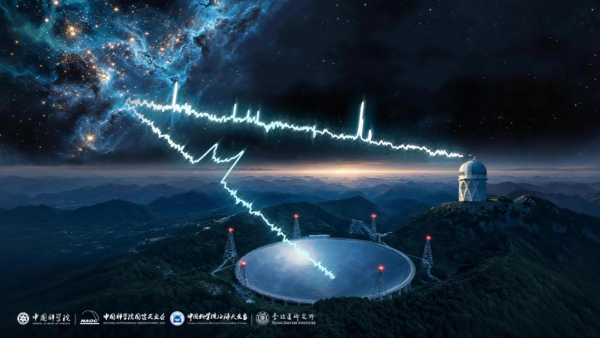
"China's Sky Eye" redraws the picture of the evolution of the universe (artistic picture)
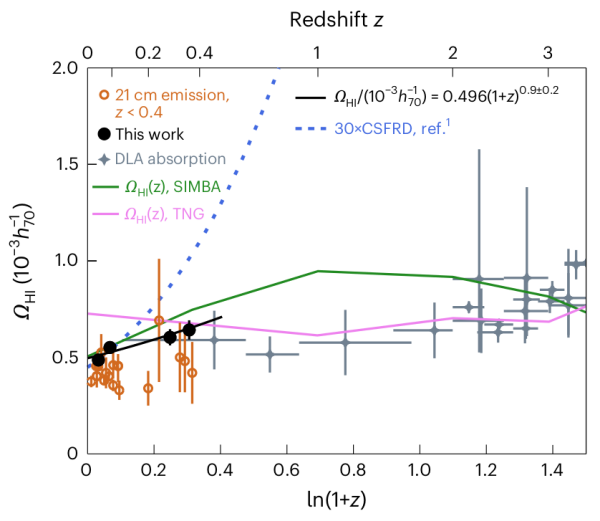
宇宙中性氢密度随红移的演化趋势,黑色圆点代表研究团队测量的数据点
Source: https://www.cas.cn/syky/202609/t20260902_5119570.shtml