硼在玻璃与陶瓷制造、农业生产等领域均发挥着重要作用。青海、西藏的盐湖虽富含液体硼矿,但高盐环境与硼酸分子的反应惰性使得硼的Efficient selective extraction faces challenges.
Recently, research teams such as the Qinghai Salt Lake Institute of the Chinese Academy of Sciences successfully constructed Co with rich interface nitrogen vacancies through interface defect engineering strategies.3O4@g-C3N4异质结提硼材料。
密度泛函理论计算与电荷分析表明,界面氮空位的引入诱发了局域电荷重组,使邻近钴原子呈现缺电子状态,显著增强了钴中心对硼酸分子的“路易斯酸性”。这种缺陷调控效应有效消除了吸附势垒,推动硼酸吸附由热力学不利转变为高度自发过程,强力驱动了Co–O–B内层化学配位键的形成。
With ultra-thin g-C3N4To Co3O4With good dispersion and defect activation effect, the optimized CoCN-5 composite material has a boron adsorption capacity of 128.5 mg/g within 120 minutes at 25°C, which is significantly better than the original Co3O4材料。在拉果错与察尔汗真实高盐卤水体系中,该材料在保持高选择性的同时,依然可实现较高的硼捕获量和良好的循环稳定性,展现出实际工业应用潜力。
Through the "structure-mechanism" integrated design, the research provides an effective defect engineering strategy for the selective capture of boron in complex salt lake systems, and also provides a theoretical reference for the development of new metal-based heterojunction adsorption materials.
Relevant research results were published in "Water Research" (Water Research)superior.
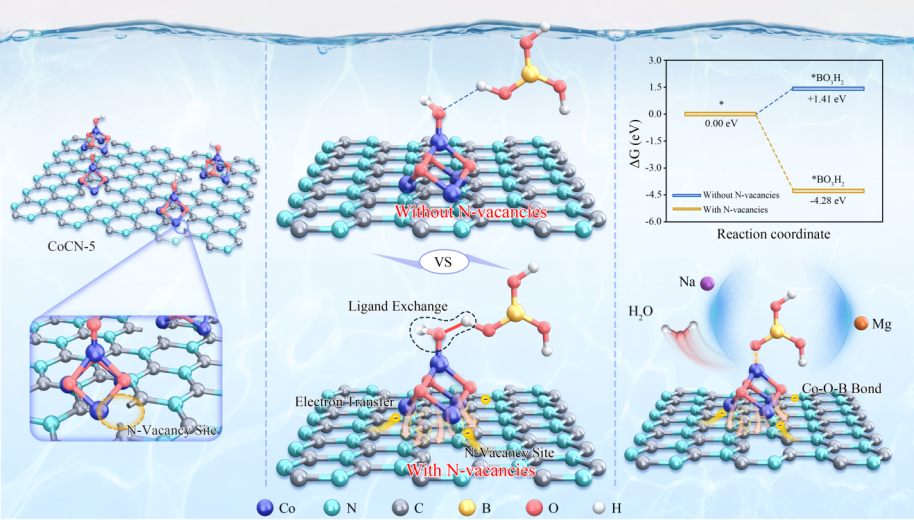
Mechanism diagram of charge redistribution induced by interfacial nitrogen vacancies and boric acid adsorption
Source: https://www.cas.cn/syky/202608/t20260819_5118579.shtml