Deep learning models have excellent performance when the distribution of training data and test data are consistent. However, in practical applications such as brain-computer interfaces and medical imaging, they will be affected by factors such as individual differences in subjects, electrode/sensor drift, changes in acquisition equipment and clinical environment, and the data distribution will shift, resulting in a significant decline in model performance. In recent years, academic circles have developed a series of domain generalization algorithms using distribution alignment, adversarial training, and invariant risk minimization. However, most mainstream methods focus on matching edge distributions or gradient statistics between different domains, which can easily lead to alignment instability or even collapse under limited samples, restricting the cross-domain discrimination ability of deep learning models in real target domains.
Recently, the scientific research team of the Institute of Process Engineering, Chinese Academy of Sciences extended the rate-distortion theory in information theory to Grassmann manifolds and proposed a geometric rate-distortion invariance (RDI) algorithm.
This algorithm uses the low-dimensional geometric structure of deep learning features in the actual distribution to construct a classification basis with strong discriminability. This framework can make the feature directions of the same category in data from different sources consistent to eliminate inter-domain bias, while controlling the "volume" of the feature distribution of each category to prevent its excessive collapse and retain the discriminative differences between categories. Through joint training with classification tasks, the model can reduce the geometric differences between data from different sources while maintaining classification accuracy.
实验结果表明,RDI具备任务自适应的调控能力。面对类别较少的场景,模型会主动扩展有效特征维度以防止信息坍缩。面对类别繁多的复杂场景,则自动压缩冗余信息以提升紧凑性。这种“收放自如”的特性使RDI在面对完全未知的目标域时仍能保持稳定的判别能力。在领域内最具权威的DomainBed标准测试集上,RDI的平均准确率超越了现有主流不变性学习方法,且在CNN与ViT等不同架构上均表现稳健。
This method will effectively solve the problem of sudden drop in discrimination performance of deep learning models in cross-domain data scenarios, and provide a new theoretical perspective and solution to the cross-domain generalization problem of deep learning models.研究工作为脑机接口等场景的分布偏移问题提供了新的几何视角与算法基础。
相关研究成果发表在ICML 2026上。研究工作得到国家自然科学基金委员会、中国科学院等的支持。
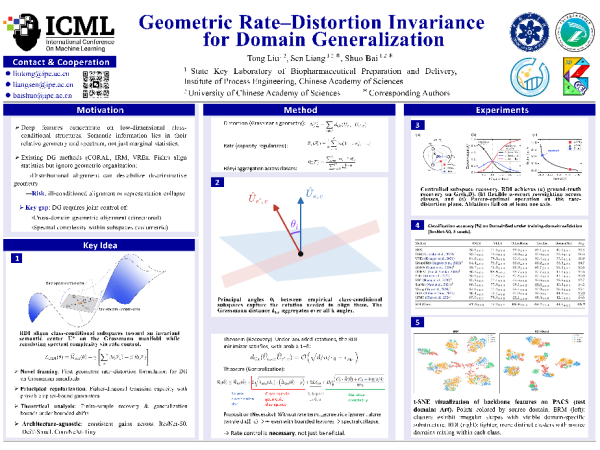
Schematic diagram of the structural design and cross-domain generalization application of the RDI geometric rate distortion invariance framework
Source: https://www.cas.cn/syky/202608/t20260827_5119141.shtml