Marine heat waves are extreme high temperature events in which sea surface temperatures are abnormally warm and last for days to months. Global warming is making such events more frequent and more intense, with impacts throughout the marine food web, from phytoplankton to top predators. As the basis of the marine food web, phytoplankton supports most of the ocean's primary productivity through photosynthesis, and its changes will affect fishery resources and ocean carbon sinks through cascade effects.The western and central equatorial Pacific has previously been considered to be slightly affected by marine heat waves. The average annual heat wave days in this area are only 22, and the average intensity is only 1.2°C, which is far lower than most sea areas in the world, so it is regarded as a "safe haven" for marine heat waves.
近日,中国科学院南海海洋研究所科研团队在海洋热浪生态效应研究中取得进展。团队利用1998年至2024年的卫星观测数据,结合BGC-Argo和TAO/TRITON锚系浮标的长期现场观测,系统评估了全球各海域浮游植物对热浪的响应强度。
The study defined the "Phytoplankton Sensitivity Index" (PSI) to quantify the relative change rate of surface chlorophyll concentration caused by unit heat wave intensity (per 1°C of sea surface temperature anomaly). The results show that the PSI in the central and western equatorial Pacific is about -50%/°C, which is significantly higher than the traditionally recognized ecologically sensitive sea areas such as the eastern boundary upwelling area. Data show that when a heat wave causes seawater to warm by 1°C, the phytoplankton biomass near the surface of the sea area will drop by half.However, the ecological response caused by the same warming in other sea areas is relatively mild.。这一发现颠覆了传统认知,该“避风港”非但未能缓冲气候扰动,反而成为全球浮游植物对海洋热浪响应最敏感的区域。
针对这一悖论,团队通过多源观测数据揭示了其潜在物理—生化耦合机制。结果显示,在热浪期间,浮游植物的水平与垂向营养盐供给通道同时受到抑制,二者叠加效应导致表层叶绿素浓度下降。赤道太平洋东部存在一条高营养盐海水向西输送的传送带,维持着中西太平洋浮游植物的生长。但热浪期间,东向的流场异常削弱了这条西向传送带,使纬向营养盐输送率减少约72%,且热浪伴随的强降水使表层海水盐度降低。盐度层化作用使混合层变浅,叠加上层海水的增温效应,导致更强的垂向层化结构,阻挡了深层营养盐向上补给。水平与垂直两条营养供给通道同时受限,共同导致表层浮游植物急剧减少。
与表层浮游植物衰减特征相反,次表层浮游植物在热浪期间出现了明显增长趋势。BGC-Argo观测数据显示,热浪期间该海域海洋次表层存在明显的温度负异常,指示温跃层抬升,这一过程改善了混合层底部的营养盐可获得性。同时,表层浮游植物锐减大幅削弱了水体自遮蔽效应,使更多阳光能够穿透至深层,真光层平均深度加深约25米。两者协同作用下,混合层底部至真光层底部之间形成了一个适宜浮游植物生长的窗口,推动热浪期间次表层叶绿素浓度上升。
The ecological significance of this discovery goes far beyond the phytoplankton itself. Phytoplankton is the basis of the marine food web. The rapid reduction of its biomass and the transformation to a smaller community structure fundamentally reduce the energy transfer efficiency of the food web and amplify it step by step along the trophic levels. Studies have shown that the intensity of subsurface heat waves at depths of 50 meters to 300 meters in the equatorial and western Pacific Ocean is about five times that of the surface layer, and this depth range is the key feeding habitat for commercial fish such as bonito and yellowfin tuna. The dual pressures of surface phytoplankton reduction and subsurface heat waves may have a profound impact on equatorial Pacific fish resources by compressing suitable habitats and changing food availability.
相关研究成果发表在《全球变化生物学》(Global Change Biology)superior. The research work is supported by the National Natural Science Foundation of China.
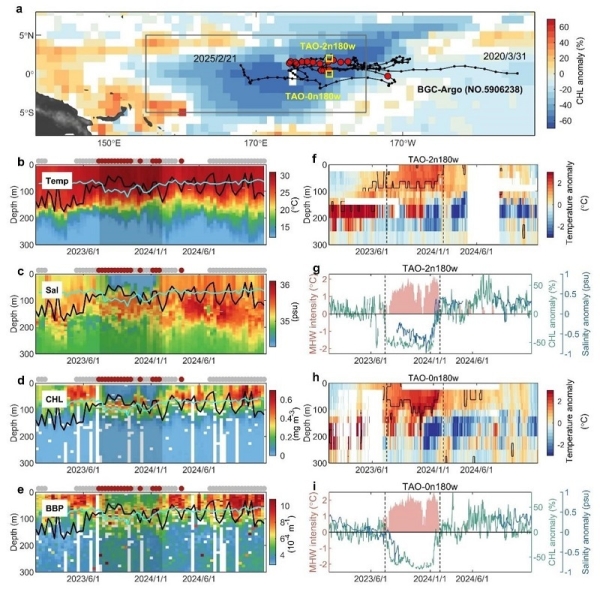
Subsurface observations of BGC-Argo and TAO/TRITON buoys in the western central equatorial Pacific (WCP)
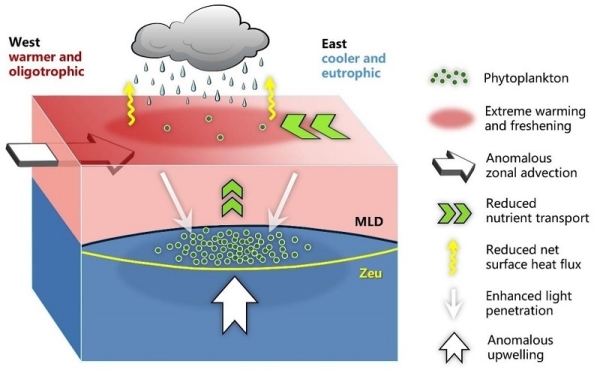
赤道中西太平洋(WCP)浮游植物响应海洋热浪示意图
Source: https://www.cas.cn/syky/202608/t20260828_5119223.shtml