Modern main banana varieties are highly dependent on vegetative reproduction and have problems such as narrow genetic base and low genetic diversity. There are about 80 species in the Musa family, and different groups have different chromosome bases (such asn=11, 10 and 9) and flower bud color and other traits, it is an ideal group to study the evolution of plant chromosome structure and the differentiation of floral organ traits. However, there has been a long lack of direct evidence at the genomic and cytogenetic level regarding the evolutionary formation mechanism of these different chromosome base numbers and the intrinsic correlation between chromosome structural variation and flower bud color differentiation.
Recently, the scientific research team of the South China Botanical Garden of the Chinese Academy of Sciences studied the early differentiation of ornamental banana species in the Musa family.Musa exotica开展端粒到端粒(T2T)基因组组装,获得了高质量的完整基因组,其contig N50达到47.41Mb。结合已有芭蕉科物种基因组,研究团队开展了系统的比较基因组分析,重建了芭蕉科祖先核型(AMK),推断其祖先单倍体染色体数为n=17.
The ancestral karyotype reconstruction results revealed the evolutionary trajectory of decreasing chromosome number in Musa family. Research has confirmed that existingn=11、n=10sumnThe =9 chromosome group did not form independently, but experienced various chromosomal rearrangement events such as telomere joining, nested fusion, and reciprocal translocation. It was formed by the ancestraln=17 chromosomes gradually evolved. This evolutionary path is highly consistent with the phylogenetic relationship constructed based on DNA sequences, and provides new evidence for understanding the evolutionary relationship between different taxa of the Musa family from the perspective of chromosome structure.
On the basis of revealing the evolutionary trajectory of chromosomes, the team further explored the potential connection between changes in chromosome structure and bud color differentiation. The study found that the chromosome rearrangement-related break region is enriched in anthocyanin biosynthesis-related genes and their regulatory factors, including chalcone synthase (CHS)、flavanone 3-hydroxylase(F3H) and other structural genes, as well as transcription factors such as MYB and bHLH. Combined with transcriptome analysis of flower buds of different colors, it was found that the anthocyanin synthesis pathwayCHS,CHI,F3′5′HandANSKey genes such as these are expressed cooperatively, and their expression differences are mainly related to transcriptional regulation rather than simple gene copy number changes. The research results show that the evolution of chromosome structure may provide a genetic basis for the phenotypic differentiation of flower bud color by reshaping the genome environment and regulatory network.
This study constructed the ancestral karyotype of the Musa family, provided new genomic evidence for understanding the gradual evolution of the Musa family's chromosome number, and linked the evolution of chromosome structure to flower bud color differentiation, providing new research ideas for analyzing the genetic regulation mechanism of ornamental banana flower color traits and the utilization of wild Musa germplasm resources.
Relevant research results were published in Current Biology (Current Biology)superior.
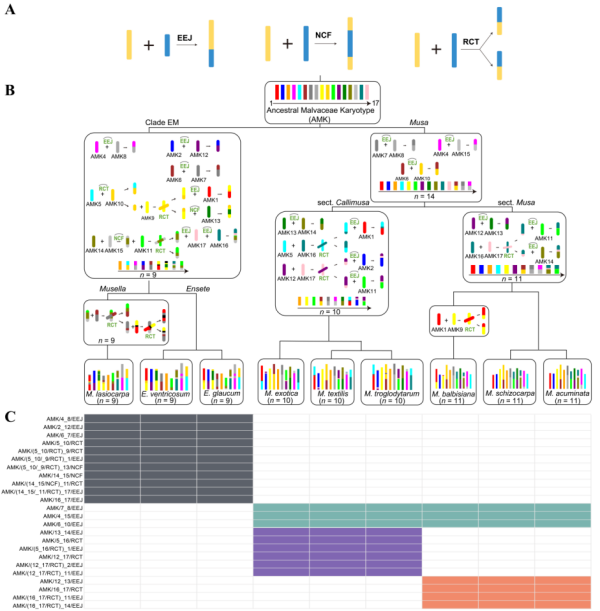
芭蕉科祖先核型(AMK,n= 17) and its adaptation to the existingn= The trajectory of the gradual evolution of chromosome groups 11, 10, and 9
Source: https://www.cas.cn/syky/202608/t20260826_5119034.shtml