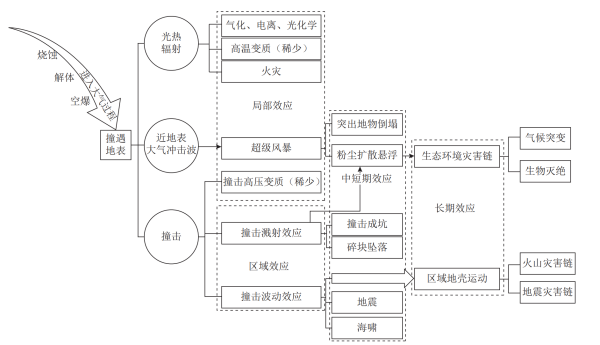
Asteroid impact is a natural disaster with low probability but complex disaster chain. The impact is accompanied by extreme dynamic effects such as ultra-high temperature, ultra-high pressure, ultra-high speed, etc., which will produce a large amount of sputtering dust. Sputtered dust is ejected into the atmosphere at high speed, and some dust enters the stratosphere and spreads, which may cause global environmental effects. Conducting research on the entire process from impact cratering to sputtering dust is of great significance to the study of near-Earth asteroid defense and Earth evolution. At present, due to technical and cost constraints, it is difficult to simulate real working conditions in indoor ultra-high-speed impact tests, and numerical simulation has become the main research method. However, most existing research focuses on a single process and lacks a systematic analysis method covering the complete chain of sputter dust formation - dust tropospheric movement - dust stratospheric diffusion.
In the past two decades, research on black hole thermodynamics has revealed the similarity between black holes and fluid systems—the existence of a small black hole-large black hole first-order phase transition in charged Anti-de Sitter (AdS) black holes. However, a key question remains unresolved - what thermodynamic behavior does a black hole exhibit in the "supercritical" region above the critical point? For a long time, people have known little about this, and the existing supercritical phase transition lines are not universal.
Standard DNA barcodes are widely used in fields such as biodiversity protection and traceability due to their advantages of strong universal primer adaptability and low sequencing costs. For closely related species, complex taxa with frequent hybridization and recent radiation evolution, standard DNA barcodes cannot meet the needs of accurate identification due to limited sequence variation and insufficient resolution. Although the strategy of shallow genome sequencing to obtain the complete plastid genome (super barcoding) has improved the identification rate of some difficult taxa, the uniparental inheritance characteristics of the plastid genome make it limited in the analysis of introgressed taxa.
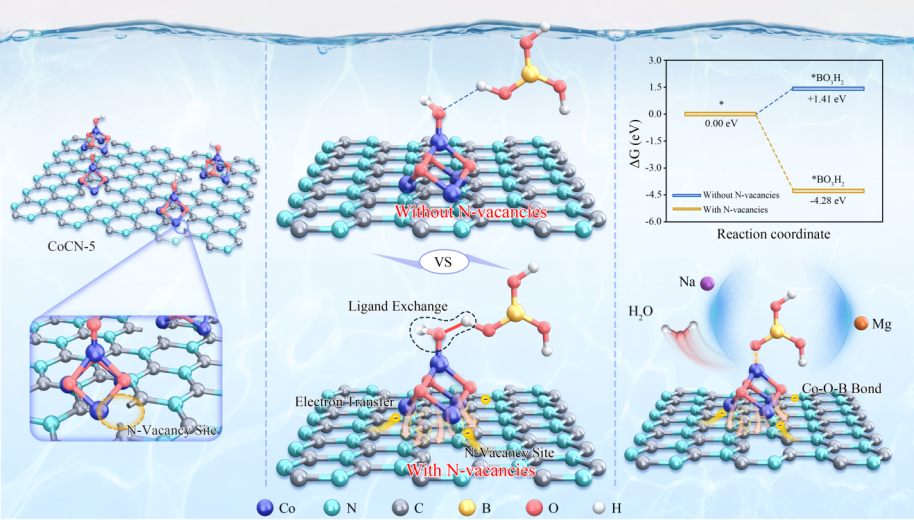
Boron plays an important role in glass and ceramic manufacturing, agricultural production and other fields. Although the salt lakes in Qinghai and Tibet are rich in liquid boron ore, the high-salt environment and the reactive inertness of boric acid molecules make efficient and selective extraction of boron challenging.
Harmful algal blooms are an important environmental problem facing aquatic ecosystems, and nutrient levels are considered to be the core factor driving algal blooms. Research in recent years has found that serious algal bloom events may not occur in high-nutrient lakes, indicating that their formation is affected by complex environmental regulation and ecological feedback mechanisms.
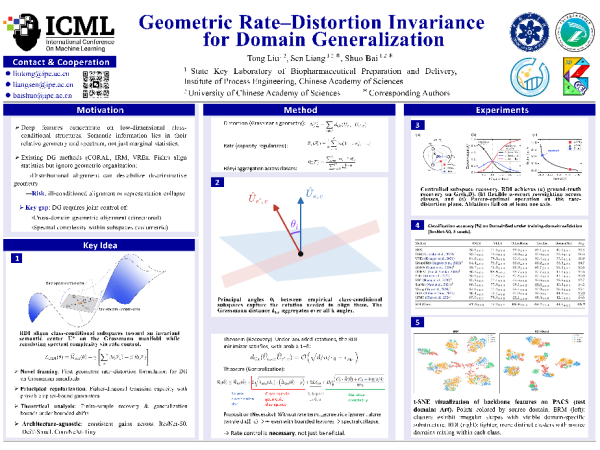
Deep learning models have excellent performance when the distribution of training data and test data are consistent. However, in practical applications such as brain-computer interfaces and medical imaging, they will be affected by factors such as individual differences in subjects, electrode/sensor drift, changes in acquisition equipment and clinical environment, and the data distribution will shift, resulting in a significant decline in model performance. In recent years, academic circles have developed a series of domain generalization algorithms using distribution alignment, adversarial training, and invariant risk minimization. However, most mainstream methods focus on matching edge distributions or gradient statistics between different domains, which can easily lead to alignment instability or even collapse under limited samples, restricting the cross-domain discrimination ability of deep learning models in real target domains.
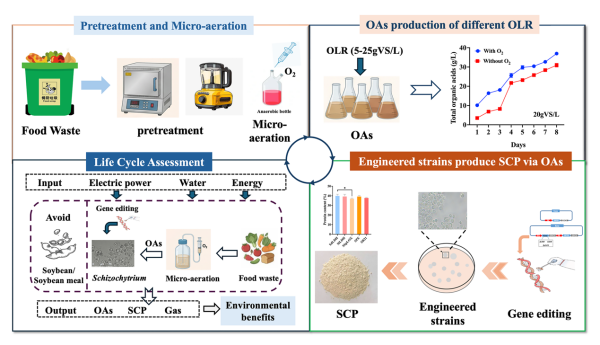
As residents' daily living standards continue to improve, the demand for high-quality protein in farming and other fields has increased significantly, and the supply is insufficient. At the same time, urban food waste production is large, and traditional disposal processes have high carbon emissions, low resource conversion efficiency, and high energy consumption. The protein supply gap and the problem of food waste disposal are superimposed, and there is an urgent need to build efficient and coordinated resource solutions.
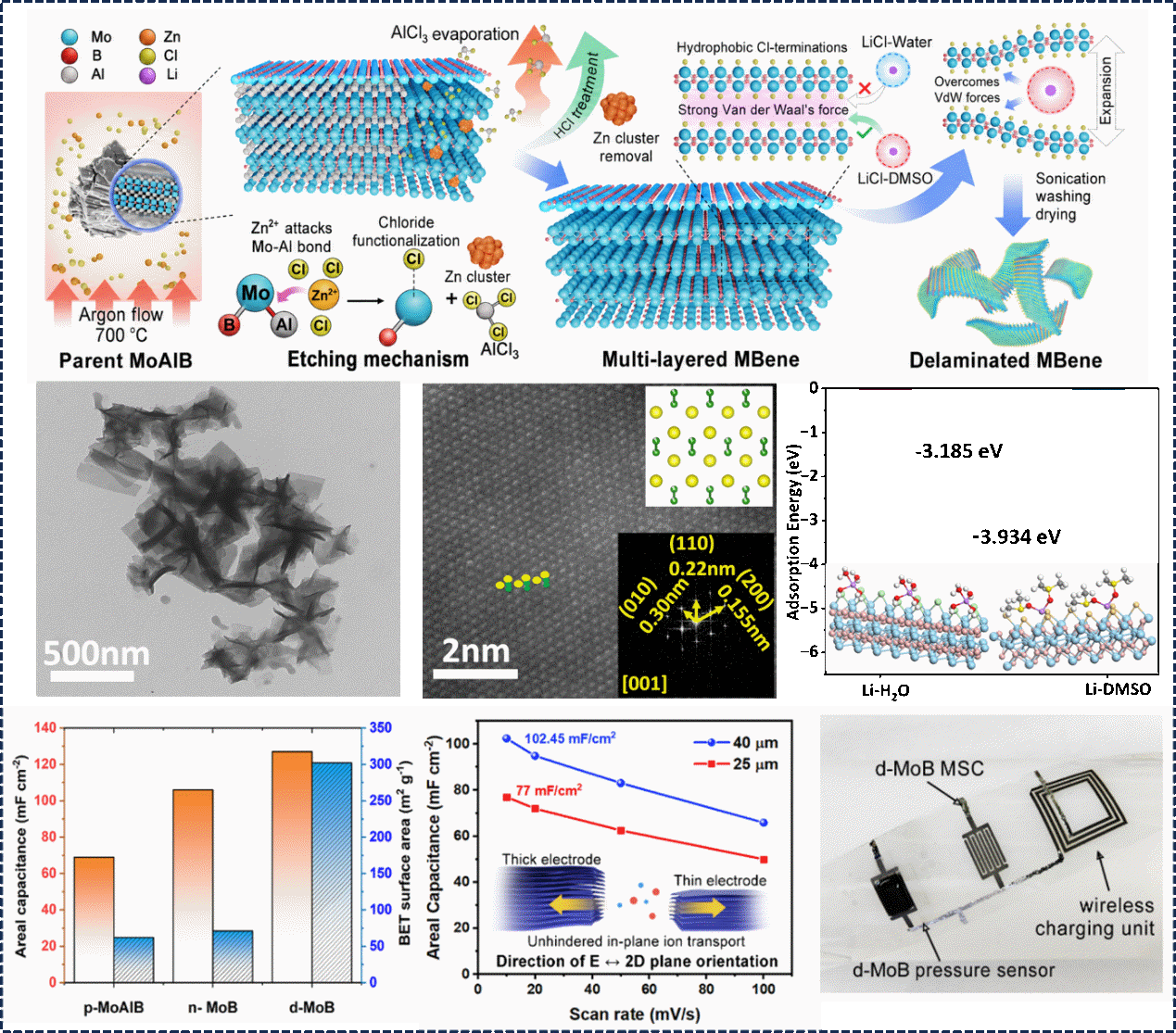
Two-dimensional transition metal borides have broad application prospects in the field of electrochemical energy storage due to their unique electronic structure, high conductivity and rich surface chemical properties. Molybdenum boride (MoB) can be obtained by selectively etching away the aluminum (Al) layer in layered molybdenum aluminum boron (MoAlB). However, this method often faces problems such as incomplete removal of Al and re-stacking of MoB layers after etching, making it difficult to fully peel off the two-dimensional nanosheets. This will reduce the available surface area of the material and prevent electrolyte ions from entering the interlayer active sites, thus restricting the performance of MoB in high-rate energy storage devices.
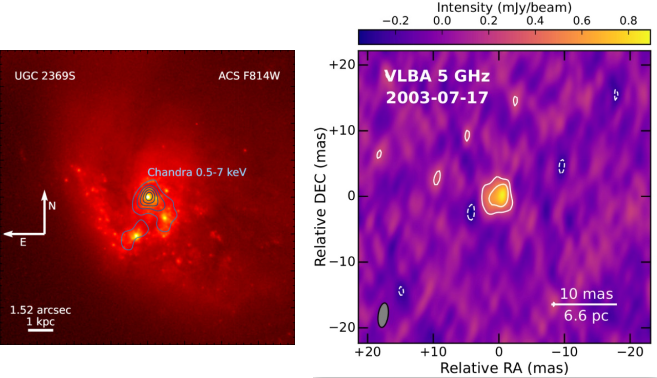
Galaxy mergers are an important process in the evolution of the universe, often causing supermassive black holes in the centers of galaxies to approach each other. Triple galaxy merger events are relatively rare in the universe and provide a unique sample for studying the co-evolution of galaxies and black holes.
Space & Astronomy#Chinese Academy of Sciences#科研进展#CAS#astronomy#astrophysics