Key points of this research result
- We have elucidated the genetic background that makes tumors more likely to grow due to radiation in mice.
- involved in DNA repairMRE11It has been found that when a person has a specific mutation in a gene (*1), the incidence of intestinal tumors increases especially after receiving radiation.
- By using model mice that are prone to tumor formation, we demonstrated the possibility of evaluating the cancer risk of rare DNA repair disorders.
overview
A research group including Assistant Professor Sylvia Natsuko Akutsu, Graduate Student Risa Matsumura, Associate Professor Takamoto Asano, Emeritus Professor Shinya Matsuura, Professor Megumi Sasaya, Professor Shinji Yoshinaga of the Atomic Bomb Radiological Research Institute of Hiroshima University, and Professor Tatsuo Miyamoto of the Yamaguchi University Graduate School of Medicine is using genome editing (*2) to develop ataxia-telangiectasia-like disorder (AT-like disorder). Found in patients with ATLD) (*3)MRE11We created a model mouse with a genetic mutation. When we examined this mouse model, we found that when it was exposed to radiation under certain genetic conditions, the number of tumors that formed in the small intestine increased significantly.
This research result was published in a British scientific journal on August 14, 2026.Scientific ReportsPublished in the online version of
Published paper
Paper name:“ATLD-derivedMRE11variant enhances radiation-induced intestinal tumorigenesis inApcMin/+“mice”
Author name:Risa Matsumura, Silvia Natsuko Akutsu, Megumi Sasatani, Guanyu Zhou, Tiancheng Liu, Ai Fukushima, Tetsuo Ozawa, Yu Kobayashi, Tatsuo Miyamoto, Shinji Yoshinaga, Satoshi Okada, Takaki Asano, Shinya Matsuura
DOI number: https://doi.org/10.1038/s41598-026-66205-w
Research background
Diseases in which the mechanism that repairs DNA when it is damaged do not work properly can make people vulnerable to radiation, and many of them can become susceptible to cancer. As a typical disease,ATMAtaxia telangiectasia (AT) (*4) is known to be caused by a gene. On the other hand, "ataxia telangiectasia-like disease (ATLD)"MRE11It is a rare autosomal recessive disease caused by genetic mutations. Although patients exhibit cerebellar ataxia, oculomotor apraxia, and dystonia similar to AT, it differs from AT in that it does not exhibit carcinogenicity. The clinical diversity of ATLD patients isMRE11Approximately 20 different mutations have been reported in 39 cases so far, and are thought to be caused by different types of genetic mutations.MRE11ATLD with mutations has increased radiosensitivity, but the potential impact of these mutations on cancer predisposition is not fully understood. So the research group found that in patients with ATLDMRE11We introduced the gene mutation (A47V) into mice and investigated how much their tumors would grow when they received radiation.
Contents of research results
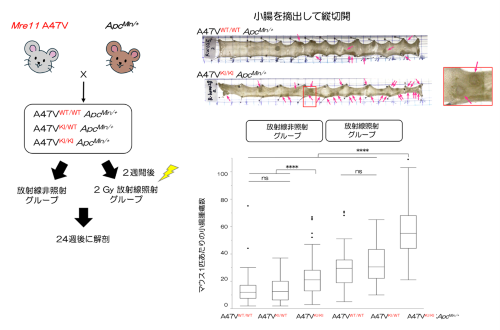
In a 2-year-old boy with ATLD,MRE11Two changes were found in the gene: the A47V (c.140C>T) missense mutation and the c.658A>C splice mutation (Figure 1). Make a mouse with A47V,ApcMin/+They were bred with mice (*5) and irradiated with 2 Gy of radiation. Then, at 24 weeks of age, the small intestine was observed and the number of tumors was counted.
・Even without radiation, mice with two A47V genes (homozygotes) tended to have more tumors (Figure 2).
・When exposed to radiation, tumors increased in mice of all genotypes, but it was found that the increase was particularly large in mice with two A47V genes.
These results indicate that when two A47Vs are present, a person may be predisposed to tumor growth due to radiation.
Future prospects
These results provide important clues in understanding the mechanism of radiation-induced carcinogenesis. It is also expected to be useful as a new model for evaluating the ``susceptibility to cancer'' in DNA repair disorders.
Reference materials
Figure 1 Found in ATLD patientsMRE11Genetic mutations and mouse models
Mice with two copies of A47V (homozygous; A47VKI/KI) showed a weak constitution (high radiation sensitivity) to radiation using the micronucleation method.
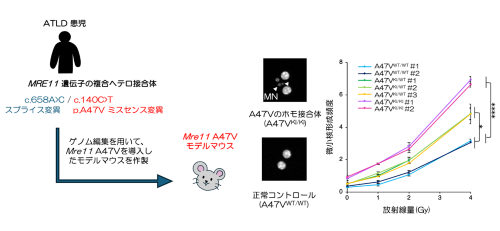
Figure 2 Comparison of the number of intestinal tumors according to different genotypes
Mice with two copies of A47V (homozygous; A47VKI/KI) showed a particularly large increase in tumor size after radiation irradiation.
Terminology explanation
(*1)MRE11gene:
A gene that acts as a "sensor" that initiates repair when DNA is damaged.
(*2) Genome editing:
A technology that uses technologies such as CRISPR/Cas9 to destroy genes or write specific changes.
(*3) Ataxia telangiectasia-like disease (ATLD):
A rare genetic disease that makes the patient vulnerable to radiation and causes unsteadiness in movement (ataxia).
(*4)Ataxia telangiectasia (AT):
A genetic disease that causes unsteadiness in movement (ataxia) and telangiectasia. In addition to having a weak immune system and repeated infections, they are extremely sensitive to radiation and have a high risk of developing malignant tumors.
(※5)ApcMin/+mouse:
This mouse is prone to developing polyps in the intestine and is widely used in radiation carcinogenesis research.
- Press release materials (675.22 KB)
- Publication journal (Scientific Reports)
- Hiroshima University Researcher Guidebook (AKUTSU SILVIA NATSUKO Assistant Professor)
(regarding research)
Natsuko Akutsu Sylvia, Assistant Professor, Hiroshima University Research Institute for Radiation Biology and Medicine
Tel: 082-257-5811
E-mail: silvia-akutsu*hiroshima-u.ac.jp
(Please replace * with half-width @)