Key points of this research result
- For the first time in the world, we succeeded in directly detecting the "cold molecular gas" that is the material for star formation in galaxies that existed in the early universe, only about 700 million years after the Big Bang.
- This shows that galaxies in the early Universe had more star material than previously thought and were growing rapidly.
- The results of this research will provide important clues to the so-called "dawn of the universe," which is why galaxies became so large in such a short period of time in the early universe.
overview
An international joint research team including Associate Professor Hanae Inami of the Hiroshima University Space Science Center has successfully detected large amounts of "cold molecular gas" that is a direct source of star formation in the distant galaxy REBELS-25, which existed in the universe approximately 700 million years after the Big Bang.
The research team conducted observations using the Very Large Array (VLA), a group of large radio telescopes in the United States, and the ALMA telescope in Chile. As a result, it was revealed that even in the early days of the universe, there was already a large amount of molecular hydrogen gas, the raw material for star formation, in galaxies.
Until now, it was expected that large amounts of gas existed in the bright, massive galaxies of the early Universe, but there had never been any direct detection of carbon monoxide (CO) gas, an indicator of cold molecular hydrogen gas, in galaxies so far away. The results of this research provide important clues in understanding why galaxies in the early Universe were able to grow so rapidly.
The results of this research were published in the journal "Monthly Notices of the Royal Astronomical Society" on June 11, 2026.
Paper information
Paper title: Direct detection of cool molecular gas in a star-forming galaxy at z=7.31
Authors: Karin Cescon, Leindert Boogaard, Lucie Rowland, Rychard Bouwens, Paul van der Werf, Pavel Mancera Piña, Matus Rybak, and Sander Schouws of Leiden University, the Netherlands; Hiddo Algera of the Institute of Astronomy and Astrophysics, Academia Sinica, Taiwan; Dominik Riechers of the University of Cologne, Germany; Renske Smit of Liverpool John Moores University, the United Kingdom; Ilse De Looze of Ghent University, Belgium; Manuel Aravena of Universidad Diego Portales and the Millennium Nucleus for Galaxies, Chile; Elisabete da Cunha of the University of Western Australia and the ARC Center of Excellence for All Sky Astrophysics in 3 Dimensions (ASTRO 3D), Australia; Pratika Dayal of the University of Toronto, Canada; Andrea Ferrara of Scuola Normale Superiore, Italy; Rebecca Fisher of the University of Manchester, the United Kingdom;Hanae Inami of Hiroshima University, Japan; Pascal Oesch of the University of Geneva, Switzerland, and the University of Copenhagen, Denmark; Andrea Pallottini of the University of Pisa, Italy; Laura Sommovigo of Columbia University and the Flatiron Institute, United States; Mauro Stefanon of the University of Valencia, Spain; and Livia Vallini of the Osservatorio di Astrofisica e Scienza dello Spazio, Italy.
Magazine: Monthly Notices of the Royal Astronomical Society
DOI: 10.1093/mnras/stag924
Release date: June 11, 2026
background
The universe was created by the Big Bang about 13.8 billion years ago. Immediately after the birth of the universe, there were no stars or galaxies yet, and the current cosmic structure has been formed over a long period of time.
Recent observations by the James Webb Space Telescope (JWST) and other instruments have revealed that extremely large and bright galaxies already existed when the universe was less than a billion years old. However, how these galaxies grew rapidly in such a short period of time has remained a big mystery.
In order for galaxies to grow, they need large amounts of gas, which is the material that produces stars. In particular, "cold molecular gas" corresponds to the direct fuel for star formation. However, in the early universe, the cosmic background radiation was stronger than it is today, making observation of this cold gas extremely difficult.
Therefore, until now, there has been no direct observation of cold molecular gas in galaxies in the early Universe.
Contents of research results
The research team targeted the galaxy REBELS-25, which existed at the dawn of the universe, about 13.1 billion years ago, when the universe was about 5% of its current age.
The observations were made using the Karl G. Jansky Very Large Array (VLA) in New Mexico, USA, and the ALMA telescope in Chile.
VLA observed cold molecular gas by capturing radio waves of a specific frequency emitted by carbon monoxide (CO) molecules. As a result, we succeeded in detecting the most distant low-excitation CO emission line ever seen in the early universe.
Furthermore, by combining this with ALMA observation data, we were able to estimate the temperature and density of the gas inside REBELS-25 in detail.
The strength of the detected signal indicates that this galaxy already had a large amount of star-forming gas. This is important evidence that galaxies in the early Universe formed stars very efficiently.
"Recent observations have revealed the possibility that galaxies in the early Universe may have grown much faster than we previously thought. This discovery provides important evidence that behind these galaxies existed a large amount of gas, which is the raw material for star formation. However, whether there was simply an abundance of fuel or whether there was a special physical process at work that accelerated star formation remains a big mystery.We hope that this result will be a new step toward elucidating this."
Future developments
The results of this study are for a single galaxy that existed in the very early days of the universe, but statistical observations of many more galaxies will be needed in the future to clarify how widespread such large amounts of gas were in the early universe.
Current state-of-the-art telescopes do not have sufficient sensitivity, making it difficult to conduct such observations on a large scale. However, with the large-scale upgrade of the ALMA telescope currently underway and the next-generation radio telescope ngVLA (Next Generation Very Large Array) being planned for construction, research is expected to develop even further.
This makes it possible to observe not only particularly bright galaxies like REBELS-25, but also early galaxies that are fainter and more distant. In the future, it is expected that this will lead to the elucidation of how the earliest galaxies in the universe collected gas, started forming stars, and grew into the giant galaxies we know today.
Reference materials
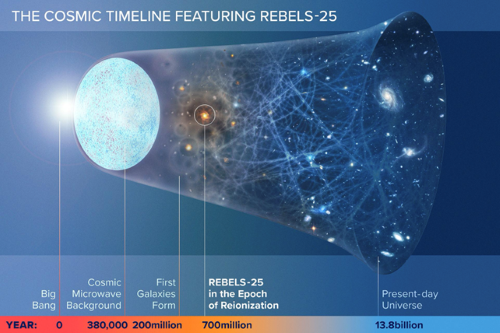
A schematic diagram showing the evolution of the universe from its birth to the present and the location of the distant galaxy "REBELS-25" observed this time. REBELS-25 is a galaxy that existed during the "cosmic reionization period" approximately 700 million years after the birth of the universe (approximately 13.1 billion years ago). Detailed observations by the VLA and ALMA revealed that this galaxy already contained large amounts of cold molecular gas. Cold molecular gas is a direct source of star formation.
Keyword/Term Explanation
■ Redshift
A phenomenon in which the wavelength of light from celestial bodies becomes redder due to the expansion of the universe. The higher the value, the more distant and past the universe we are looking at. The object of this observation, which has a redshift of 7, has been capturing light that has been reaching us since about 13.1 billion years ago (about 700 million years after the birth of the universe).
■ Cold molecular gas
A low-temperature gas consisting mainly of hydrogen molecules. It is a direct material for star formation. Carbon monoxide (CO) is a molecule that serves as a landmark when observing low-temperature hydrogen molecular gas.
■ Cosmic reionization period
After the birth of the universe, the first stars and galaxies were formed, and the state of the universe as a whole changed significantly.
■ ALMA (Atacama Large Millimeter/submillimeter Array, abbreviated as ALMA)
One of the world's largest radio telescopes located in the Atacama Desert in Chile. Atacama Large Millimeter/Submillimeter Interferometer.
■ Karl G. Jansky Very Large Array (VLA)
A large radio interferometer installed in New Mexico, USA.
- Press release materials (354.54 KB)
- Publication journal (Monthly Notices of the Royal Astronomical Society)
- Hiroshima University Researcher Guidebook (Associate Professor Hanae Inami)
Space Science Center Associate Professor Hanae Inami
Tel: 082-424-3468 FAX: 082-424-0717
E-mail: hanae*hiroshima-u.ac.jp
(Please replace * with half-width @)