point
- Focusing on "binding to cells," which is the first step in virus infection, we focused on the cell surface molecules involved in binding (collectively called "virus receptors").Note 1)We have developed a new analysis method that can identify
- This method is Proximity LabelingNote 2)This is an application of the ``receptor candidate molecules'' that can be quickly narrowed down to receptor candidate molecules in as little as 10 days if the virus's gene sequence information is available.
- Examination of the receptors for influenza viruses revealed that a molecule called Neuropilin-1 may be important for the binding of influenza viruses to host cells.
- This method is a quick and simple receptor identification platform that can be applied to various viruses in the future.
- Information on virus receptors will greatly contribute to the development of new antiviral drugs.
overview
Professor Norihiro Kotani (Pharmacology, Faculty of Medicine), Professor Takashi Murakami (Microbiology, Faculty of Medicine), Associate Professor Dai Horiuchi (Microbiology, Faculty of Medicine), Associate Professor Yosuke Mizuno (Central Research Institute, Faculty of Medicine), Professor Hideyuki Takeuchi (Faculty of Pharmacy, Biochemistry), Tadanobu Takahashi, from Saitama Medical University (President Tsutomu Takeuchi), University of Shizuoka Prefecture (President Yasuyuki Imai) Associate Professor (Faculty of Pharmacy/Biochemistry), Associate Professor Miyako Nakano (Graduate School of Integrated Life Sciences) of Hiroshima University (President Mitsuo Ochi), Koichi Honke of Kochi University (President Hiroyuki Ukeda) A joint research group led by a specially appointed professor (Department of Biochemistry, School of Medicine) and others has developed a new method to efficiently identify a group of cell surface molecules (collectively referred to as "virus receptors") that are involved when viruses bind to host cells. Information about viral receptors is not only important for understanding the mechanism of viral infection, but also for finding targets for antiviral drugs. However, some viruses involve multiple receptors or co-receptors, making it difficult to identify them, and even for known viruses, the receptors are often not fully understood.
In this study, we introduced the proximity labeling method (PL) for the first time to identify receptors, and identified pseudoviruses (pseudoviruses), which are special genetically modified viruses.Note 3)By using this method, we succeeded in establishing a new method to identify multiple receptor candidate molecules at once. pandemicNote 4)From the results of analysis of influenza viruses that can cause influenza, Neuropilin-1 (NRP1) was identified as a new receptor candidate molecule, and it was revealed that it plays an important role in the binding of influenza viruses to host cells.
The results of this research were published online in the ``Journal of Virology'', an international journal specializing in virology, published by the American Society for Microbiology on April 29, 2026.
Research background
Viral infections, as exemplified by the coronavirus pandemic, pose a serious threat to humanity. In order to limit the damage as much as possible, it is important to quickly understand the nature of the causative virus and develop therapeutic drugs and preventive methods.
Viral infection begins when virus particles bind to molecules such as virus receptors and co-receptors (hereinafter collectively referred to as virus receptors) on the surface of host cells. For many viruses, this binding involves the spike protein on the particle surface.Note 5)is used. On the other hand, virus receptors are important elements that determine which cells a virus is likely to infect and which species it can infect, and are also attracting attention as a target for antiviral drugs. However, in conventional receptor identification research, researchers often narrow down candidate molecules in advance and then verify them, and it is extremely rare for a comprehensive and systematic search to be conducted. Therefore, there was a need to establish a simple and highly versatile receptor analysis method that can quickly respond to emerging viruses and mutant viruses.
Research content
The joint research group has focused on the fact that virus receptors are spatially concentrated near the virus-host cell binding site, and has proposed a new strategy to label and identify a group of molecules that exist near the ``location where the virus spike protein binds to the host cell'' by applying an experimental technique called proximity labeling (PL: below) (Kotani N. et al.J. Biol. Chem. 2022).
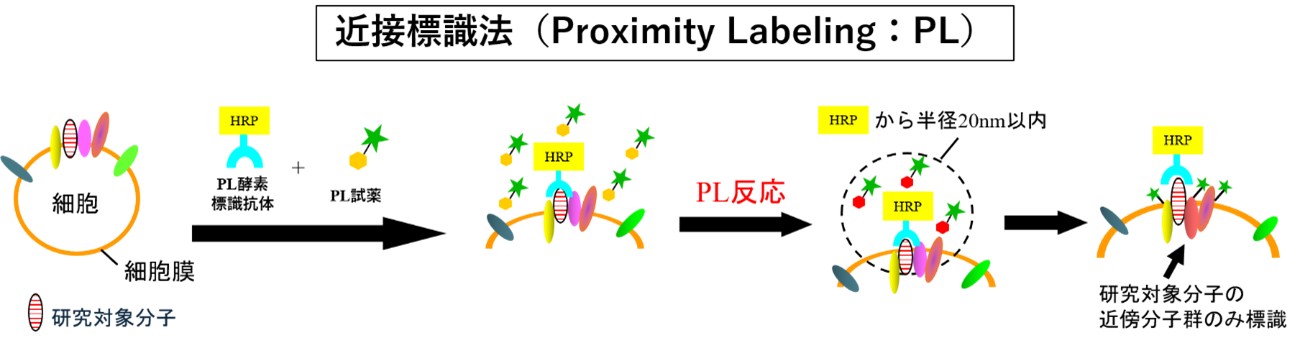
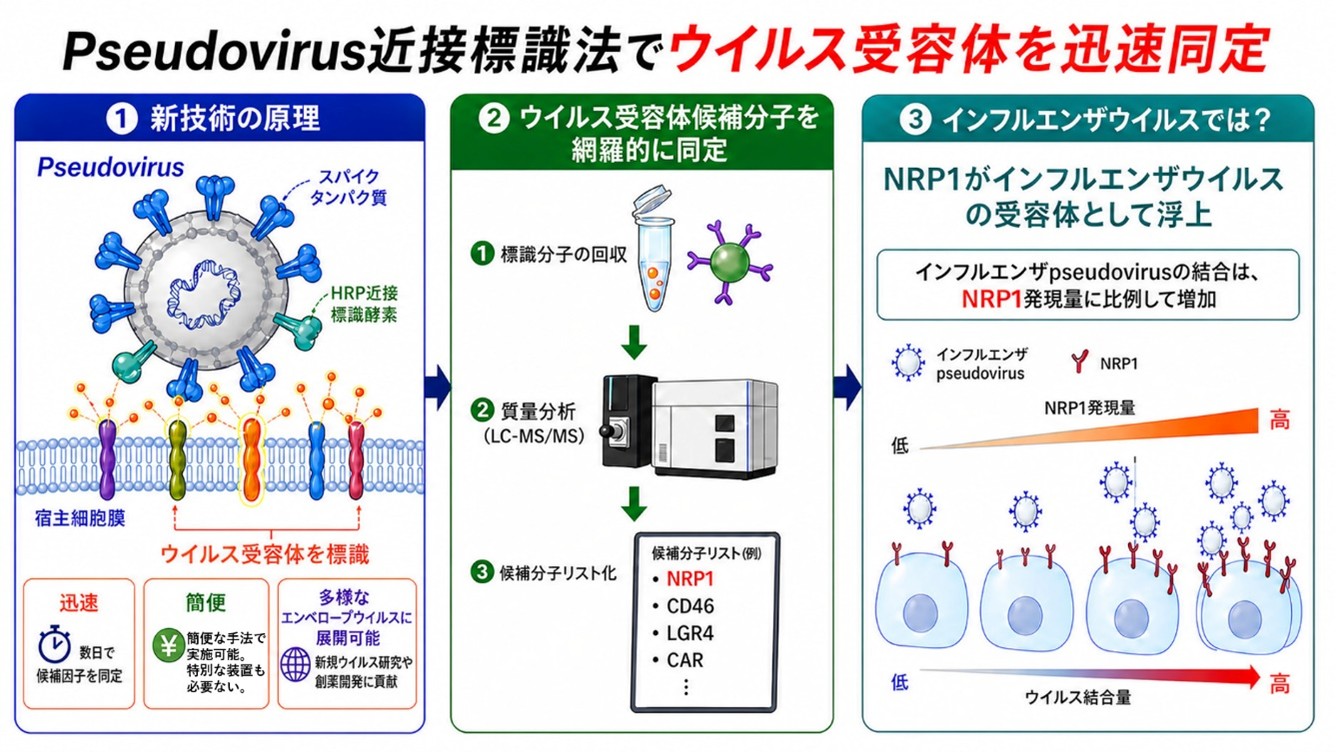
In this study, we created a "recombinant Pseudovirus for PL" in which both the PL enzyme (Horseradish Peroxidase: HRP) responsible for the labeling reaction and the spike protein of the research target virus were expressed on the surface of a recombinant virus called Pseudovirus, and performed the PL reaction while bound to host cells. Through this reaction, we were able to specifically label a group of membrane proteins that exist near the virus binding site, and perform proteome analysis and identification using mass spectrometry. Furthermore, by using pseudovirus, rapid analysis is possible in as little as 10 days.
Furthermore, the above analysis provided new knowledge about the viral receptors of influenza viruses that have the potential to cause pandemics. Until now, ``sialic acid'' was the main receptor known for influenza viruses, but it has been suggested that there may be other molecules involved in infection. Multiple candidate molecules were identified through PL reaction and proteome analysis using a pseudovirus expressing hemagglutinin and HRP, which are influenza virus surface proteins that bind to host cells, and human lung-derived host cells. When one of these, NRP1, was verified using a virus binding assay, it was confirmed that influenza virus binding increases depending on the amount of NRP1 expressed on the cell surface. This result indicates that influenza virus infection is affected not only by sialic acid but also by a molecule called NRP1. Therefore, it has been suggested that drug development targeting NRP1 may lead to new antiviral drugs against influenza viruses.
Future prospects
This method can theoretically be applied to a variety of viruses by simply replacing the spike protein gene expressed in the recombinant pseudovirus for PL. Therefore, it is expected that it will be widely and timely utilized for analyzing the infection mechanisms of emerging viruses with pandemic potential and known viruses whose receptors are unknown. Furthermore, the development of a "virus receptor database" that can cross-sectionally organize and compare the obtained receptor information will lead to strengthening the foundations for infectious disease research and antiviral drug development.
research funding
This research was supported by the Takeda Science Foundation High-Risk Emerging Infectious Diseases Research Grant. Additionally, the mass spectrometer used in the proteome analysis was provided with support from the JSPS Regional Core and Distinctive Research Universities Strengthening Promotion Project JPJS00420230009.
Thank you very much.
Paper information
Paper title: Pseudovirus-mediated proximity labeling identifies candidate host cell membrane proteins involved in viral attachment.
Magazine name: Journal of Virology (American Society for Microbiology)
Author: Norihiro Kotani, Kensuke Iwasa, Tomoko Amimoto, Chikara Yamashita, Kumiko Komatsu, Yutaka Narimichi, Yoshiki Wakabayashi, Yuuki Kurebayashi, Yutaka Horiuchi, Leona Kashimata, Ryoko Sasaki, Megumi Kumagai, Nan Yagishita-Kyo, Takeo Awaji, Takashi Murakami, Yosuke Mizuno, Miyako Nakano, Tadanobu Takahashi, Hideyuki Takeuchi, Koichi Honke
Posting date: April 29, 2026
URL: https://journals.asm.org/doi/10.1128/jvi.00507-26
Explanation of terms
Note 1) Virus receptor:
A molecule on the surface of host cells that is necessary when viruses infect cells. Some viruses require more than one molecule for infection.
Note 2) Proximity Labeling:
An experimental method that identifies groups of molecules that exist in the vicinity of the molecules that are the subject of research.
Note 3) Pseudovirus:
An experimental virus created to relatively safely investigate the infection mechanism by reproducing only the surface of a real virus. Genes necessary for pathogenicity and replication are deleted.
Note 4) Pandemic:
A global pandemic to which many people have no immunity. A pandemic virus is a virus that can cause this. Coronavirus is one example.
Note 5) Spike protein:
It protrudes from the surface of the virus particle and binds to the surface of the host cell. In influenza viruses, hemagglutinin functions as the spike protein.
- Press release materials (842.72 KB)
- Journal of publication (Journal of Virology)
- Hiroshima University Researcher Guidebook (Associate Professor Miyako Nakano)
*If you would like to conduct an interview, please contact the following in advance.
⊳ Inquiries about research
- Norihiro Kotani
Professor, Department of Pharmacology, Faculty of Medicine, Saitama Medical University
TEL: 049-276-1157
Email: kotani*saitama-med.ac.jp
- Hideyuki Takeuchi
Professor, Department of Biochemistry, Faculty of Pharmaceutical Sciences, University of Shizuoka
TEL: 054-264-5725
Email: htakeuchi*u-shizuoka-ken.ac.jp
- Miyako Nakano
Associate Professor, Graduate School of Integrated Life Sciences, Hiroshima University
TEL: 082-424-4539
Email: minakano*hiroshima-u.ac.jp
-Koichi Honke
Specially Appointed Professor, Department of Biochemistry, Faculty of Medicine, Kochi University
TEL: 088-880-2588
E-mail: khonke*kochi-u.ac.jp
⊳ Inquiries regarding interviews and reporting
- Saitama Medical University
Public Relations Office (in charge: Makita)
TEL: 049-276-2125
Email: koho*saitama-med.ac.jp
- Shizuoka Prefectural University
Corporate Planning Office
TEL: 054-264-5130
Email: koho*u-shizuoka-ken.ac.jp
- Hiroshima University
Public Relations Office (Person in charge: Takada)
TEL: 082-424-4383
Email: koho*office.hiroshima-u.ac.jp
- Kochi University
Public Relations/Alumni Division Public Relations Section
TEL: 088-844-8643
Email: kh13*kochi-u.ac.jp
(Please replace * with half-width @)