研究者情報
研究者名
Masato Kubo
overview
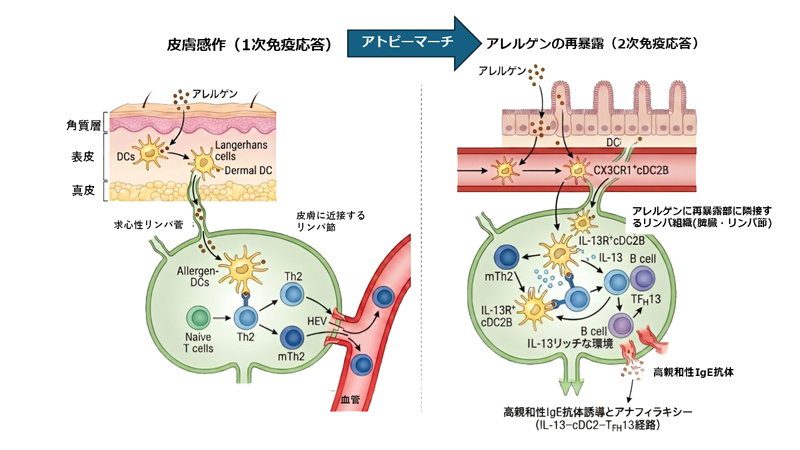
Professor Emeritus Masato Kubo of Tokyo University of Science (Kyoto University Graduate School of Medicine Specially Appointed Staff (Immunology Monitoring Center (KIC) Specially Appointed Professor), Associate Professor Yasutaka Motomura of the Institute of Biomedical Sciences of the same university, Assistant Professor Takanori Sasaki of the Department of Internal Medicine (Rheumatology and Collagen Diseases), Keio University School of Medicine (at the time of the research: Assistant Professor of Tokyo University of Science, Harvard Medical School, Brigham and Women's Hospital Research) An international collaborative research group from RIKEN Center for Biomedical Sciences, Benaroya Research Institute, University of Alabama, Icahn School of Medicine at Mount Sinai, and Washington University in St. Louis has elucidated the cellular and molecular mechanisms underlying the "atopic march," in which local skin inflammation such as atopic dermatitis progresses to food allergy, asthma, and even fatal systemic anaphylaxis.
The research group first conducted experiments using a mouse model, and found that in atopic march, the type 2 cytokine "IL-13" is not affected by B cells or T cells, but by specific dendritic cells (IL-13 receptor and fractalkine receptor receptors). We discovered that it acts on type 2 classical dendritic cells (cDC2) to significantly improve (license) their antigen-presenting ability and induces the production of IgE antibodies with high affinity for allergens, leading to systemic anaphylaxis.
Next, a correlation between an increase in cDC2 positive for IL-13 receptor expression and blood allergen-specific IgE levels was confirmed in the skin of human atopic dermatitis patients and in the peripheral blood of allergic patients. In addition, cDC2 patrolling in the blood transport allergens to secondary lymphoid tissues depending on the fractalkine receptor (CX3CR1). Inhibitors of this receptor suppressed the rise in allergen-specific IgE antibodies.
本成果は、アトピー性皮膚炎における抗IL-13抗体医薬の高い臨床的有効性のメカニズム的根拠を提供するものです。また、フラクタルカイン受容体の阻害薬がアトピーマーチに有効である発見は、新たなアレルギー疾患治療戦略の開発に大きく貢献することが期待されます 。
The results of this research were published in the Proceedings of the National Academy of Sciences (PNAS) on July 9, 2026. Additionally, on July 23, 2026, a review paper on the role of IL-13 signals and cDC2 in atopic march, including the results of this research, was published in the international academic journal Barrier Immunity.
研究者のコメント
"It is known that people with atopic dermatitis are prone to various allergies. In recent years, food-derived ingredients in cosmetics, substances in the saliva of ticks, and even sugar in red meat can enter the body through the skin without realizing it, causing anaphylactic shock after eating, which has become a social issue.
私たちの研究は、このような『アレルギーが連鎖的に起こる仕組み』をどのようにコントロールできるかを明らかにすることを目的に行われました。
本研究は、京都大学大学院医学研究科 医学研究支援センター 先端バイオメディシン解析技術室の多大なご協力により実施されました。この場を借りて深く感謝申し上げます。」(久保允人)
Source: https://www.kyoto-u.ac.jp/ja/research-news/2026-08-24-0