Thirty-five years on — well, 12 million technically — Ashfall Fossil Beds State Historical Park continues to offer up important glimpses of prehistoric life in Nebraska.
Consider, for example, Borophaginae, known commonly as bone-crushing dogs. In recent years, researchers have found footprints believed to be from these carnivores amid the ash at the site. They also have found tooth marks that seem to match the dogs’ teeth in the bones of rhinos, horses and camels that died in the ash, said Sam Matson, the park’s superintendent.
However, university scientists have yet to find skeletal remains, suggesting the animals — not actual dogs but an evolutionary offshoot about the size of wolves — may have survived the ash that trapped their prey at a watering hole long enough for them to enjoy some meals but left the scene before they died there with their dinner.
Video: Shane Tucker and Sam Matson discuss current research at Ashfall Fossil Beds
“We even find coprolites — fossil poop — that have chips of bone in it. So, we know those are coming from a dog. But so far, no skeletons of the scavengers, so we don’t know if they survived the event,” Matson said.
It’s possible that researchers will yet find skeletal remains of the animals, perhaps in fossil dens.
Ashfall Fossil Beds, part of the University of Nebraska State Museum, is celebrating its 35th year in 2026. Recent years’ findings about the bone-crushing dogs exemplify how research at the site, housed within 360 acres of Nebraska prairie near Royal, Nebraska, continues to yield knowledge.
Geologists believe that this mass graveyard is the result of an enormous volcanic eruption — 1,000 times larger than the 1980 Mount St. Helens blast — that occurred 12 million years ago in what is now southwestern Idaho, nearly 900 miles due west of the Ashfall Fossil Beds. The fine volcanic ash was deposited thousands of miles from the volcano, including a huge area of the Great Plains. The ash from this supervolcano eruption is still intact across much of northern Nebraska, about a foot thick in most places — but 8 to 10 feet thick at the Ashfall site.
Research has determined that the site was the location of a watering hole, basically a large depression on the landscape that would retain water during the wet season and dry out during arid spells, much like waterholes dotted across the savannas of Africa today. Fossils of pond turtles, remains of reed-like plant stems, and diatoms within the ash are evidence of water, but the lack of fish fossils and the absence of channeling in the strata indicate something less permanent than a lake or stream-fed pond. Nevertheless, the watering hole would have been a source of drinking water for local animals, as well as a place to wallow or bathe.
Smaller animals probably succumbed to the ash almost immediately. Larger ones would have survived the initial ashfall but slowly suffocated as the dust covered their food supply and became airborne. Their skeletons were preserved in the ash.
Paleontologist Mike Voorhies found the first fossil in 1971 while studying rocks in the area. He discovered a baby rhino jaw buried in volcanic ash up a gully, connected to the rest of the skull and skeleton. Several adult rhinos were found nearby.
National Geographic sponsored a dig in the late 1970s. A 1981 National Geographic article raised awareness, and the site became a State Historical Park in 1991 through a partnership between the University of Nebraska State Museum and the Nebraska Game and Parks Commission.
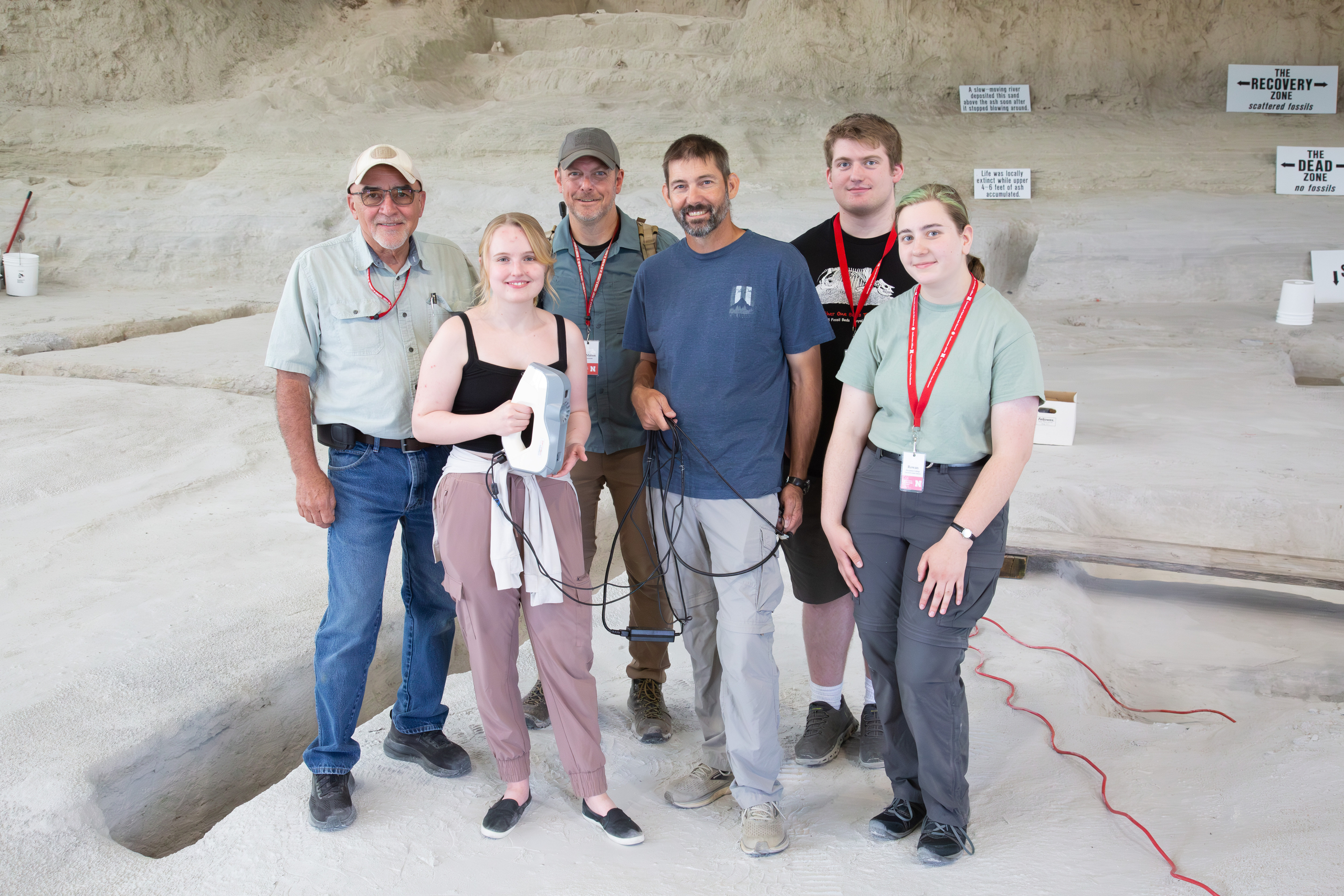
Ashfall Fossil Beds is unusual in that fossils are left, and studied, where they’re found, rather than moved to a laboratory. Ashfall also remains an active dig site, staffed every summer by student interns, who use tiny tools such as small paint brushes and dental picks to gently excavate the ash. Researchers also are working to digitize the fossil record with 3D scanning technology.
A structure named the Rhino Barn was built over a portion of the fossil bed.
Matson estimates there’s another 10 to 15 summers worth of work in the current excavation area.
There’s a misconception that everything has been found, he said, “but we find new things every summer.”
Matson, who grew up not far from the site and was an intern there himself 25 years ago, says Ashfall is a special place, both for visitors and those who work there.
“Especially in the mornings, when nobody’s here yet, just unlocking things for the day … the Rhino Barn feels like a type of sanctuary,” Matson said.
As for the next 35 years, Matson would love to host Earth system camps that would teach students about the interacting physical, chemical and biological processes that make up the planet and that are represented at Ashfall.