point
- Ammonia from samples from the asteroid Ryugu*1and various nitrogen compounds form salt crystals.*2の周辺に集まっていることを発見しました。
- Approximately 4.5 billion years ago, the water in the celestial body that formed Ryugu's parent body evaporated, froze, and decreased, creating dense salt water and forming salt crystals. It is thought that nitrogen compounds were also concentrated in the salt water at this time.
- Nitrogen compounds such as ammonia are used in the synthesis of living materials such as amino acids and nucleobases. This research has shown that the highly concentrated salt water that existed in the parent body may have been an environment in which chemical reactions that could lead to the creation of life could easily occur.
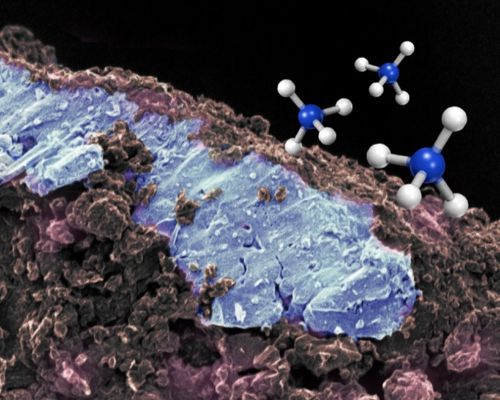
図1:Electron microscope pseudocolor images of salt minerals (blue) and clay minerals (brown) in Ryugu's sand and ammonium molecules (NH4+) illustration). (Kyoto University)
overview
Kyoto University Hakubi Center/Graduate School of Science Assistant Professor Toru Matsumoto, Kyoto University, National Institutes of Natural Sciences Research groups including the Institute for Molecular Science, Hiroshima University, Tokyo University of Science, Ehime University, and the High-Intensity Photon Science Research Center (JASRI) are using X-rays and infrared light to separate the sand from asteroid Ryugu brought back by the asteroid explorer Hayabusa2. As a result of the analysis, we discovered that nitrogen compounds such as nitrogen-containing salt crystals (nitrates), ammonia, and organic substances in which carbon and nitrogen are strongly bonded gather around salt crystals that are easily soluble in water, such as sodium carbonate and rock salt.
Ryugu is made up of fragments of a large celestial body that was formed about 4.5 billion years ago. Water used to flow inside the celestial body that is Ryugu's parent body, but as time passed, water decreased due to freezing and evaporation. At that time, salt crystals precipitated from the concentrated brine left behind, and nitrogen compounds are also thought to have been highly concentrated.
Organic substances such as amino acids and nucleobases, which are the building blocks of life, have already been discovered in Ryugu's sands, and nitrogen compounds such as ammonia are thought to have played a central role in their synthesis. This research shows that not only did water exist in Ryugu's parent body, but there was also a ``mechanism in which water decreased and components were concentrated,'' allowing reactive substances such as ammonia to encounter high concentrations and promoting reactions that evolved into complex living materials.
Such a thick salt water soup may exist not only on Ryugu but also on water bodies in the solar system, such as the dwarf planet Ceres, where salt water is expected to exist underground. Research on Ryugu is expected to provide clues to how and where the materials for life are formed on celestial bodies other than Earth.
本成果は松本徹特定助教のほか、分子科学研究所の湯澤勇人主任技術員、広島大学の小池みずほ准教授、東京科学大学の癸生川陽子准教授、京都大学の野口高明教授、JAXAの矢田達主任研究開発員、高輝度光科学研究センターの菅大暉研究員、伊奈稔哲研究員、物質・材料研究機構の佐久間博主任研究員、愛媛大学の白勢洋平講師、京都大学理学研究科博士前期課程(当時)の北村悠樹氏、京都大学理学研究科の伊神洋平准教授、同所属の三宅亮教授らによるもので、国際科学誌『Nature Astronomy』に2026年8月27日付で掲載されました。
Read the full article online here.
https://rdcu.be/fCpUr
1.背景
The Hayabusa2 asteroid probe of the Japan Aerospace Exploration Agency (JAXA) collected sand (Figure 2) from the surface layer of the asteroid Ryugu and brought it back to Earth. Since the return of the sample capsule at the end of 2020, researchers around the world have continued to study Ryugu samples. Analysis to date has revealed that the sand is rich in water and organic matter, and that the parent body of Ryugu (Botentai) was formed about 4.5 billion years ago, and water was flowing inside it. Ryugu's organic matter includes the compounds that form our life, such as amino acids and nucleobases, and it is thought that the water-filled environment of its parent body encouraged the synthesis of these organic matter. From this point of view, Ryugu's sand provides clues to understanding the extent to which life components were formed on celestial bodies other than Earth during the early solar system.
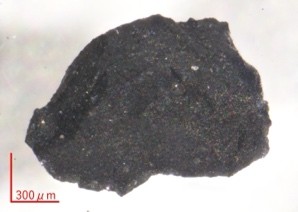
Figure 2:Ryugu sand (provided by JAXA)
Organic matter, which is the material of life, is a compound mainly composed of carbon, but one of the more important elements is nitrogen. Nitrogen is an element that is the main component of the earth's air, but it is also included in substances that support life, such as amino acids and DNA. The research group focused on the location of nitrogen in Ryugu's sand, and investigated the environment in which the celestial body was likely to produce the components that lead to life.
2. Research methods/results
Analysis of nitrogen compounds in Ryugu sand
Most of the volume of Ryugu's sand particles is made up of clay minerals created by the reaction between rocks and water.*3で占められています(図1)。一方で、炭酸ナトリウム(重曹の親戚)、塩化ナトリウム(岩塩)、などを含む塩結晶の脈が稀に含まれることを研究グループは透過型電子顕微鏡※4を使って見つけていました(図1と図3a)。今回の研究では、これまでにほとんど調べられていないリュウグウの塩結晶に注目し、窒素や有機物の分析を行いました。
まず、塩結晶を含む粒子に吸収される赤外線のスペクトルを調べたところ、アンモニアの吸収が確認されました。次に、塩の結晶の周囲からくりぬいた板に対して、X線吸収分光と呼ばれる手法*5We investigated the types of compounds (Figure 3). In this study, we used the beamline (BL4U) of the Extreme Ultraviolet Light Research Facility (UVSOR) of the Institute for Molecular Science in Okazaki City, Aichi Prefecture, and the beamline (BL27SU) of the large synchrotron radiation facility SPring-8 in Harima Science Park City, Hyogo Prefecture.
X-ray absorption indicative of ammonia was observed from clay near sodium carbonate, the main component of salt crystals (Figure 3c). Clay minerals have a structure consisting of many layers of plates with a skeleton of silicon and oxygen (Figure 3b). Between the plates, ammonia (actually ammonium: NH4+という陽イオンの状態)が入り込んでいると考えられます。
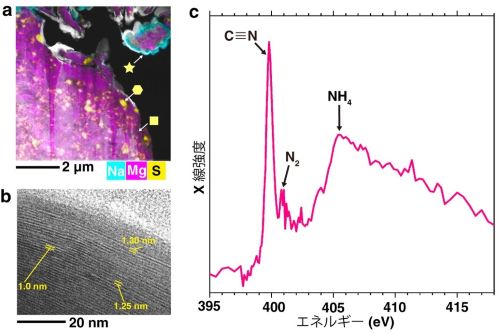
Figure 3:(a) Transmission electron microscopy image of Ryugu's sand. The distributions of sodium (cyan), magnesium (magenta), and sulfur (yellow) are overlaid. The light blue area indicated by the star is sodium carbonate. The yellow part pointed to by the hexagon is iron sulfide. A clay mineral in which the magenta color indicated by the square is spread throughout the particle. (b) Enlarged image of clay (saponite). You can see the layers that form the clay. (c) X-ray absorption spectrum obtained from the clay part. The horizontal axis is the irradiated energy, and the vertical axis is the X-ray absorption intensity. Ammonium (NH4+)とアンモニアが測定中に分解し生成した窒素ガス(N2), the peak of organic matter containing nitrogen (cyan or nitrile: C≡N) can be confirmed (Kyoto University)
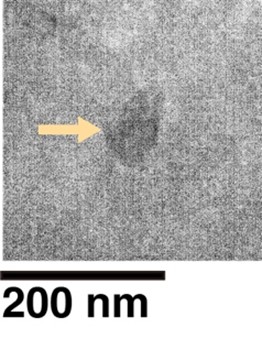
図4:硝酸ナトリウムの電子顕微鏡写真(京都大学)
On the other hand, another sample without salt showed no obvious nitrogen signature. This result shows that ammonia is not uniformly present everywhere on Ryugu, but is concentrated near the salt crystals. In addition, absorption of infrared rays and X-rays revealed that nitrile or cyanide (C≡N) compounds, in which carbon and nitrogen are strongly bonded, are often found around salt crystals. On the other hand, some sodium carbonate contains sodium nitrate crystals (NaNO3) was also found (Figure 4).
Why did nitrogen gather around salt crystals?
太陽系では、太陽から遠ざかるほど冷たくなります。近く熱い場所では物質が気体となり、「雪線(せっせん)」と呼ばれる境界より遠い場所では物質が凍ります。H2O and carbon dioxide (CO2)、アンモニア(NH3)には、太陽系初期にそれぞれの雪線がありました(図5)。これらの雪線より遠い場所、つまり氷が豊富に存在する場所でリュウグウの母天体は形成し、氷を大量に取り込んだと考えられています。その位置は木星よりも遠い場所であったと推定されています。
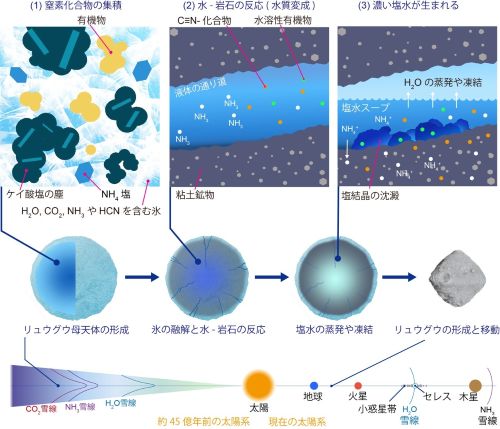
図5:リュウグウの母天体の形成と水-岩石の反応、そして塩水が消失するまでの一連の歴史(京都大学提供)
その後の母天体の太陽系内側への移動や、天体衝突による大規模破壊と破片の再集積を経て、現在のリュウグウができあがりました。リュウグウの軌道である地球ー火星の間はこれらの物質の雪線よりもかなり内側に位置します。
母天体の内部が温められると氷が融けて液体の水が生まれ、水が岩石と反応しました。この反応によって、もとの岩石から粘土などの新しい鉱物ができました。その後、天体の内部が冷えていくと、水は再び凍ったり、岩石の割れ目から蒸発したりして減少しました。残った少量の水には、溶けていた成分が集まります。これは、海水を蒸発させると塩が残る仕組みとよく似ています。また、水が凍るときには、氷の中に入りにくい塩が液体の水に集まります。炭酸ナトリウムなどの塩結晶は、こうした現象によって高濃度の塩水が最後に消失する際に形成したと推測されます。そして、アンモニアやその他の窒素化合物もまた、濃い塩水に溶けていた成分として残されたと考えられます。
母天体に存在した濃厚な塩水スープが有機物合成を促進
The highly reactive nitrogen compounds such as ammonia discovered in this study are the main raw materials when organic substances, such as amino acids and nucleobases, which are the building blocks of life, are synthesized in water. In Ryugu's parent body, such nitrogen compounds are thought to have been taken in along with ice and organic matter in the early stages of the body's formation, and some remained until the final stage when water disappeared. Furthermore, in salt water where the amount of water is reduced and nitrogen compounds and organic matter are concentrated, it is possible that the components in the water more easily meet each other, making it easier for chemical reactions to proceed. In this study, we showed that the last salt water inside such a parent body may have been an environment favorable for the synthesis of living materials.
3.波及効果、今後の予定
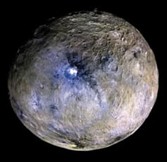
図6:準惑星セレス(NASA提供)
太陽系には、準惑星セレス(図6)など地下に塩水が存在すると予想されている天体が存在します。また天文観測によって、アンモニアを含む小惑星が次々と見つかっています。とくにセレスにはアンモニアを含む粘土や炭酸ナトリウムが見つかっており、リュウグウと似た塩水の環境があるのかもしれません。リュウグウの母天体のような有機物質を育む濃い塩水環境は、太陽系の様々な天体でも存在するかもしれず、将来の惑星探査が期待されます。
4. About the research project
In connection with this research, we received the following support. Grants-in-Aid for Scientific Research (19H00725, 19KK0094, 20H00198, 20H00205, 21H05424, 21K113981, 21H05431, 23H01286, 23K17700, 24K00692, 24H00271, 24H00268, 26H00688), Kyoto University Hakubi Center, National Institutes of Natural Sciences Astrobiology Center, Institute of Molecular Science (Research Projects: 24IMS6628, 25IMS6633), High Brightness Photo Science Research Center (SPring-8 Research Projects: 2020A2139, 2021B2093, 2024A1958, 2025B1220)
用語解説
※1 アンモニア:アンモニア(NH3) is a substance made of nitrogen and hydrogen. In water, some of it is ammonium (NH4+)というイオンに変わります。アンモニウムは粘土の層の間などに保存されることがあります。
※2 塩結晶:リュウグウで見つかっている塩鉱物である炭酸ナトリウム(重曹の親戚)や硫酸ナトリウム(バスソルトで使われる)、塩化ナトリウム(岩塩)の結晶は、私たちが水回りで接する機会があります。硝酸ナトリウム(チリ硝石)は南米チリで産出することが知られています。
※3 粘土鉱物:非常に薄い板が何枚も重なったような鉱物です。板と板の間に、水やナトリウム、アンモニウムなどを取り込むことがあります。
*4 Transmission electron microscope: A microscope that irradiates a sample processed to a thickness of 100 nm with a high-voltage electron beam and obtains an interference image of the electrons generated when the electrons pass through the sample, making it possible to observe microstructures on an atomic scale.
※5 X線吸収分光:物質にX線を照射してその吸収量を調べることで、元素分布などを調べる分析手法のことです。UVSORでは走査型透過X線顕微鏡(STXM)という分析装置を用いました。これは、100nmの厚さに薄く加工した薄膜の試料に軟X線を集光して照射し、さらに試料をスキャンすることで、透過したX線の強度の2次元画像を撮り、軟X線吸収量の分布を数十ナノメートル程度の空間分解能で測定できる分析装置です。この装置を利用すると、標的元素(主に軽元素や遷移金属元素)や,その化学状態の分布をマッピングすることが可能です。SPring-8ではPFY-XANES(部分蛍光収量X線吸収端近傍構造)と呼ばれる手法を用いました。これは試料にX線を照射し、特定元素から放出される蛍光X線だけを選んで測定する分析手法です
Researcher's comments
リュウグウの砂に含まれる塩の結晶は、湿気にさらされるだけでも溶けてしまうほど変化しやすく、地上で雨風にさらされる隕石からはほとんど見つかっていません。宇宙から直接持ち帰ったリュウグウの砂を分析したことで、母天体内部の塩水環境が、少しずつ明らかになってきました。今後、NASAの探査機が持ち帰った小惑星ベヌーの試料の分析も進み、リュウグウとの共通点や違いが明らかになれば、生命の材料となる物質が宇宙でどのように、どこまで作られたのか、そしてそれらが地球へ運ばれた可能性があるのかについて、さらに理解が深まると期待しています。(松本徹)
論文タイトルと著者
タイトル:Ammonium-bearing clays and multiple nitrogen species linked to late-stage brines of Ryugu's parent body (リュウグウ母天体の末期塩水に関連するアンモニウム含有粘土と多様な窒素化学種)
Authors: Toru Matsumoto, Hayato Yuzawa, Mizuho Koike, Yoko Hibukawa, Takaaki Noguchi, Tatsu Yada, Daiki Suga, Minoru Ina, Hiroshi Sakuma, Yohei Shirase, Yuki Kitamura, Igami Youhei, Ryo Miyake
¹京都大学、²分子科学研究所、³広島大学、⁴東京科学大学、⁵宇宙航空研究開発機構、⁶高輝度光科学研究センター、⁷物質・材料研究機構、⁸愛媛大学、⁹日本分光株式会社
掲 載 誌:Nature Astronomy DOI:10.1038/s41550-026-02962-y
Reference materials
Toru Matsumoto
Kyoto University Hakubi Center/Graduate School of Science Department of Earth and Planetary Sciences Special Assistant Professor
E-mail: matsumoto.toru.2z*kyoto-u.ac.jp
Mizuho Koike
Associate Professor, Graduate School of Advanced Science and Engineering, Hiroshima University
TEL: 082-424-7467
E-mail: mizuhokoike*hiroshima-u.ac.jp
癸生川陽子
東京科学大学 理学院 地球惑星科学系 准教授
E-mail: kebukawa.y.ca28*m.isct.ac.jp
京都大学 広報室 国際広報班
TEL: 075-753-5727
E-mail: comms*mail2.adm.kyoto-u.ac.jp
Public Relations Office, Research Strengthening Strategy Office, Institute of Molecular Science, National Institutes of Natural Sciences
TEL: 0564-55-7209
Email: press*ims.ac.jp
Hiroshima University Public Relations Group
TEL: 082-424-4518
E-mail: koho*office.hiroshima-u.ac.jp
Tokyo University of Science, General Affairs and Planning Department, Public Relations Division
TEL: 03-5734-2975
E-mail: media*adm.isct.ac.jp
Ehime University General Affairs Department Public Relations Division
TEL: 089-927-9022
E-mail: koho*stu.ehime-u.ac.jp
Public Interest Incorporated Foundation High Brightness Photon Science Research Center (JASRI) Utilization Promotion Department Dissemination Information Division
TEL: 0791-58-2785
E-mail:kouhou*spring8.or.jp
(Please replace * with half-width @)