Stars mostly form in clusters. Open star clusters on the Milky Way disk are affected by the tidal force of the Milky Way during their long-term evolution, gradually disintegrating and releasing their member stars into the Milky Way disk. Neutron stars, as the remnants of the evolution of massive stars, also originate from star clusters. Currently, thousands of neutron stars acting as pulsars have been discovered in the Milky Way disk. However, astronomers have never directly observed neutron stars entering the Milky Way disk from birth clusters before. As a result, there has been a lack of observational evidence for the evolutionary origin of the neutron star population on the Milky Way disk.
Recently, international teams such as the Purple Mountain Observatory of the Chinese Academy of Sciences and the National Astronomical Observatory, relying on the "China Sky Eye" (FAST), the MeerKAT radio telescope in South Africa, and the Canada-France-Hawaii optical telescope, accurately identified pulsars in the tidal tails of open star clusters for the first time. Through multi-body dynamics simulations, they reconstructed the process of low-kick neutron stars disintegrating with the cluster and gradually entering the Milky Way disk.
The team's observation target focused on NGC 6791, the oldest open star cluster in the Milky Way. This star cluster is about 8 billion years old and is one of the most massive open star clusters in the Milky Way, with obvious tidal structures on the periphery. Team passedFAST detected the isolated pulsar PSR J1921+3745 with a rotation period of about 1.9 seconds, and further determined its sub-arcsecond precise position with the help of the MeerKAT radio telescope in South Africa. It also used the Canada-France-Hawaii Telescope CFHT in Hawaii to depict the star distribution in the outer reaches of the cluster from the depth of the optical band. It was found that the pulsar was located in a tidal structure on the east side of the cluster.
Multi-body dynamics simulations show that almost all high-kick-speed neutron stars formed by core-collapse supernovae escape from the star cluster within 40 million years after its formation. Low-kick neutron stars, represented by electron capture supernovae, can be retained in star clusters for billions of years, and then gradually enter the tidal tail due to stellar interactions and tidal stripping of the Milky Way. Dynamic simulations and collaborative radio-optical observations found the missing "household certificate" for the origin of the neutron star.
This study provides key observational evidence to connect the origin of neutron stars in star clusters and the evolution of neutron star populations on the Milky Way disk, filling in the key evolutionary link of neutron stars from their birth clusters to the Milky Way disk. This result shows that ancient and massive open star clusters may have long-term preservation of a batch of neutron stars that are difficult to observe directly, and release them to the Milky Way disk in the process of gradual disintegration.
Relevant research results were published in "Science Bulletin" (Science Bulletin)superior. The research work is supported by the National Natural Science Foundation of China and the Ministry of Science and Technology.
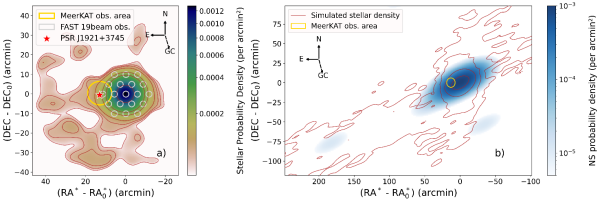
Star density map of NGC 6791 member stars based on observations (left picture) and numerical simulation (right picture)
Source: https://www.cas.cn/syky/202609/t20260908_5119891.shtml