The establishment of complex terrestrial ecosystems is a milestone in the history of the evolution of life on Earth. It marks the complete escape of life from the constraints of the ocean and opens a new stage in the evolution of terrestrial biodiversity.Molecular clock estimates, trace fossils, and evidence from specific buried biota indicate that the evolutionary process of arthropod landings can be traced back to the Cambrian-Ordovician period, much earlier than recognized by traditional fossil records. As the animal group with the highest species diversity on Earth, there has been a long-standing research gap in the early origins and landing evolution history of insects.
Previously, there was a famous "hexapod gap" in the world of paleontology. Molecular clocks estimate that hexapods diverged from marine crustaceans and started adapting to land as early as the Cambrian-Ordovician period. However, the uncontroversial hexapod fossils discovered around the world only date back to the Early Devonian (about 405 million years ago), while confirmed insect fossils did not appear in large numbers until the late Carboniferous. There is a gap of 80 million years in the fossil record between the two.At the same time, there is still a lack of direct fossil evidence on how early insects gradually adapted to terrestrial life from aquatic and semi-aquatic environments. The evolution of their body structure has always lacked direct fossil evidence. The academic community has a vague understanding of the evolutionary path, morphological innovation and ecological adaptation mechanism of insect landing.
Recently, the Nanjing Institute of Geology and Palaeontology of the Chinese Academy of Sciences, in collaboration with an international scientific research team, discovered a new stem group of insects from the late Mississippian Period, about 324 million years ago - the pioneer Joxitonia (Chosha praecursorTihelka, Engel & Cai, 2026), and re-examined cryptic stem group insect fossils from the British Early Devonian Leni Chert Biota and the American Late Carboniferous Mazon Creek Biota.The discovery of this batch of insect fossils has filled a key gap in the early evolution of insects, revised the traditional understanding of the evolution of insect body structure and the landing process of pan-crustaceans, and provided core evidence for revealing the gradual evolution of insects from aquatic to terrestrial.
The pioneer Joxiton fossils discovered by the scientific research team this time were produced in the calcareous claystone nodules of the Tesnus Formation in the Marathon Uplift in western Texas, USA. They are well preserved and have a fine structure.The team used cross-polarized light imaging technology to analyze its unique body morphological characteristics and clarified the misunderstanding that it had long been misjudged as a crustacean larvae. The fossil specimen is a female adult with a body length of 32.09 mm, including a mid-caudal filament and two caudal palps, with a total length of up to 49.66 mm. The overall body is spindle-shaped, with typical characteristics derived from hexapods and insects, and retains the characteristics of its original ancestors.
Studies have shown that the pioneer Joxitonia possesses key structures such as the ovipositor and terminal filament that are iconic to insects. It has a segmented trunk and six-segmented walking legs on the thorax, which is consistent with the body structure of insects. However, its most special original feature is that segmented appendages are developed on segments 1 to 9 of the abdomen, and the rear abdominal legs are specialized into a paddle-like structure. This unique shape has never been found in living crown group insects.Combined with paleoenvironmental analysis, the fossil was produced in a shallow water, delta coastal environment, confirming that this early stem group of insects had semi-aquatic amphibious living habits and inhabited a humid microenvironment at the junction of water and land.
Relying on detailed morphological observations and phylogenetic analysis, the research team re-revised three mysterious Paleozoic hexapod fossils, including the Early Devonian Leverhulmeia in Scotland (Leverhulmia), an unnamed hexapod fossil from the Mazon Creek biota in the United States. The results of phylogenetic reconstruction confirmed that the pioneer Choxizoa and the above-mentioned fossils together constitute the original basal group of insects. As the oldest insect fossil group in the world, this group connects the evolutionary lineage of early insects.
The research has reshaped the core understanding of the terrestrial evolution of insects. In view of the "hexapod evolutionary gap" that has troubled the academic community for a long time, the conclusive origin and early differentiation time of insects have been traced back from the Late Carboniferous to the Early Devonian, reconciling the contradiction between the molecular clock inference results and the fossil record.
Previously, academic circles generally believed that insects directly evolved a completely terrestrial body structure after landing. However, the paddle-shaped gastropods and amphibious living habits discovered this time directly prove that the insect landing did not evolve in a leap, but went through a long semi-aquatic amphibious transition stage.In addition, fossils also reveal key evolutionary rules of insect body configuration. Living hexapods only retain six legs in the thorax, and the abdominal appendages are completely degenerated, while basal insects in the Paleozoic generally retain segmented gastropods, confirming that the degeneration of abdominal appendages is a key evolutionary innovation for insects to adapt to terrestrial life. This feature was gradually simplified and lost from the swimming legs of aquatic crustaceans, and eventually formed the standard body pattern of living insects, clarifying the morphological transition mechanism of the evolution of crustacean to hexapod insect bodies.
The primitive ovipositor structure preserved by the pioneer Joxitonia also proves that early insects have evolved diversified egg-laying adaptation capabilities, laying a structural foundation for their subsequent development of diverse terrestrial microhabitats and the realization of a large-scale radiation of species.At the same time, the study clarified the ecological adaptation scenarios of early insects. Basal insects have both aquatic movement, respiratory adaptation, and terrestrial body structure, and their feeding habits include humus, plant detritus, fungal spores, and small arthropods. This indicates that early insects played multiple ecological roles such as decomposers and predators in the aquatic and terrestrial ecosystem, and were a key group in the improvement of the Paleozoic terrestrial ecosystem.
Pioneer Joexitida and related basal insect fossils from the Paleozoic era completely restore the early landing and evolution of the most successful animal groups on earth, refreshing the academic community's understanding of insect body size evolution, ecological adaptation and the co-evolution of terrestrial ecosystems. It is confirmed that land colonization by insects is a step-by-step process. The retention, transformation and degradation of aquatic structures run through the entire early evolution process. The existence of the amphibious transitional stage is the key evolutionary cornerstone for insects to finally conquer land.This result not only provides precious fossil evidence for analyzing the origin differentiation and body structure evolution of hexapods, but also provides a new research perspective for exploring the origin and early evolution of complex terrestrial ecosystems on Earth.
Relevant research results were published in Nature (Nature)superior. The research work is supported by the National Natural Science Foundation of China and the Ministry of Science and Technology.
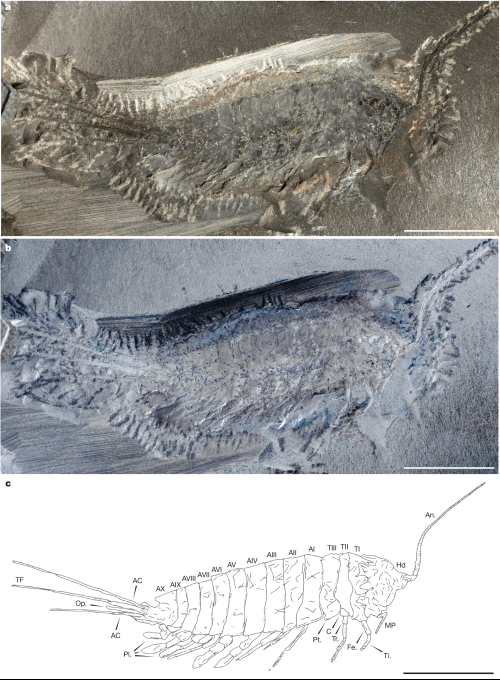
The pioneer of dry group insects, Joxitonia, from the Carboniferous Tesnas Formation of Texas, USA (approximately 324 million years ago)
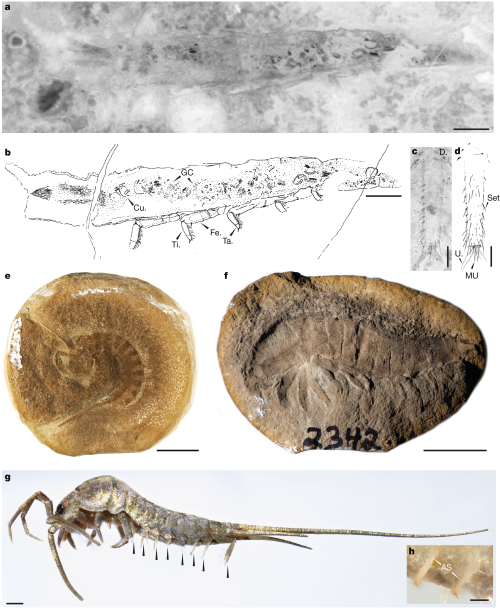
Comparison of anatomical details of stem group insects and living wingless insects
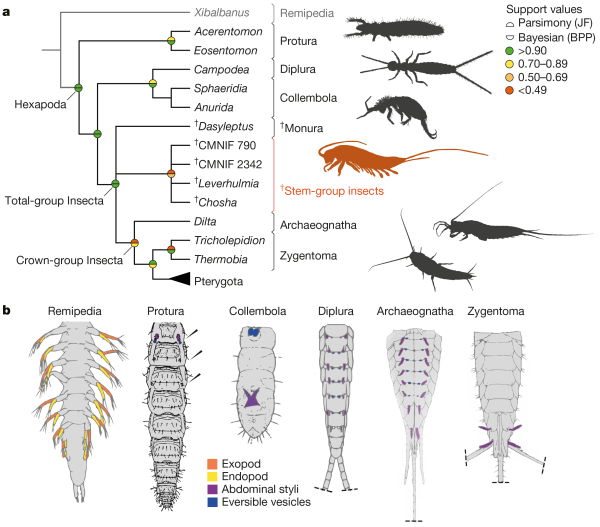
Early hexapod phylogeny and evolution of important characteristics
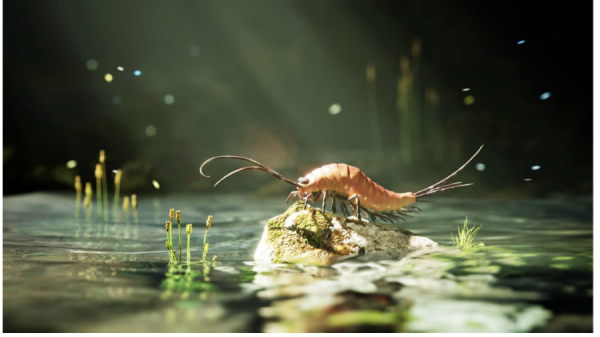
Paleoecological restoration map of the Carboniferous pioneer Joxitida (drawn by Tan Chao of the Nanjing Institute of Paleontology)
Source: https://www.cas.cn/syky/202608/t20260825_5119003.shtml