Researchers from the Institute of Microbiology of the Chinese Academy of Sciences (IMCAS) have characterized the structural and functional properties of the emerging SARS-CoV-2 sublineage BA.3.2.2 by studying RE.2.2, the lineage designation for the BA.3.2.2 branch gaining prevalence after prolonged low detection in European surveillance datasets.
The study, conducted by Prof. GAO George Fu's laboratory at the Institute of Microbiology of the Chinese Academy of Sciences (IMCAS), was published in PNAS on September 8.
The researchers found that RE.2.2 has enhanced binding to the human ACE2 receptor, a distinct antibody escape profile, and a previously unobserved N-linked glycosylation site at residue N529 of the spike (S) protein. These features are discussed below.
The sublineage BA.3.2.2, derived from Omicron BA.3, has shown accelerated spread across several regions of the world. Using surface plasmon resonance (SPR) and cryo-electron microscopy (cryo-EM), the researchers determined that the receptor-binding domain (RBD) of RE.2.2 displays high affinity for human angiotensin-converting enzyme 2 (hACE2). Structural analyses revealed that a reverse mutation, R493Q, forms an additional hydrogen bond with hACE2 residue K31, serving as a primary determinant of heightened receptor engagement.
The researchers also tested the interaction of RE.2.2 with ACE2 proteins from different animal species. The results indicated that the host species range of RE.2.2 was broadly comparable to that of the Omicron variants used for comparison.
In addition, the researchers noted that pseudovirus neutralization and binding assays demonstrated a remodeled immune evasion landscape. While RE.2.2 evaded multiple antibody classes, several broadly neutralizing antibodies that had lost activity against earlier Omicron lineages (such as S2K146 and L4.65) regained potent neutralizing capacity against RE.2.2.
Cryo-EM ternary structures showed that the key substitution G446D directly facilitates antibody interactions, illustrating that viral antigenic evolution is constrained by structural requirements and cannot proceed without limits.
Furthermore, comprehensive glycoproteomic profiling using liquid chromatography–tandem mass spectrometry (LC-MS/MS) and cryo-EM revealed up to 26 N-linked glycosylation sites on the S trimer.
Among them, RE.2.2 harbors a novel N-linked glycosylation site at position N529 on the RBD, an alteration previously unobserved in SARS-CoV-2 variants. This modification forms inter-protomer hydrogen bonds that structurally stabilize the spike in a closed conformation, balancing high receptor affinity with regulated viral entry.
The findings also support the "O-follows-N" rule of protein glycosylation, highlighting the coordinated organization of glycans in coronavirus spike proteins.
This work was supported by the National Key Research and Development Program of China, the External Cooperation Program of CAS, and the National Natural Science Foundation of China.
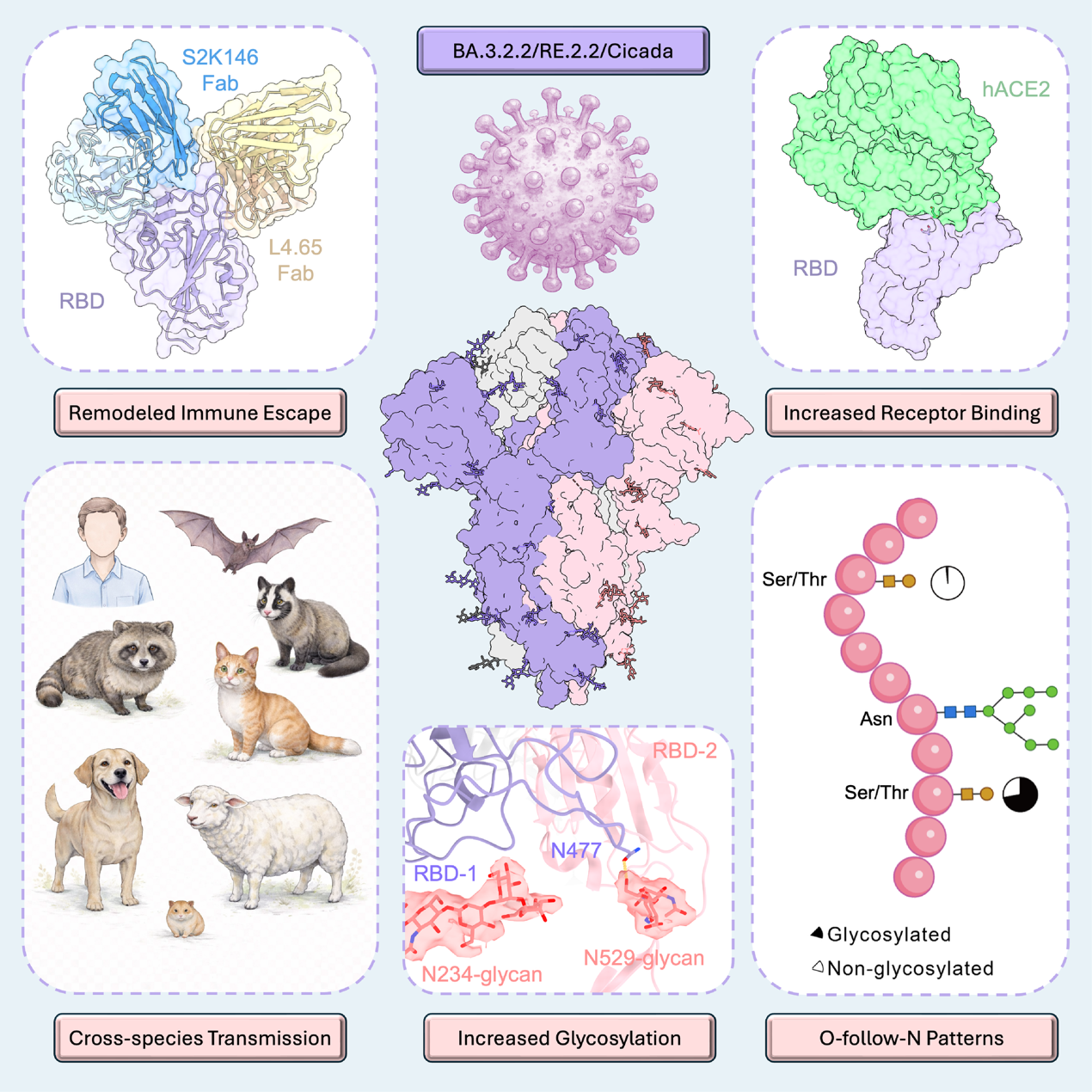
Structural features, receptor recognition, and glycosylation profiling of SARS-CoV-2 sub-variant BA.3.2.2/RE.2.2. (Image by Prof. GAO George Fu's group)
Source: https://english.cas.cn/newsroom/research-news/202609/t20260908_1192775.shtml