The pistil is the female reproductive organ of flowering plants. The stigma at the top is responsible for capturing and identifying pollen, and the style below provides a growth channel for the pollen tube. The presence of a clear, stable boundary between the stigma and style is essential to ensure sexual reproduction in the plant.
中国科学院植物研究所、遗传与发育生物学研究所等以十字花科植物淡红荠(Capsella rubella) as the research object, and made a breakthrough in the study of the mechanism of establishing the top boundary of the pistil.
The team found that the auxin response factor CrARF3/CrETT protein accumulated at high levels in the style and was selectively excluded in the stigma formation area. In contrast, the distribution of auxin was highest in the stigma area, showing a complementary distribution pattern with CrETT protein.CrettThe mutation causes the stigma-specific papilla cells to be ectopically derived into the style region, so CrETT protein and auxin distribution jointly delineate the boundary between the stigma and style.
The team's comparative analysis of ETT homologous proteins within the scope of land plants showed that ETT homologous proteins from gymnosperms, ferns, and bryophytes were insensitive to auxin treatment, while all tested ETT homologous proteins from angiosperms showed varying degrees of auxin-induced degradation. This result clearly shows that auxin-induced ETT degradation is a "new characteristic" acquired during the evolution of angiosperms and may be closely related to the origin of the complex pistil structure of angiosperms.
The study revealed a new mechanism by which auxin establishes the stigma-style boundary of pistils by inducing the degradation of the transcription factor ETTIN, and discovered an angiosperm-specific ARF protein degradation regulation method mediated by the PxS2 motif. This discovery enriches the understanding of the auxin signal transduction pathway, answers the basic question of developmental biology "how tissue boundaries are established", and provides important clues for understanding the origin and evolution of angiosperm reproductive organs.
相关研究成果在线发表在《美国国家科学院院刊》(PNAS)superior. The research work is supported by the National Natural Science Foundation of China.
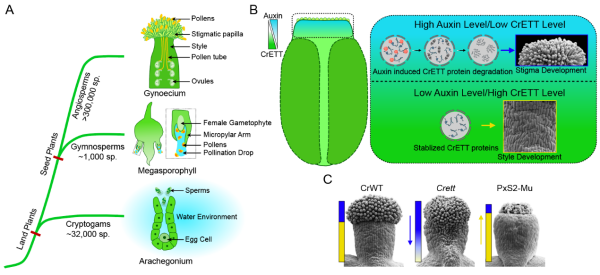
Auxin-mediated ETT protein degradation and stigma-style boundary formation mechanism
Source: https://www.cas.cn/syky/202608/t20260826_5119035.shtml