Key points of this research result
- Asteroid Ryugu*1It was revealed that the particles brought back to Earth (Ryugu particles) begin to undergo alteration within a few weeks on Earth, and spread to the surrounding area within a few months.
- Pyrrhotite widely contained in Ryugu grains*2We showed that a mineral called (pyrhotite) oxidizes first, and that this reaction causes a chain reaction of alteration of surrounding minerals and organic matter.
- Experimental data showed that a strict environment that combines low temperature, low oxygen, and low humidity is important for preserving valuable samples brought back from space.
overview
A joint research group led by Associate Professor Masaaki Miyahara of Hiroshima University's Graduate School of Advanced Science and Engineering, consisting of Kyoto University, Japan Agency for Marine-Earth Science and Technology, Kochi Core Research Institute, Institute for Molecular Science, Osaka Public University, and the National Institute of Polar Research, has discovered that the Hayabusa 2 spacecraft is an asteroid. We conducted atmospheric exposure experiments, electron microscopy, and synchrotron radiation X-ray spectroscopy on the particles brought back from Ryugu, and found that alteration begins within a few weeks after returning to Earth, and that the effects spread to surrounding minerals and organic matter within a few months.
In this study, pyrrhotite in Ryugu particles is first oxidized, forming an amorphous iron- and oxygen-rich*3The reaction forms an altered layer and the surrounding phyllosilicate.*4It was shown that it causes deterioration of organic matter. Furthermore, we estimated the initial rate of alteration of pyrrhotite to be approximately 0.1 nm/day, and presented quantitative indicators that indicate that alteration can proceed even under room temperature and low humidity conditions.
This result is based on Ryugu and Bennu.*5Asteroid samples such as the future Mars moon Phobos as well as*6This will also provide important implications for preservation strategies for samples returned from Mars. The results of this research were published in the international academic journal "Nature Communications" on May 29th.
Paper information
Magazine name: Nature Communications
Paper title: Pyrrhotite-driven early-stage terrestrial alteration in Ryugu grains
Author: Masaaki Miyahara, Takaaki Noguchi, Toru Matsumoto, Naotaka Tomioka, Tohru Araki, Akira Miyake, Yohei Igami, Yusuke Seto, Akira Yamaguchi
DOI: https://doi.org/10.1038/s41467-026-73875-7
background
Samples brought back from asteroids, the Moon, Mars, etc. are extremely valuable materials that allow us to directly investigate the evolution of materials in the early solar system and the origins of water, volatile components, and organic matter. In particular, samples from the carbonaceous asteroid Ryugu contain hydrated minerals and organic matter, and are thought to be the key to understanding water quality alteration and organic chemical evolution in the early solar system.
On the other hand, such samples are extremely sensitive to the earth's environment, which is rich in water and oxygen, and may undergo alteration during the storage, transportation, and analysis processes after return. However, it has not been clear until now which minerals undergo alteration first, how the effects spread to their surroundings, and at what rate.
Contents of research results
The research group conducted an atmospheric exposure experiment using a sample plate loaded with Ryugu particles at a temperature of 20 to 23 degrees Celsius and a relative humidity of 30 to 40%. Samples can be tracked over weeks or months and scanned using scanning electron microscopy.*7, transmission electron microscope*8, synchrotron X-ray absorption spectroscopy*9We used this to examine the surface and internal changes in detail. As a result, we found the following:
1. Surface alteration of pyrrhotite begins in a few weeks.
When the pyrrhotite in Ryugu particles was exposed to the Earth's atmosphere, it oxidized from the surface, forming an amorphous altered layer rich in iron and oxygen (Figure 1).
2. Within a few months, the alteration spreads to surrounding minerals and organic matter.
On this time scale, pyrrhotite oxidized first, and as a result an acidic and oxidizing environment was created locally. As a result, the surrounding phyllosilicates partially became amorphous, and nanoscale bubbles and carbon/oxygen-rich precipitated layers were formed in the organic matter. In other words, the oxidation of pyrrhotite was the starting point, and a chain of alteration of the surrounding materials progressed.
3. The initial alteration rate was quantified.
Based on the thickness of the altered layer of pyrrhotite, the initial stage alteration rate was estimated to be approximately 0.1 nm/day. This shows that important mineralogical and chemical information can be lost even on relatively short time scales after return to Earth.
4. Can deteriorate even under current standard storage conditions
General curation, such as storage in dry air, nitrogen atmosphere, or near room temperature*10It was shown that alteration can proceed even under these conditions. These results demonstrate that when storing returned samples, it is necessary to manage low temperature, low oxygen, and low humidity in addition to simply using inert gas. In particular, nanometer-scale alteration can progress on a daily basis near room temperature, so samples must be stored and analyzed at as low a temperature, low oxygen, and low humidity as possible.
Future developments
In the future, we will conduct similar analyzes on a larger number of Ryugu particles to clarify how the process of alteration changes depending on the type of mineral and the fine structure of the particles. Furthermore, we hope to utilize the knowledge gained from this research to help establish more appropriate storage, transportation, and analysis methods for samples scheduled to be returned from Bennu, Phobos, Mars, etc. in the future.
Furthermore, the alteration of extraterrestrial materials in the global environment has long been a major issue in meteorite research. For example, the carbonaceous chondrite meteorite that will be compared to the Ryugu samples was recovered by an Antarctic expedition and stored at a curation facility. However, these meteorites also contain pyrrhotite, which undergoes alteration through oxidation, sometimes producing white weathering products on the rock surface (Figure 2). This study shows that even samples stored in a facility may not be able to completely prevent deterioration depending on the conditions. In order to protect the important scientific information originally contained in extraterrestrial samples, it is necessary to consider even more rigorous storage conditions in the future.
Reference materials
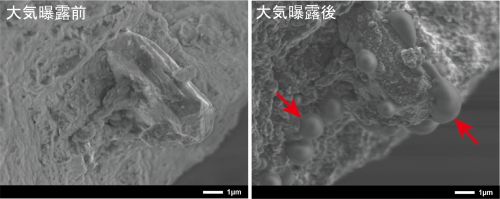
Figure 1. Electron micrographs of pyrrhotite before and after exposure to the atmosphere. Red arrows indicate iron- and oxygen-rich alterations resulting from the oxidation of pyrrhotite.
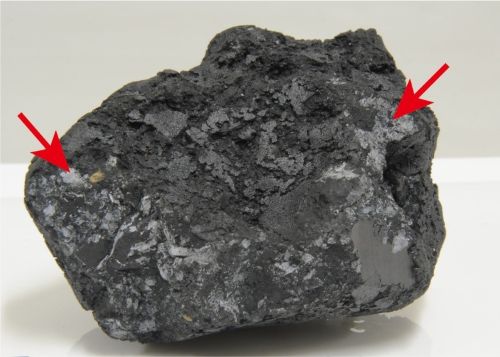
Figure 2. A white product formed by earth weathering on the surface of a carbonaceous chondrite meteorite containing pyrrhotite (provided by the National Institute of Polar Research)
Glossary
*1 Ryugu: A carbonaceous asteroid that was explored by JAXA's Hayabusa2 spacecraft and returned samples to Earth in 2020. It is thought to be a "rubble pile" type object with a diameter of about 900 m.
*2 Pyrrhotite: A sulfide mineral consisting of iron and sulfur. Highly reactive with water and easily oxidized in the Earth's atmosphere.
*3 Amorphous substance: A substance with no regular arrangement of atoms.
*4 Phyllosilicate: A silicate mineral with a layered crystal structure. This will provide clues to how water works in asteroids and meteorites.
*5 Bennu: A carbonaceous asteroid from which NASA's OSIRIS-REx probe returned samples. A celestial body that contains water-containing minerals and organic matter, and is important for investigating the evolution of materials in the early solar system.
*6 Phobos: One of the small moons orbiting Mars. Mars has two moons, Phobos and Deimos.
*7 Scanning electron microscope (SEM): A device that shines an electron beam onto the surface of a sample to observe differences in surface shape, irregularities, and composition. Suitable for investigating the surface structure of a sample over a relatively wide range.
*8 Transmission electron microscope (TEM): A device that passes an electron beam through an extremely thin sample to observe the internal microstructure and crystalline state. It can examine internal structures on a nanometer scale with higher resolution than SEM.
*9 Synchrotron radiation X-ray absorption spectroscopy: A method that can examine the oxidation state and chemical bond state of elements.
*10 Curation: All the work involved in storing and managing samples while protecting them from contamination and deterioration, and providing them to researchers.
others
This research was carried out with the approval of ``Early-stage terrestrial weathering process in Ryugu particles'' (2nd Ryugu sample AO open call project, representative: Masaaki Miyahara). A part of this research was carried out as part of IMS program 24IMS6819 at BL4U of the Institute for Molecular Science UVSOR synchrotron radiation facility. Part of this research was also supported by the Ministry of Education, Culture, Sports, Science and Technology Grant-in-Aid for Scientific Research (Project number: 18H01269).
- Press release materials (434.88 KB)
- Publication journal (Nature Communications)
- Hiroshima University Researcher Guidebook (Associate Professor Masaaki Miyahara)
Masaaki Miyahara, Associate Professor, Graduate School of Advanced Science and Engineering, Hiroshima University
Tel: 082-424-7461
E-mail: miyahara*hiroshima-u.ac.jp
Hiroshima University Public Relations Group
Tel: 082-424-4518
E-mail: koho*office.hiroshima-u.ac.jp
Kyoto University Public Relations Office International Public Relations Section
Tel: 075-753-5729 Fax: 075-753-2094
E-mail: comms*mail2.adm.kyoto-u.ac.jp
Japan Agency for Marine-Earth Science and Technology (JAMSTEC)
Business Promotion Department News Room
Tel: 045-778-5690
E-mail: press*jamstec.go.jp
National Institutes of Natural Sciences, Institute of Molecular Science, Research Strengthening Strategy Office, Public Relations Officer
Tel: 0564-55-7209 Fax: 0564-55-7340
E-mail: press*ims.ac.jp
Osaka Public University Public Relations Division
Tel: 06-6967-1834
E-mail: koho-list*ml.omu.ac.jp
National Institute of Polar Research Public Relations Office
Tel: 042-512-0655
E-mail: koho*nipr.ac.jp
(Please replace * with half-width @)