Have you ever wondered how a flower ensures that it's pollen-catching "landing pad" (the stigma) stays neatly separated from the "pollen tube highway" beneath it (the style)? This clear boundary is crucial for plant reproduction, but for decades, biologists didn't know how it was drawn.
In a study published in PNAS, researchers from the Institute of Botany of the Chinese Academy of Sciences (CAS), the University of Oxford, Tsinghua University, and the Institute of Genetics and Developmental Biology of CAS, revealed that auxin acts like a pair of molecular scissors, which deliberately cuts down a key protein exactly where the boundary should form, creating a sharp dividing line between the two tissues.
Using cruciferous plant Capsella rubella as a model, researchers discovered that auxin concentration was highest at the gynoecium tip, which triggers the degradation of CrETT through 26S proteasome. The more auxin presented, the more CrETT got broken down. When this degradation was disabled by mutating a specific motif called PxS within the protein, the boundary disappeared, and style-like tissues invaded the stigma territory, causing severe developmental defects.
Through an evolutionary lens, researchers compared similar proteins in plants. They found that in ancient plant groups like gymnosperms, ferns and mosses, these proteins are completely unresponsive to auxin, but in all flowering plants, the proteins are degraded with varying degrees. This finding shows that flowering plants evolve a "auxin-triggered demolition" strategy which may be a key innovation that allows them to develop the complex female reproductive organs we see today.
"We uncover a new mechanism that plants use auxin, not just to turn genes on or off, but to remove a protein to define a tissue boundary," said Prof. DONG Yang from the Institute of Botany, the corresponding author of the study. "This study answers a fundamental question in developmental biology, and offers a glimpse into how flowering plants evolve their reproductive success."
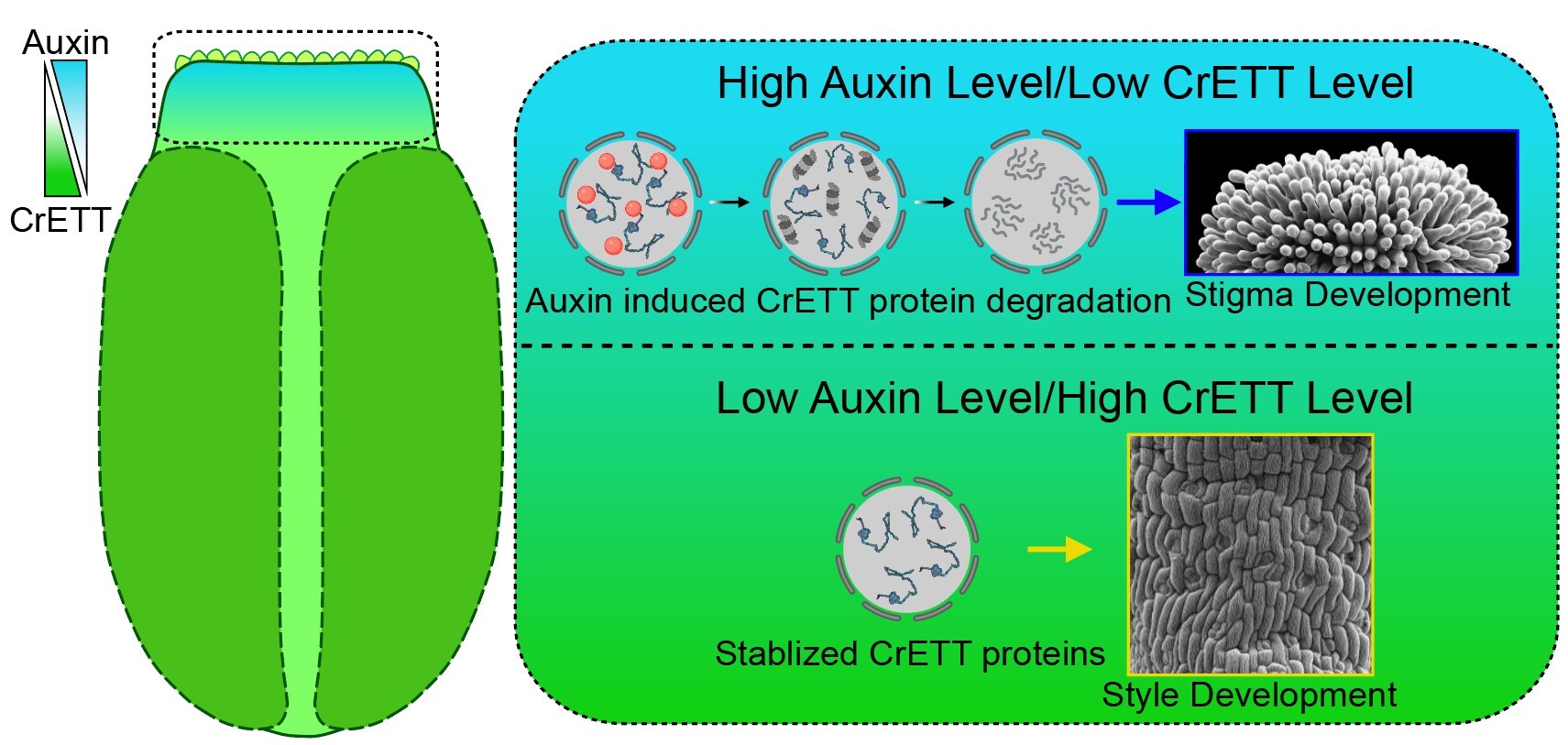
Schematic model for auxin-dependent CrETT degradation in stigma-style boundary establishment. (Image by DONG Yang)
Source: https://english.cas.cn/newsroom/research-news/202608/t20260824_1188748.shtml