Recently, the Hefei Institute of Physical Sciences, Chinese Academy of Sciences, has made progress in research on multifunctional electromagnetic wave absorbing superstructures. The team proposed a machine learning-assisted "material-structure-function" collaborative design strategy, using fused deposition modeling 3D printing technology to integrate the polyamide 6/carbon fiber composite (PACF) absorbing unit, low-loss pure polyamide 6 (N-PA) spacer layer and laser-induced PACF (LI-PACF) functional backplane to build a superstructure with multi-level resonant gradient impedance, achieving broadband and wide-angle microwave absorption from 2 to 40 GHz, with both structural load-bearing and electrothermal de-icing capabilities.
This study uses the three top diameters and three heights of the three-level PACF truncated cone unit as variables, and based on 729 sets of simulation data, established four random forest, XGBoost, CatBoost and multi-layer perceptronkindAgency model. The coefficients of determination of the four types of models on the independent test set are all greater than 0.95, and the mean absolute errors are all less than 1. The study integrated absorption bandwidth, angle stability, structural height and quality and other indicators, determined the multi-layer perceptron as the optimal solution, and revealed the dominant role of different levels of geometric parameters in broadband absorption, depth absorption and large angle stability, enhancing the physical interpretability of the model.
In terms of materials and structure, the carbon fiber network in PACF and the heterogeneous interface formed with the PA6 matrix provide conduction loss, dipole polarization and interface relaxation; the N-PA spacer layer regulates impedance transition and interlayer coupling. Via CO2After laser treatment, the carbon fibers on the PACF surface are further exposed and form a carbon-rich, non-uniform interface, which enhances dielectric dissipation, loss reflection and in-plane conductivity, and also gives the backsheet a stable Joule thermal response. The three-stage truncated cone responds to different frequency bands respectively, and adjacent frequency bands overlap to form multi-stage resonance complementation; the gradually shrinking structure and the N-PA spacer layer jointly build a gradient impedance, which facilitates the entry of electromagnetic waves and continuous dissipation inside the structure.
Research shows that the total thickness of the optimized structure is 14.7mm. This structure has excellent absorbing performance in a wide frequency band, has a wide effective absorption bandwidth coverage under vertical incidence, and can maintain efficient absorption capabilities under large-angle oblique incidence and different polarization conditions. At the same time, the structure has excellent radar scattering suppression and engineering practicality. In the range of 2 to 40 GHz, the radar scattering cross section can be reduced; after conformally loading the aircraft model, the average radar scattering cross section in the top-view and forward-view areas at 11.8 GHz decreases. In terms of mechanical properties, the structure has good compressive strength and load-bearing capacity. In addition, the LI-PACF backplane can heat up to about 48°C at 25V and operate stably for 900s. It can completely melt an ice layer with a thickness of 3mm within 60s in an environment of about 0°C.
This research combines machine learning optimization, multi-material dielectric loss design, gradient impedance matching, multi-level resonance and laser interface engineering to provide an interpretable technical path for the design and development of multi-functional stealth structures in complex service environments.
Relevant research results were published in the "Journal of Chemical Engineering" (Chemical Engineering Journal)superior. The research work is supported by the National Natural Science Foundation of China and the National Key Research and Development Program.
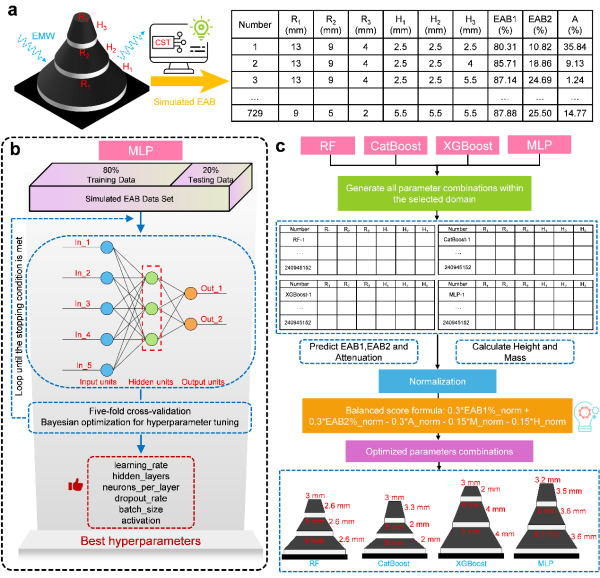
Wave-absorbing structure optimization process based on multi-machine learning agent model
Source: https://www.cas.cn/syky/202609/t20260904_5119718.shtml