Researchers from the Ningbo Institute of Materials Technology and Engineering (NIMTE) of the Chinese Academy of Sciences (CAS), in collaboration with researchers from the Technical Institute of Physics and Chemistry of CAS, have developed a coumarin-linked covalent organic framework (COF) that enables high-efficiency photocatalytic water splitting for hydrogen production.
The study was published in Nature Synthesis on September 8.
Photocatalytic water splitting is a promising method for converting solar energy into hydrogen, which could help alleviate the global energy crisis. However, the rapid recombination of photogenerated electrons and holes severely limits the efficiency of organic photocatalysts.
COFs are crystalline, porous polymers constructed from organic molecules linked by strong covalent bonds. Their customizable structures allow for precise tuning of properties, making them ideal candidates for photocatalysis.
In conventional conjugated COFs, flexible linkages can undergo out-of-plane rotation, disrupting π-conjugation and aggravating energy dissipation, which severely limits charge separation and photocatalytic efficiency.
To address this challenge, the researchers introduced a rigid and planar coumarin linkage into a fully conjugated COF through a one-pot polycondensation strategy. Compared with conventional imine and vinyl linkages, the coumarin linkage exhibited substantially higher conformational rigidity, promoting π-electron delocalization and suppressing structural fluctuations.
The resulting coumarin-linked COF exhibited markedly improved charge separation, with the charge-separated state lasting roughly 1,000 times longer than that of the imine-linked counterpart.
With Pt nanoparticles as a cocatalyst, photogenerated electrons transferred from the COF to Pt within approximately 407 picoseconds, facilitating efficient proton reduction and hydrogen evolution.
As a result, the coumarin-linked COF achieved a hydrogen evolution rate of 531 mmol g-1 h-1 under 440 nm irradiation, with an apparent quantum yield of 37.95% at 405 nm. It also achieved a rate of 166 mmol g-1 h-1 under visible light above 420 nm, demonstrating its potential for practical solar-driven hydrogen production.
"This work provides a facile and effective strategy for tuning charge dynamics in conjugated COFs via linkage engineering," said Prof. ZHANG Tao from NIMTE, a corresponding author of the study. "It sheds light on the design and application of high-performance organic photocatalysts for solar hydrogen production."
This study was supported by the National Key R&D Program of China, the National Natural Science Foundation of China, and the Zhejiang Provincial Natural Science Foundation of China, among others.
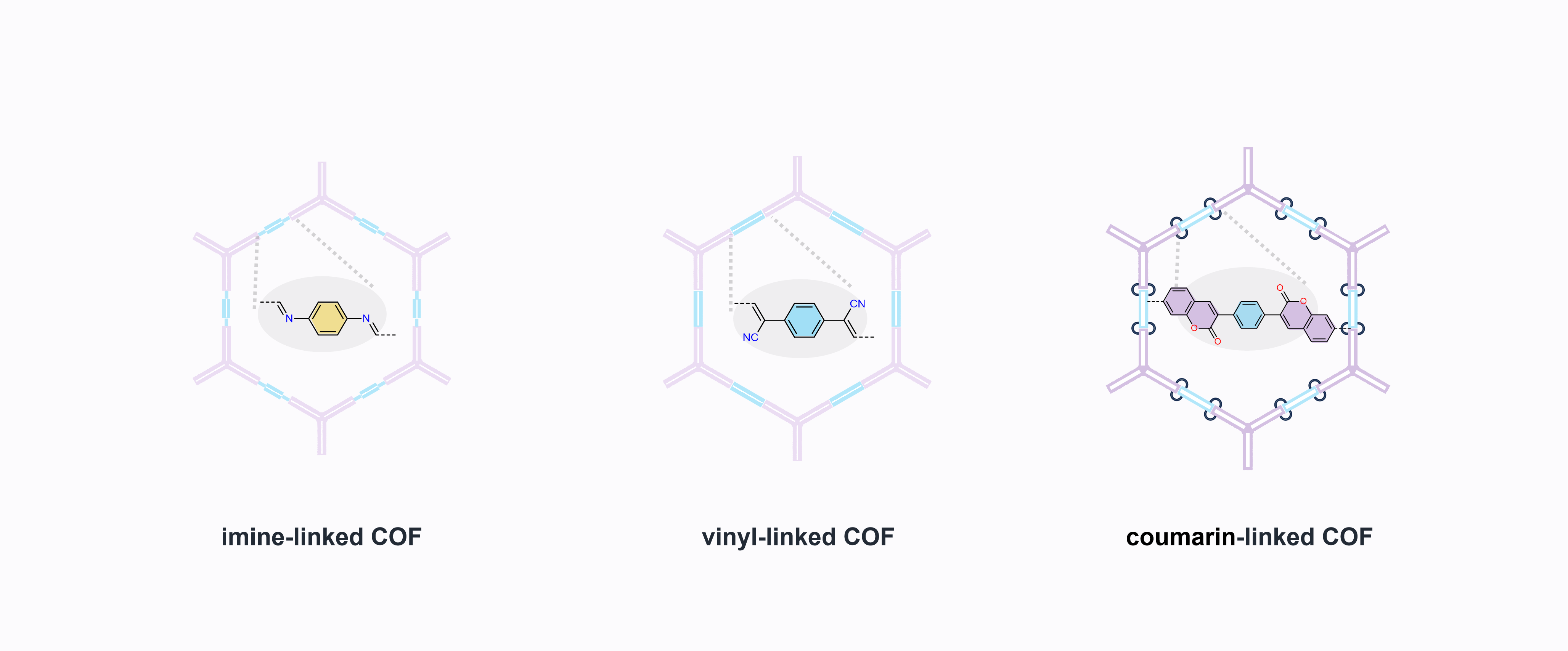
The 2D covalent organic frameworks with different linkages (Image by NIMTE)
Source: https://english.cas.cn/newsroom/research-news/202609/t20260908_1192763.shtml