Natural products are an important source of modern therapeutic drugs. Their unique skeleton structure, abundant functional groups and multiple chiral centers form the chemical basis for a wide range of biological activities. In the later biosynthesis of such active natural products, iron(II)/2-oxoglutarate-dependent (Fe/2OG) enzymes can precisely introduce pharmacophore groups through a variety of reactions. Among them, the carbon-carbon bonding reaction catalyzed by this enzyme family can build a molecular skeleton with complex structure and significant biological activity. However, the related reaction process is complicated, and its mechanism of action is still unclear so far. In-depth analysis of the catalytic mechanism of this type of enzyme is of great significance for natural product biosynthesis research, new drug development and rational transformation of biocatalysts.
Recently, the Shanghai Institute of Materia Medica, Chinese Academy of Sciences and others have made progress in research on the mechanism of continuous carbon-carbon bonding catalyzed by iron enzymes. The study systematically explained the molecular process of the Fe/2OG enzyme Hvm1 catalyzing the formation of continuous carbon-carbon bonds to construct the heterobicyclic piperazine alkaloid Helvamide B. It also confirmed the absolute stereoconfiguration of Helvamide B and revealed the molecular basis of the enzyme's catalytic process.
The research comprehensively used technologies such as deuterium labeling experiments, electron effect probes, and X-ray crystallography to accurately restore the three key steps of "precise hydrogen extraction-free radical attack on alkenes-ring closure through different pathways" in the catalytic process. Research has confirmed that this process belongs to a typical Minisci type free radical addition pathway rather than a Friedel–Crafts type carbocation pathway. The structure analysis of the crystal complex shows that tyrosine residue Y67 is a key amino acid that regulates the stereoselective branch in the second step of carbon-carbon bond formation, and its mutation can mainly generate the epimer Helvamide A.
This study clarifies the molecular basis of the stereoselectivity of iron enzyme catalyzed products, provides new ideas for the directional modification of the stereoselectivity of iron enzyme catalyzed products, and also provides a material basis for the biosynthesis research, activity mining and structure-activity relationship of heterobicyclic piperazine alkaloids.
Relevant research results were published in the Journal of the American Chemical Society (Journal of the American Chemical Society)superior.
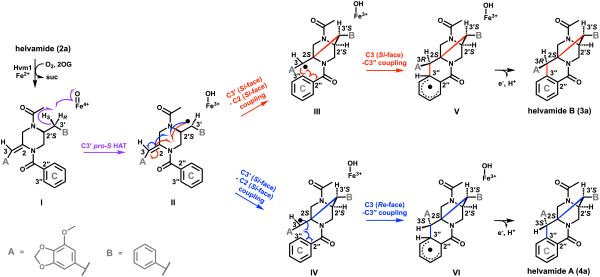
Schematic diagram of the catalytic mechanism of Hvm1
Source: https://www.cas.cn/syky/202608/t20260824_5118841.shtml